|
Rigdon-Spaulding Theory
|
No Preview Available
|
|
External Link
|
|
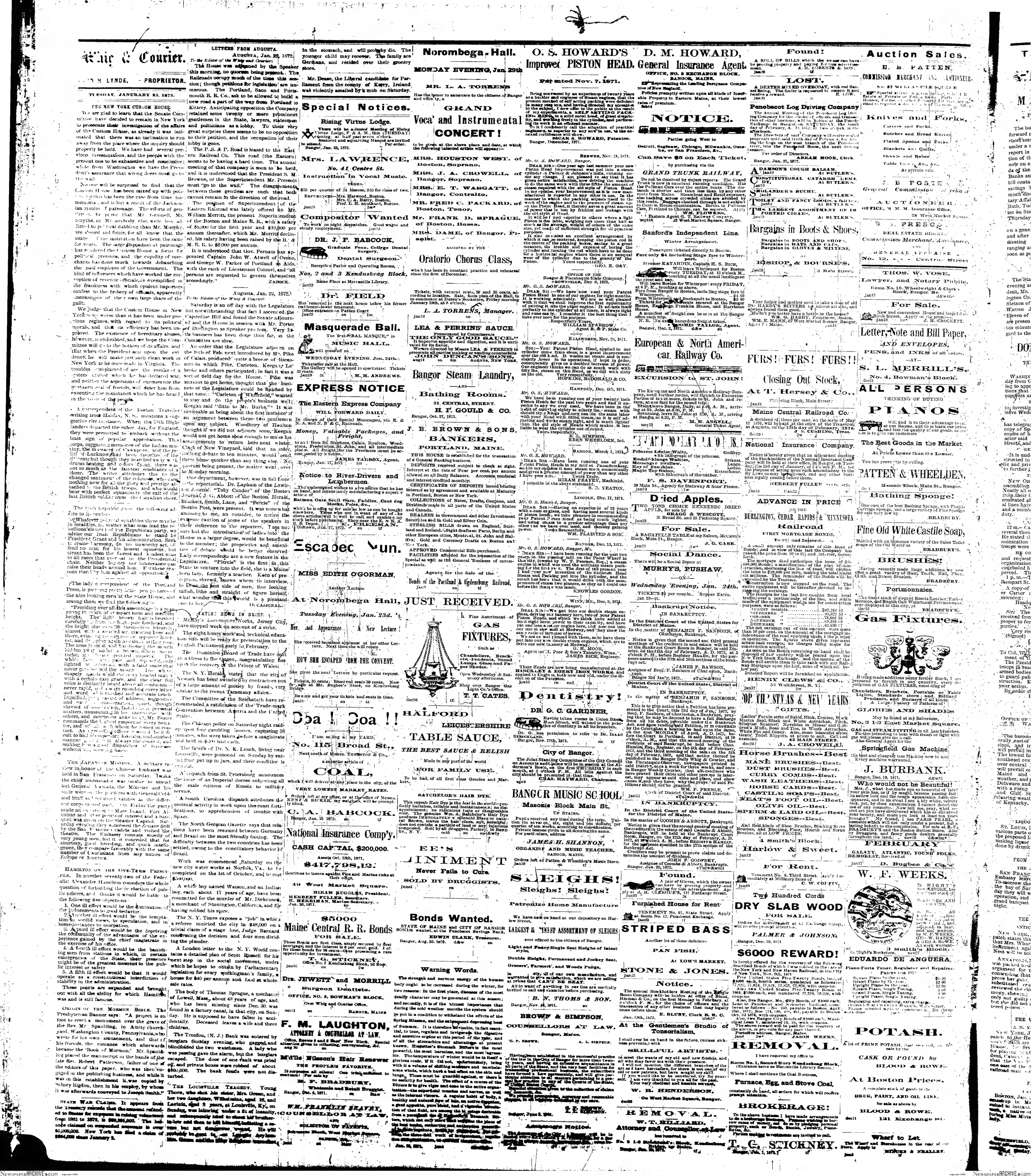
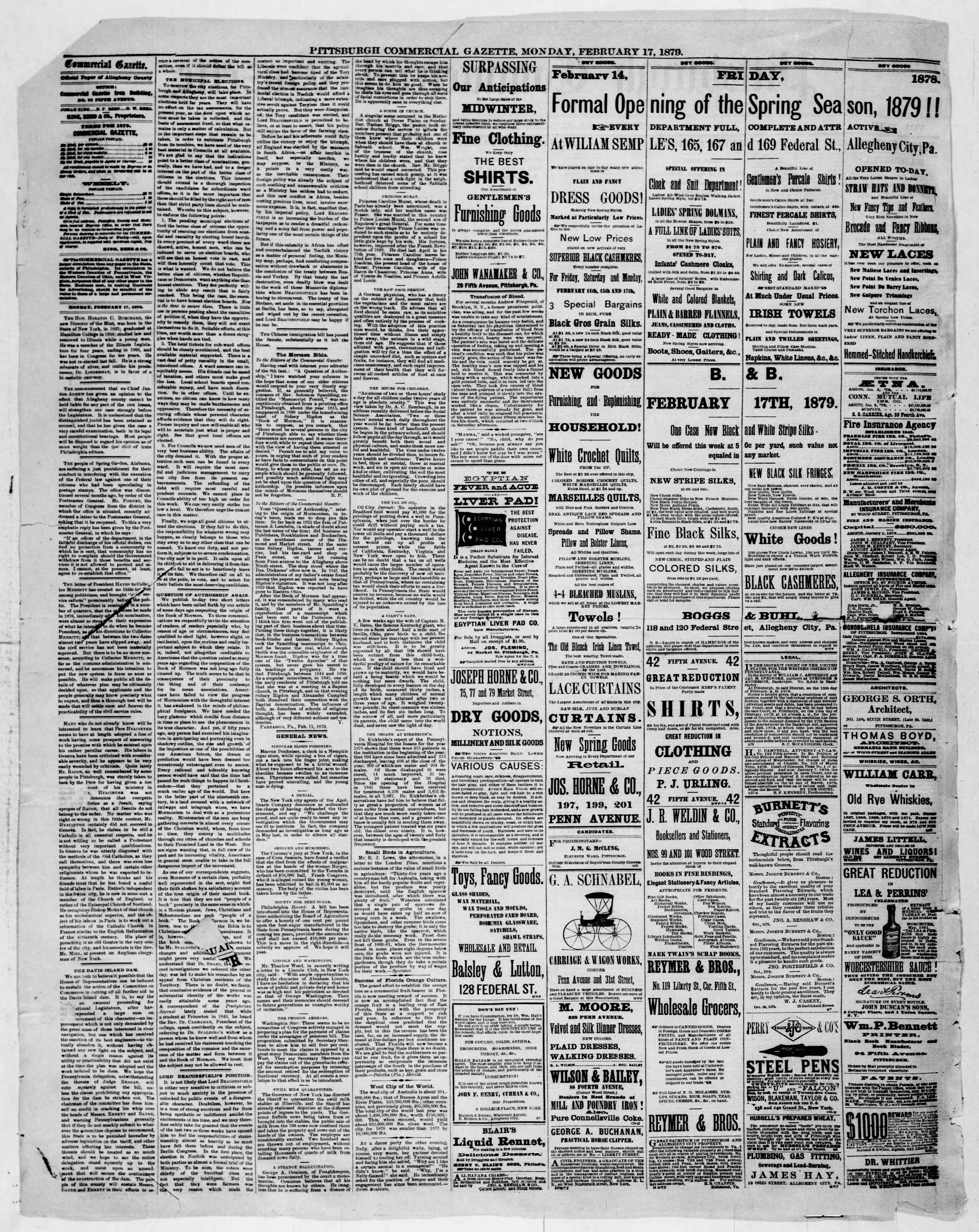
The Commonwealth, Pittsburg, PA, July 9, 1816, Vol 1, No 15
|
|
|
|
|
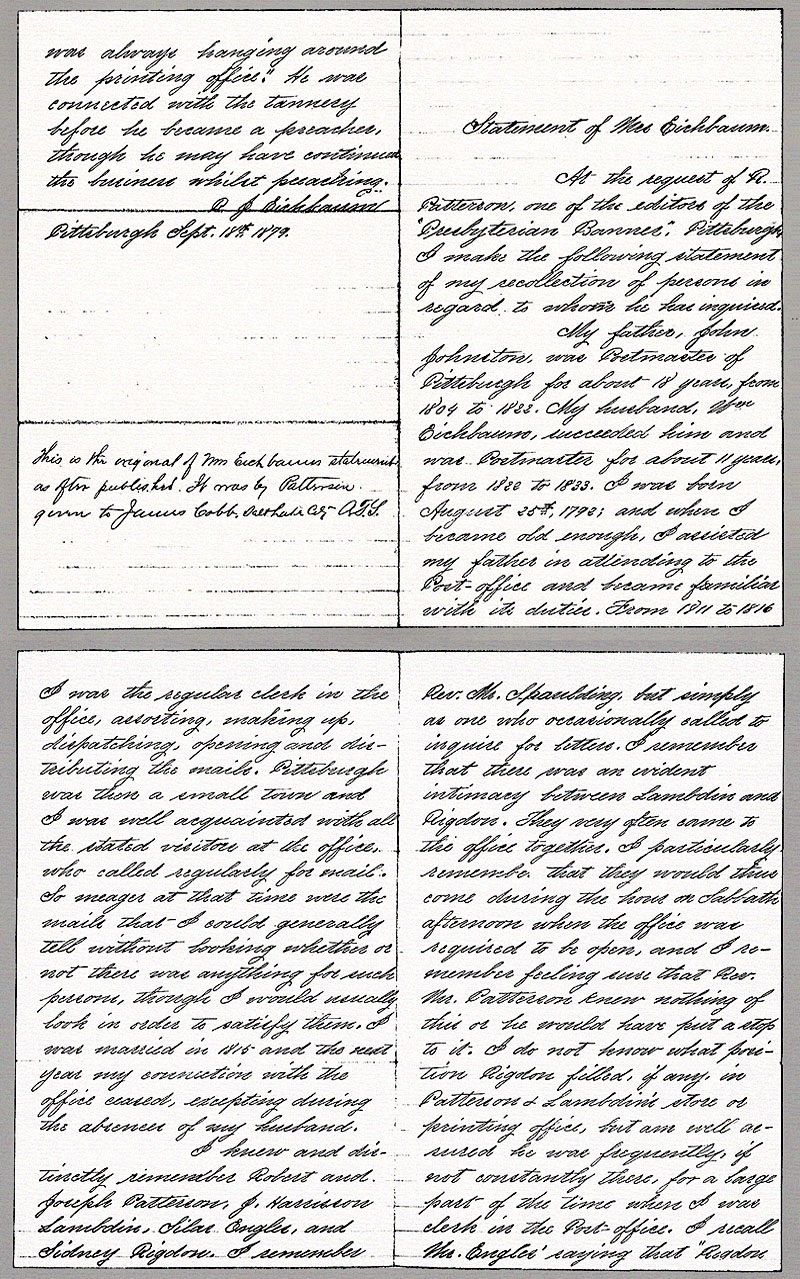
Rigdon and Spaulding shared the same post office
|
|
The Commonwealth
|
|
9 Jul, 1816
|
|
|
LIST OF LETTERS
Remaining in the Post Office, at Pittsburgh, June 30, 1816...
| R | S |
| David Robb | Benja. Summerton 2 |
| G. C. Russel | Daniel Stotler |
| Henry Richardson | Dandridge Spotswood |
| Jacob Rudolf | Geo. Slacket Esq. |
| John Robinson | Jacob Sangree |
| John Richa | Jacob Smyth |
| Joseph Richardson | Jacob Steally |
| Joseph Rieldy | James Snodgrass 2 |
| Rulif Rinyan | James Steel |
| Samuel Robinson | John Smith |
| Sidney Rigdon | John Stotler |
| Wm. C. Roberts | Capt. John Srodel |
| Wm. Reed | Roswell Sturdevant |
| Wm. Robinson jun. | Joel Smith |
| Robert Sibbit |
| Samuel Still |
| Solomon Spalding |
| Wm. Skillen |
| Wm. Sinclair |
| Wm. Simpson 2 |
| Wm. Smith |
| Wm. Steward |
| Miss Mary Snyder |
| Mary Stuard |
|
|
|
(Note:
Spaulding's name appears on the list of unclaimed letters on multiple occasions as early as May 5, 1813. Rigdon's name makes its first appearance on this July 9, 1816 list. Solomon Spaulding subsequently contracted dysentery and died on October 20, 1816.
No images of the original list is available online. Please contact me if you have any information.)
|
|
|
|
|
No Preview Available
|
|
External Link
|
|
Cleveland Advertiser, February 15, 1831, Vol 1, No 5
|
|
|
|
|
Earliest Claim that Rigdon Wrote the Book of Mormon
|
|
Cleveland Advertiser
|
|
15 Feb, 1831
|
|
|
|
Rigdon was formerly a disciple of Campbell's and who it is said was sent out to make proselytes, but is probable he thought he should find it more advantageous to operate on his own capital, and therefore wrote, as it is believed the Book of Mormon, and commenced his pilgrimage in the town of Kirtland, which was represented as one of the extreme points of the Holy Land. |
|
|
|
(Note:
Joseph Smith, who had just arrived in Kirtland the prior month, is not mentioned in this article. No images of the original appear to be available online. Please contact me if you have any information.)
|
|
|
|
|
|
External Link
|
|
Morning Courier-NY Enquirer, 31 Aug, 1831, Vol 7, No 562
|
|
|
|
|
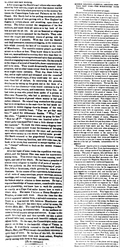
Account of early contact between Joseph Smith and "Rangdon" or "Ringdon"
|
|
James Gordon Bennett
|
|
31 Aug, 1831
|
|
|
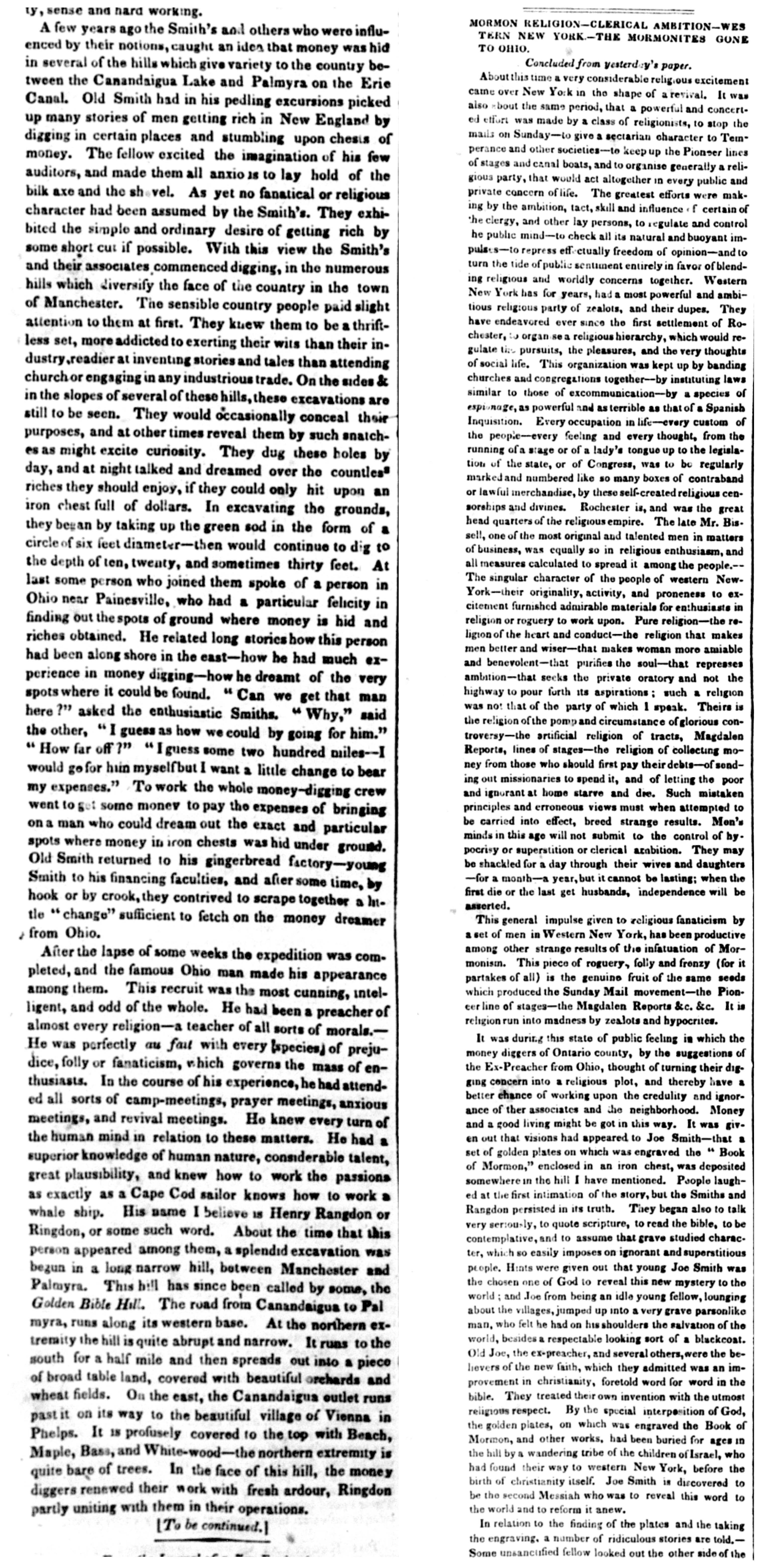
A few years ago the Smith's and others who were influenced by their notions, caught an idea that money was hid in several of the hills which give variety to the country between the Canandaigua Lake and Palmyra on the Erie Canal.... They dug these holes by day, and at night talked and dreamed over the counties' riches they should enjoy, if they could only hit upon an iron chest full of dollars.... At last some person who joined them spoke of a person in Ohio near Painesville, who had a particular felicity in finding out the spots of ground where money is hid and riches obtained. He related long stories how this person had been along shore in the east -- how he had much experience in money digging -- how he dreamt of the very spots where it could be found. "Can we get that man here?" asked the enthusiastic Smiths. "Why," said the other, "I guess as how we could by going for him." "How far off?" "I guess some two hundred miles -- I would go for him myself but I want a little change to bear my expenses." To work the whole money-digging crew went to get some money to pay the expenses of bringing on a man who could dream out the exact and particular spots where money in iron chests was hid under ground. Old Smith returned to his gingerbread factory -- young Smith to his financing faculties, and after some time, by hook or by crook, they contrived to scrape together a little "change" sufficient to fetch on the money dreamer from Ohio.
After the lapse of some weeks the expedition was completed, and the famous Ohio man made his appearance among them. This recruit was the most cunning, intelligent, and odd of the whole. He had been a preacher of almost every religion -- a teacher of all sorts of morals. -- He was perfectly au fait with every species of prejudice, folly or fanaticism, which governs the mass of enthusiasts. In the course of his experience, he had attended all sorts of camp-meetings, prayer meetings, anxious meetings, and revival meetings. He knew every turn of the human mind in relation to these matters. He had a superior knowledge of human nature, considerable talent, great plausibility, and knew how to work the passions as exactly as a Cape Cod sailor knows how to work a whale ship. His name I believe is Henry Rangdon or Ringdon, or some such word. About the time that this person appeared among them, a splendid excavation was begun in a long narrow hill, between Manchester and Palmyra. This hill has since been called by some, the Golden Bible Hill.... In the face of this hill, the money diggers renewed their work with fresh ardour, Ringdon partly uniting with them in their operations.
...It was during this state of public feeling in which the money diggers of Ontario county, by the suggestions of the Ex-Preacher from Ohio, thought of turning their digging concern into a religious plot, and thereby have a better chance of working upon the credulity and ignorance of the [their] associates and the neighborhood. Money and a good living might be got in this way. It was given out that visions had appeared to Joe Smith -- that a set of golden plates on which was engraved the "Book of Mormon," enclosed in an iron chest, was deposited somewhere in the hill I have mentioned. People laughed at the first intimation of the story, but the Smiths and Rangdon persisted in its truth. |
|
|
|
(Note:
The continuation of this account, or last part, can be read in the September 1, 1831 issue of the Morning Courier and New-York Enquirer, here)
|
|
|
|
|
|
|
Orson Hyde and Samuel H. Smith preach in Salem (Conneaut)
|
|
Orson Hyde
|
|
12-15 Feb, 1832
|
|
|
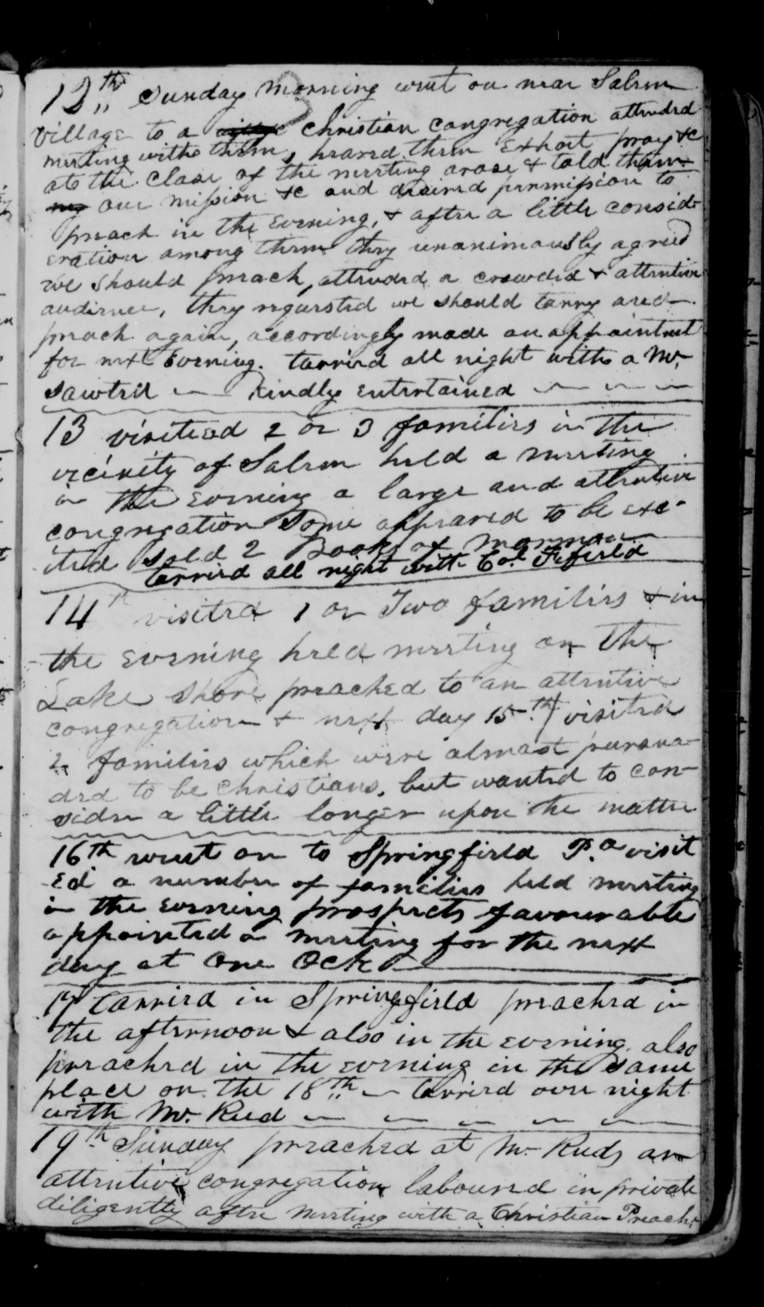
February 12th, 1832: Sunday morning went on near Salem Village to a Christian congregation, attended meeting with them, heard them exhort, pray, &c. At the close of the meeting arose and told them our mission, &c. and desired permission to preach in the evening. And after a little conversation among them, the[y] unanimously agreed we should preach; attended a crowded and attentive audience. They requested we should tarry and preach again. Accordingly made an appointment for next evening. Tarried all night with a Mr. Sawtril; -- kindly entertained.
February 13th, 1832: Visited two or three families in the vicinty of Salem; held a meeting in the evening, a large and attentive congregation -- some appeared to be excited -- sold two Books of Mormon. Tarried all night with Col. Fifield.
February 14th, 1832: Visited one or two families, and in the evening held meeting on the Lake Shore, preached to an attentive congregation. And next day the 15th of February, visited two families which were almost persuaded to be Christians, but wanted to consider a little longer upon the matter. |
|
|
|
(Note:
Later in 1832 Salem was incorporated and renamed to Conneaut. Samuel Smith also recorded this visit in his journal, which can be read here.)
|
|
|
|
|
|
|
Wayne Sentinel Announcement
|
|
Wayne Sentinel
|
|
20 Dec, 1833
|
|
|
|
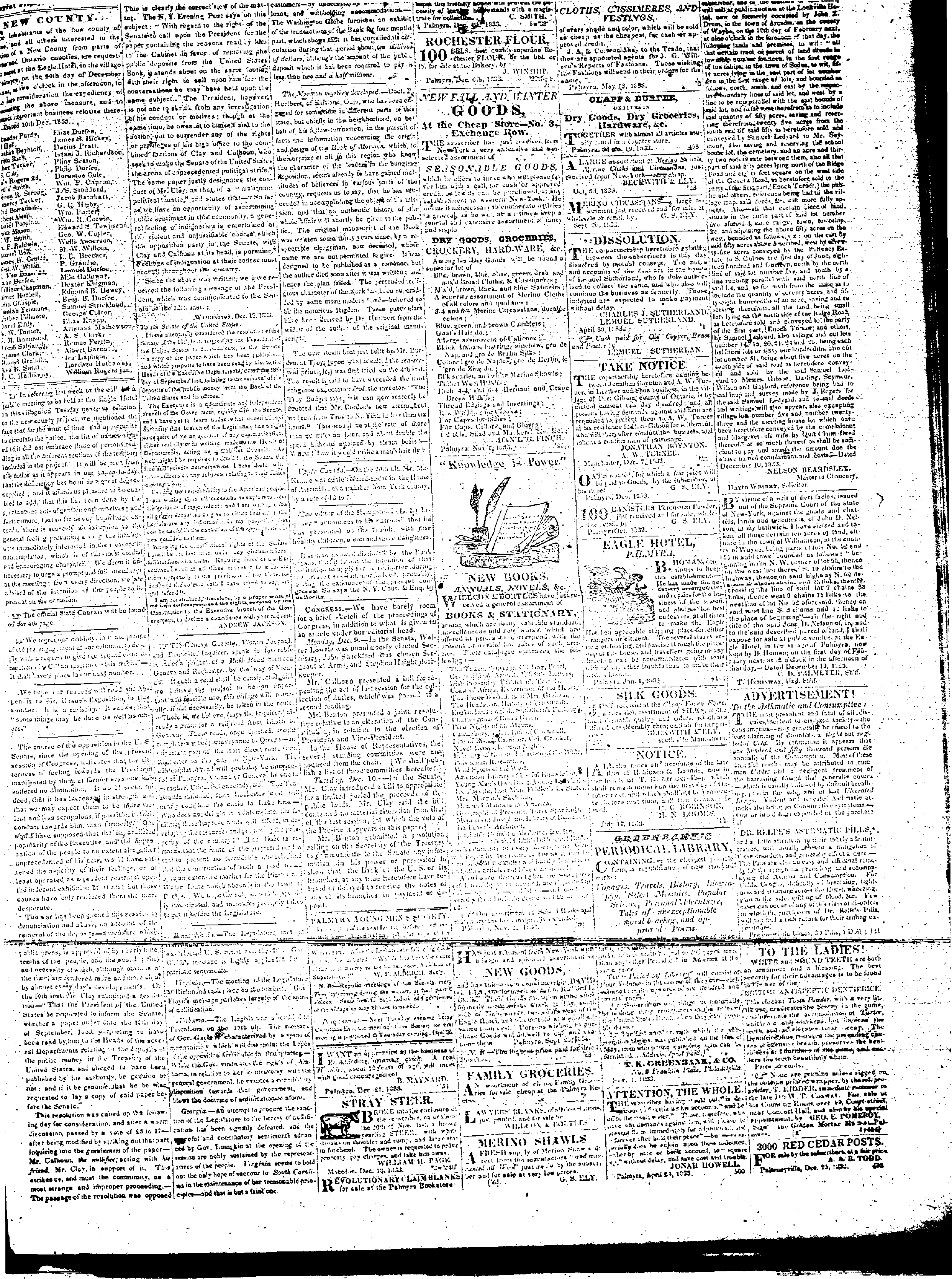
The Mormon mystery developed. -Doct. P. Hurlbert, of Kirtland Ohio, who has been engaged for some time in different parts of this state, but chiefly in this neighborhood, on behalf of his fellow townsmen, in the pursuit of facts and information concerning the origin and design of the Book of Mormon, which, to the surprize of all in this region who know the character of the leaders in the bungling imposition, seems already to have gained multitudes of believers in various parts of the country, requests us to say, that he has succeeded in accomplishing the object of his mission, and that an authentic history of the whole affair will shortly be given to the public. The original manuscript of the Book was written some thirty years since, by a respectable clergyman, now deceased, whose name we are not permitted to give. It was designed to be published as a romance, but the author died soon after it was written; and hence the plan failed. The pretended religious character of the work has been superadded by some more modern hand - believed to be the notorious Rigdon. These particulars have been derived by Dr. Hurlbert from the widow of the author of the original manuscript. |
|
|
|
|
|
|
Painesville Telegraph Announcement
|
|
Painesville Telegraph
|
|
31 Jan, 1834
|
|
|
To the Public.
The undersigned Committee appointed by a public meeting held in Kirtland, Geauga Co., Ohio, for the purpose of ascertaining the origin of the Book of MORMON, would say to the Public, that when met as directed by said meeting, it became a subject of deliberation whether the committee without violating the spirit of that instrument which declares that ‘no human authority can in any case whatsoever control or interfere with the rights of conscience' could take measures to avert the evils which threaten the Public by location in this vicinity, of Joseph Smith Jun. otherwise known as the Mormon Prophet - and who is now, under pretense of Divine Authority, collecting about him an impoverished population, alienated in feeling from other portions of the community, thereby threatening us with an insupportable weight of pauperism. The committee were of the opinion that the force of truth might without delay be applied to the Book of Mormon, and the character of Joseph Smith, Jun. With this object in view, the Committee employed D.P. Hurlbut to ascertain the real origin of the Book of Mormon, and to examine the validity of Joseph Smith's claims to the character of a Prophet. The result of this inquiry so far as it has proceeded has been partially laid before the public in this vicinity by Mr. Hurlbut and the Committee are now making arrangements for the Publication and extensive circulation of a work which will prove the ‘ Book of Mormon' to be a work of fiction and imagination, and written more than twenty years ago, in Salem, Ashtabula County, Ohio by Solomon Spalding, Esq. and completely divest Joseph Smith of all claims to the character of an honest man, and place him at an immeasurable distance from the high station which he pretends to occupy.
O. A. CRARY
AMOS DANIELS.
JOHN F. MORSE.
SAMUEL WILSON.
JOSIAH JONES.
WARREN CORNING Jr.
JAMES H. PAINES.
JOS. H. WAKEFIELD.
SYLVESTER CORNWELL.
TIMOTHY D. MARTINDALE.
Kirtland, Geauga Co, Ohio. |
|
|
|
|
|
|
John Spalding Affidavit
|
|
John Spalding
|
|
1834
|
|
|
|
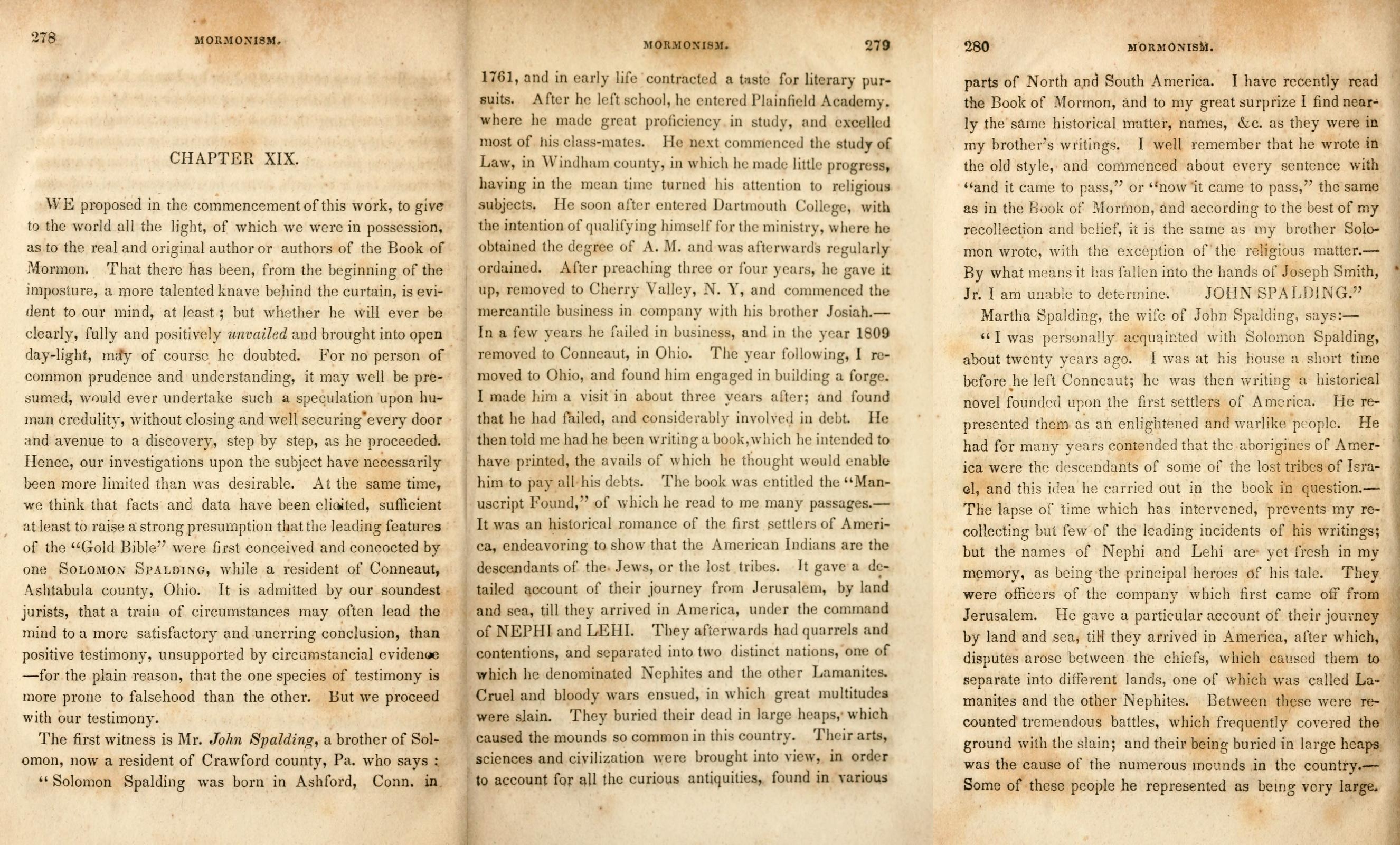
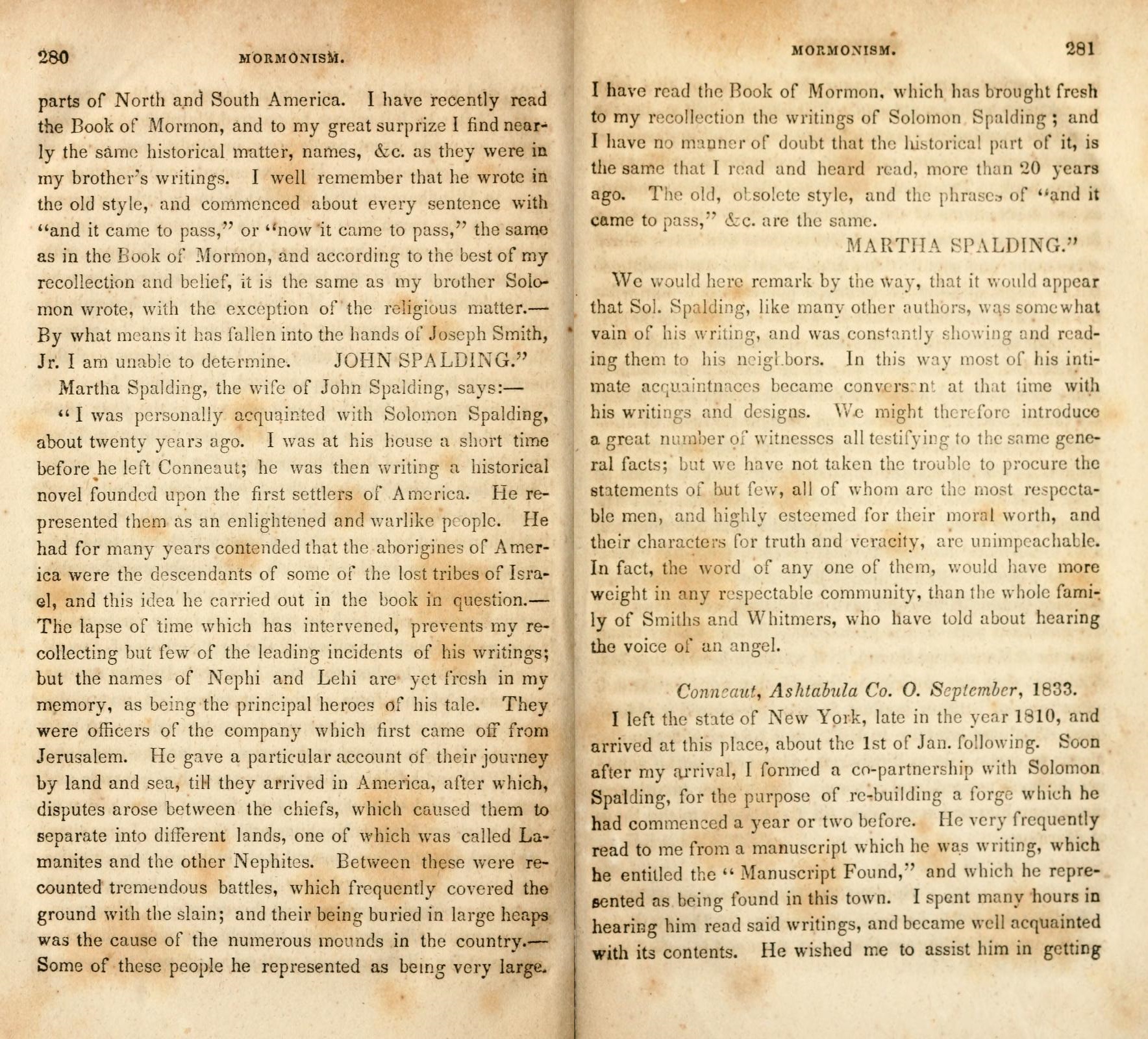
Solomon Spaulding was born in Ashford, Conn. in 1761, and in early life contracted a taste for literary pursuits.... After preaching three or four years, he gave it up, removed to Cherry Valley, N.Y., and commenced the mercantile business in company with his brother Jasiah. In a few years he failed in business, and in the year 1809 removed to Conneaut, in Ohio. The year following, I removed to Ohio, and found him engaged in building a forge. I made him a visit in about three years after; and found that he had failed, and considerably involved in debt. He then told me had he been writing a book, which he intended to have printed, the avails of which he thought would enable him to pay all his debts. The book was entitled the ‘Manuscript Found,' of which he read to me many passages. It was an historical romance of the first settlers of America, endeavoring to show that the American Indians are the descendants of the Jews, or the lost tribes. It gave a detailed account of their journey from Jerusalem, by land and sea, till they arrived in America, under the command of NEPHI AND LEHI. They afterwards had quarrels and contentions, and separated into two distinct nations, one of which he denominated Nephites and the other Lamanites. Cruel and bloody wars ensued, in which great multitudes were slain. They buried their dead in large heaps, which cause the mounds so common in this country. Their arts, sciences, and civilizations were brought into view, in order to account for all the curious antiquities, found in various parts of North and South America. I have recently read the Book of Mormon, and to my great surprise I find nearly the same historical matter, names, &c. as they were in my brother's writings. I well remember that he wrote in the old style, and commenced about every sentence with ‘and it came to pass,' or ‘now it came to pass,' the same as in the Book of Mormon, and according to the best of my recollection and belief, it is the same as my brother Solomon wrote, with the exception of the religious matter. By what means it has fallen into the hands of Joseph Smith, Jr. I am unable to determine. |
|
|
|
(Note:
John Spaulding was Solomon Spaulding's brother)
|
|
|
|
|
|
|
Martha Spalding Affidavit
|
|
Martha Spalding
|
|
1834
|
|
|
|
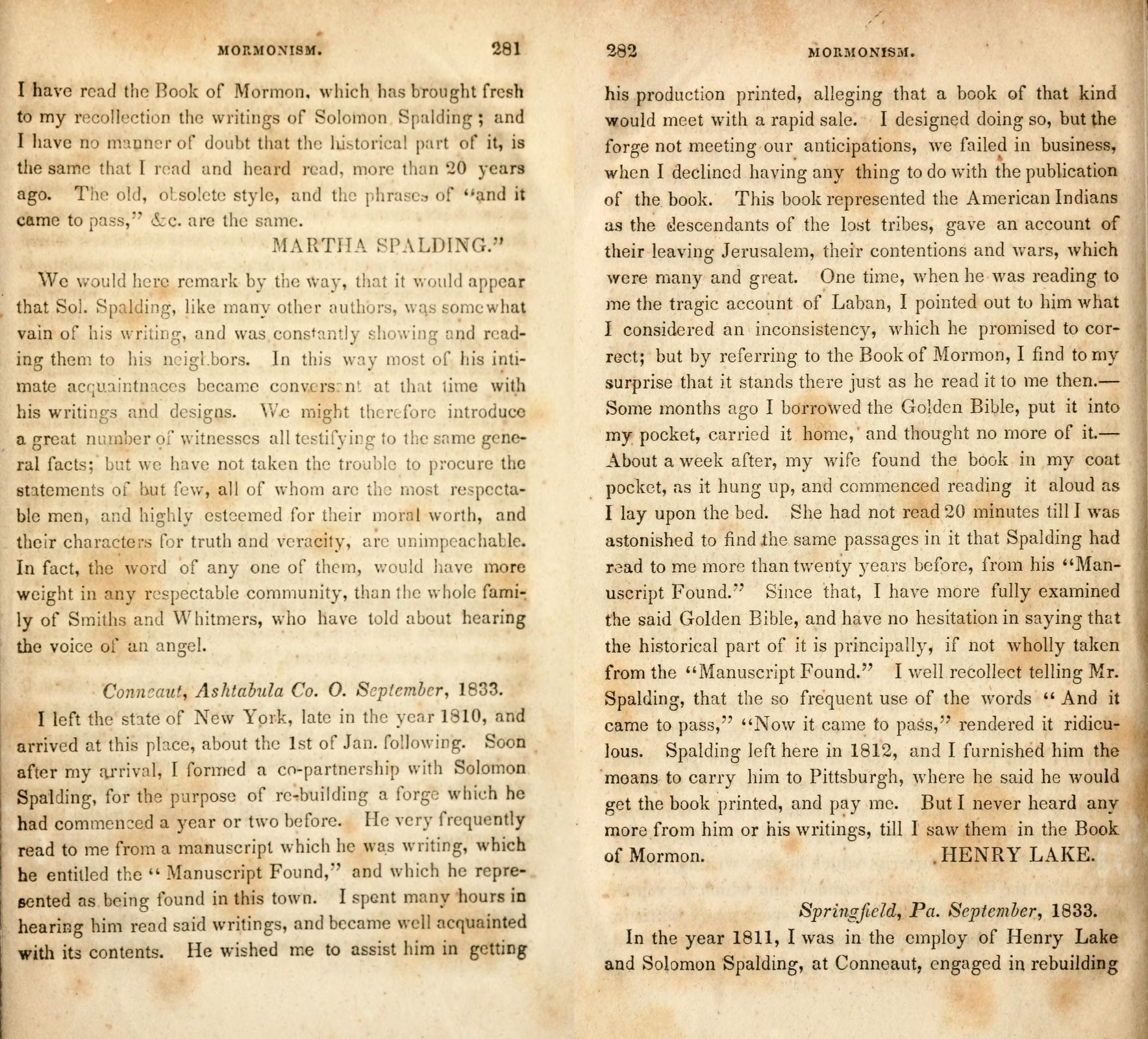
I was personally acquainted with Solomon Spaulding, about twenty years ago. I was at his house a short time before he left Conneaut; he was then writing a historical novel founded upon the first settlers of America. He represented them as an enlightened and warlike people. He had for many years contended that the aborigines of America were the descendants of some of the lost tribes of Israel, and this idea he carried out in the book in question. The laps of time which has intervened, prevents my recollecting but few of the leading incidents of his writings; but the names of Nephi and Lehi are yet fresh in my memory, as being the principal heroes of his tale. They were officers of the company which first came off from Jerusalem. He gave a particular account of their journey by land and sea, till they arrived in America, after which, disputes arose between the chiefs, which caused them to separate into different lands, one of which was called Lamanites and the other Nephites. Between these were recounted tremendous battles, which frequently covered the ground with the slain; and their being buried in large heaps was the cause of the numerous mounds in the country. Some of these people he represented as being very large. I have read the Book of Mormon, which has brought fresh to my recollection the writings of Solomon Spaulding; and I have no manner of doubt that the historical part of it, is the same that I read and heard read, more than 20 years ago. The old, obsolete style, and the phrases of ‘and it came to pass,' etc. are the same. |
|
|
|
(Note:
Martha Spaulding was John Spaulding's wife)
|
|
|
|
|
|
|
Henry Lake Affidavit
|
|
Henry Lake
|
|
Sep, 1833
|
|
|
|
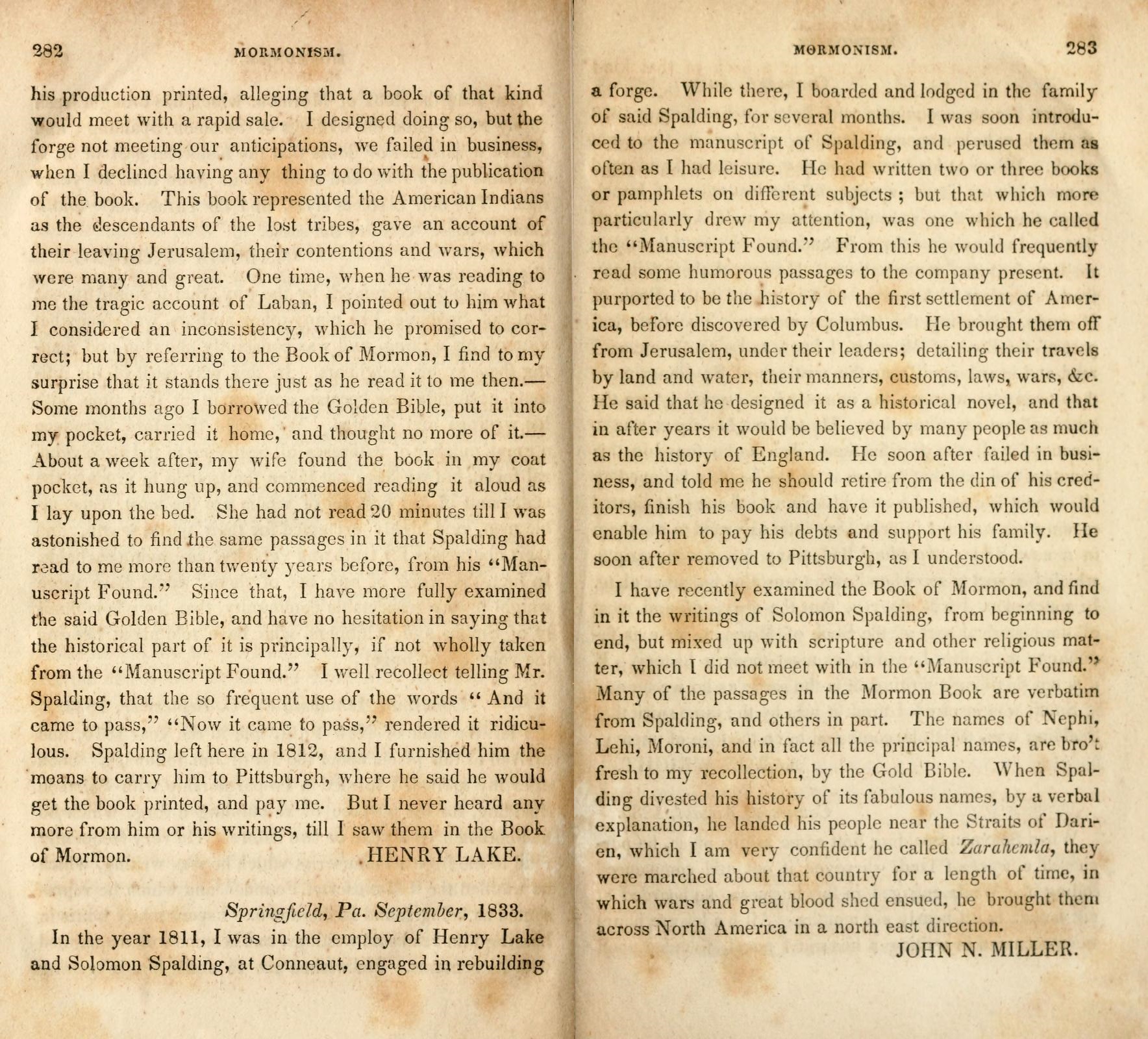
I left the state of New York, late in the year 1810, and arrived at this place, about the 1st of Jan. following. Soon after my arrival, I formed a co-partnership with Solomon Spalding, for the purpose of re-building a forge which he had commenced a year or two before. He very frequently read to me from a manuscript which he was writing, which he entitled the "Manuscript Found," and which he represented as being found in this town. I spent many hours in hearing him read said writings, and became well acquainted with its contents. He wished me to assist him in getting his production printed, alleging that a book of that kind would meet with a rapid sale. I designed doing so, but the forge not meeting our anticipations, we failed in business, when I declined having any thing to do with the publication of the book. This book represented the American Indians as the descendants of the lost tribes, gave an account of their leaving Jerusalem, their contentions and wars, which were many and great. One time, when he was reading to me the tragic account of Laban, I pointed out to him what I considered an inconsistency, which he promised to correct; but by referring to the Book of Mormon, I find to my surprise that it stands there just as he read it to me then. -Some months ago I borrowed the Golden Bible, put it into my pocket, carried it home, and thought no more of it. -About a week after, my wife found the book in my coat pocket, as it hung up, and commenced reading it aloud as I lay upon the bed. She had not read 20 minutes till I was astonished to find the same passages in it that Spalding had read to me more than twenty years before, from his "Manuscript Found." Since that, I have more fully examined the said Golden Bible, and have no hesitation in saying that the historical part of it is principally, if not wholly taken from the "Manuscript Found." I well recollect telling Mr. Spalding, that the so frequent use of the words "And it came to pass," "Now it came to pass," rendered it ridiculous. Spalding left here in 1812, and I furnished him the means to carry him to Pittsburgh, where he said he would get the book printed, and pay me. But I never heard any more from him or his writings, till I saw them in the Book of Mormon. |
|
|
|
|
|
|
John N. Miller Affidavit
|
|
John N. Miller
|
|
Sep, 1833
|
|
|
In the year 1811, I was in the employ of Henry Lake and Solomon Spalding, at Conneaut, engaged in rebuilding a forge. While there, I boarded and lodged in the family of said Spalding, for several months. I was soon introduced to the manuscript of Spalding, and perused them as often as I had leisure. He had written two or three books or pamphlets on different subjects; but that which more particularly drew my attention, was one which he called the "Manuscript Found." From this he would frequently read some humorous passages to the company present. It purported to be the history of the first settlement of America, before discovered by Columbus. He brought them off from Jerusalem, under their leaders; detailing their travels by land and water, their manners, customs, laws, wars, &c. He said that he designed it as a historical novel, and that in after years it would be believed by many people as much as the history of England. He soon after failed in business, and told me he should retire from the din of his creditors, finish his book and have it published, which would enable him to pay his debts and support his family. He soon after removed to Pittsburgh, as I understood.
I have recently examined the Book of Mormon, and find in it the writings of Solomon Spalding, from beginning to end, but mixed up with scripture and other religious matter, which I did not meet with in the "Manuscript Found." Many of the passages in the Mormon Book are verbatim from Spalding, and others in part. The names of Nephi, Lehi, Moroni, and in fact all the principal names, are bro't fresh to my recollection, by the Gold Bible. When Spalding divested his history of its fabulous names, by a verbal explanation, he landed his people near the Straits of Darien, which I am very confident he called Zarahemla, they were marched about that country for a length of time, in which wars and great blood shed ensued, he brought them across North America in a north east direction. |
|
|
|
|
|
|
Aaron Wright Affidavit
|
|
Aaron Wright
|
|
Aug, 1833
|
|
|
|
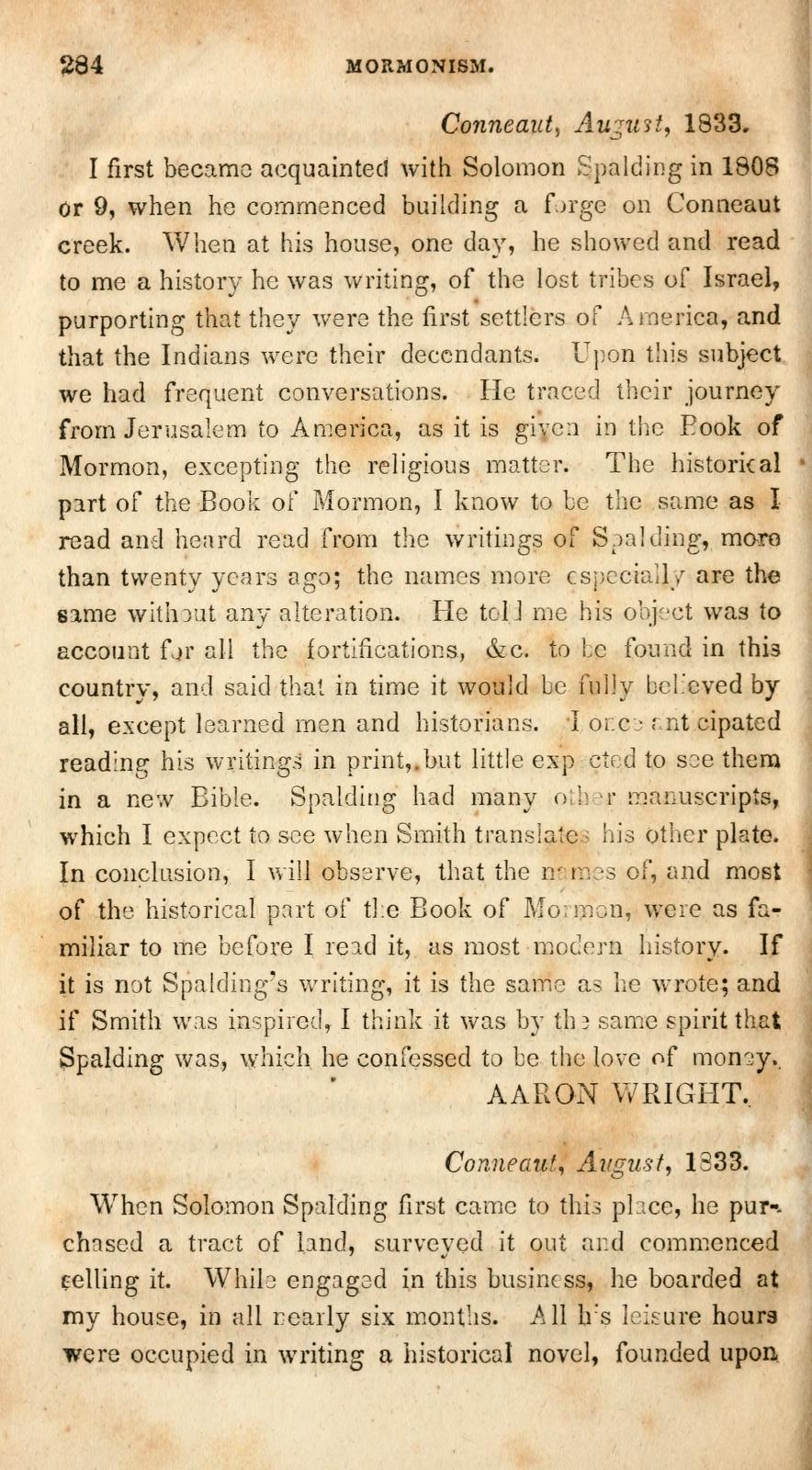
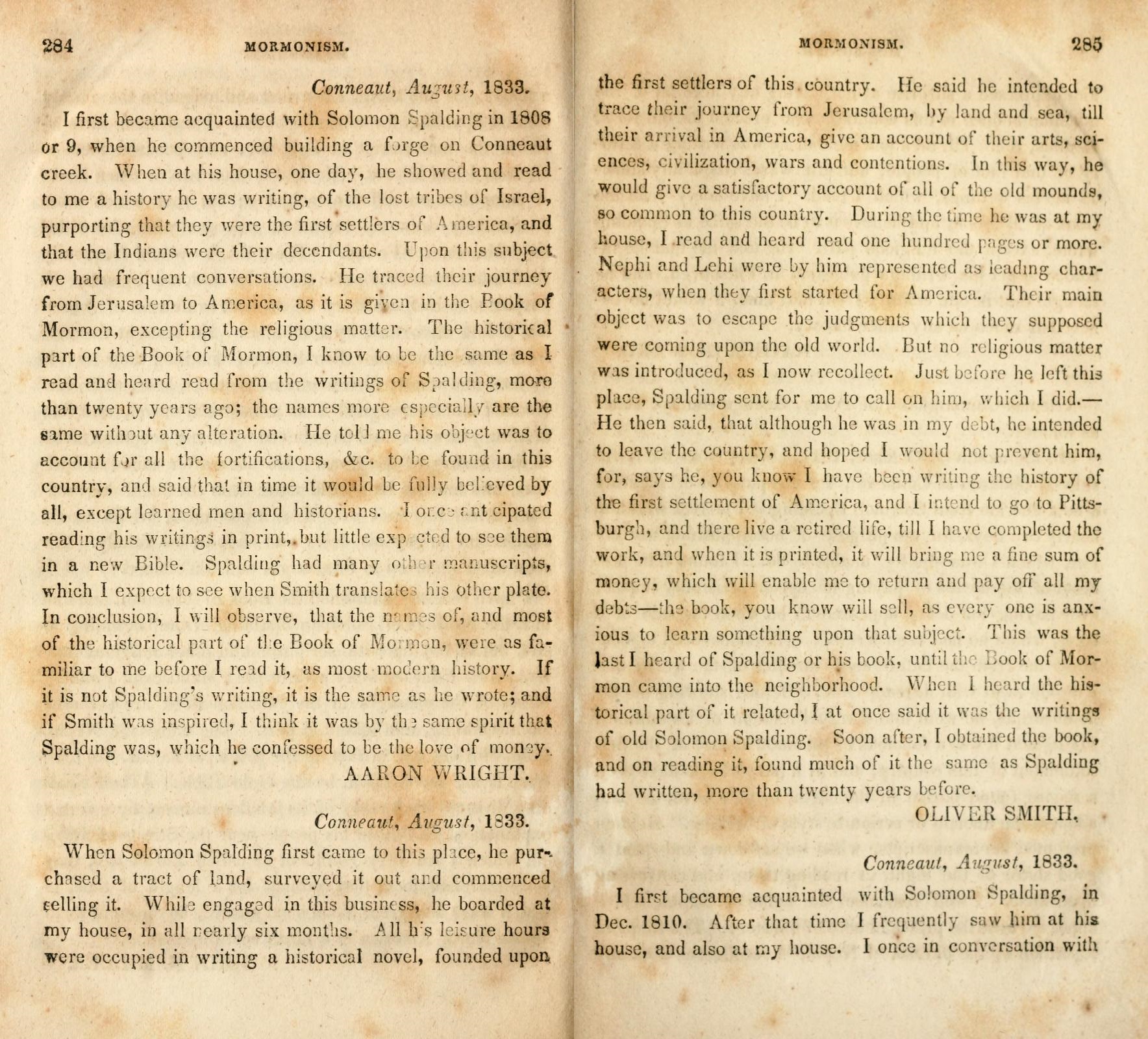
I first became acquainted with Solomon Spalding in 1808 or 9, when he commenced building a forge on Conneaut creek. When at his house, one day, he showed and read to me a history he was writing, of the lost tribes of Israel, purporting that they were the first settlers of America, and that the Indians were their descendants. Upon this subject we had frequent conversations. He traced their journey from Jerusalem to America, as it is given in the Book of Mormon, excepting the religious matter. The historical part of the Book of Mormon, I know to be the same as I read and heard read from the writings of Spalding, more than twenty years ago; the names more especially are the same without any alteration. He told me his object was to account for all the fortifications, &c. to be found in this country, and said that in time it would be fully believed by all, except learned men and historians. I once anticipated reading his writings in print, but little expected to see them in a new Bible. Spalding had many other manuscripts, which I expect to see when Smith translates his other plate. In conclusion, I will observe, that the names of, and most of the historical part of the Book of Mormon, were as familiar to me before I read it, as most modern history. If it is not Spalding's writing, it is the same as he wrote; and if Smith was inspired, I think it was by the same spirit that Spalding was, which he confessed to be the love of money. |
|
|
|
|
|
|
Oliver Smith Affidavit
|
|
Oliver Smith
|
|
Aug, 1833
|
|
|
|
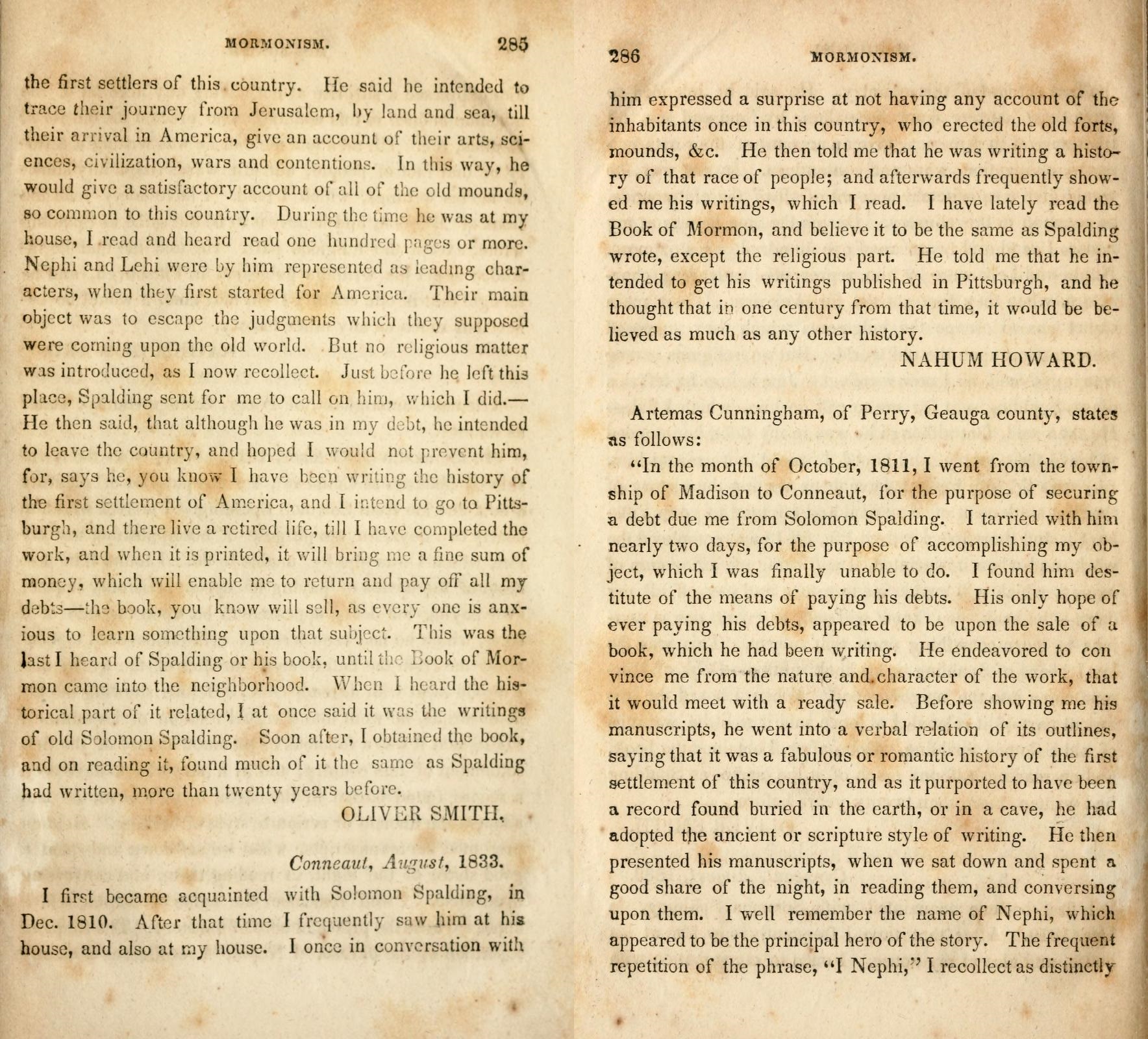
When Solomon Spalding first came to this place, he purchased a tract of land, surveyed it out and commenced selling it. While engaged in this business, he boarded at my house, in all nearly six months. All his leisure hours were occupied in writing a historical novel, founded upon the first settlers of this country. He said he intended to trace their journey from Jerusalem, by land and sea, till their arrival in America, give an account of their arts, sciences, civilization, wars and contentions. In this way, he would give a satisfactory account of all of the old mounds, so common to this country. During the time he was at my house, I read and heard read one hundred pages or more. Nephi and Lehi were by him represented as leading characters, when they first started for America. Their main object was to escape the judgments which they supposed were coming upon the old world. But no religious matter was introduced, as I now recollect. Just before he left this place, Spalding sent for me to call on him, which I did. -He then said, that although he was in my debt, he intended to leave the country, and hoped I would not prevent him, for, says he, you know I have been writing the history of the first settlement of America, and I intend to go to Pittsburgh, and there live a retired life, till I have completed the work, and when it is printed, it will bring me a fine sum of money, which will enable me to return and pay off all my debts-the book, you know will sell, as every one is anxious to learn something upon that subject. This was the last I heard of Spalding or his book, until the Book of Mormon came into the neighborhood. When I heard the historical part of it related, I at once said it was the writings of old Solomon Spalding. Soon after, I obtained the book, and on reading it, found much of it the same as Spalding had written, more than twenty years before. |
|
|
|
|
|
|
Nahum Howard Affidavit
|
|
Nahum Howard
|
|
Aug, 1833
|
|
|
|
I first became acquainted with Solomon Spalding, in Dec. 1810. After that time I frequently saw him at his house, and also at my house. I once in conversation with him expressed a surprise at not having any account of the inhabitants once in this country, who erected the old forts, mounts, &c. He then told me that he was writing a history of that race of people; and afterwards frequently showed me his writings, which I read. I have lately read the Book of Mormon, and believe it to be the same as Spalding wrote, except the religious part. He told me that he intended to get his writings published in Pittsburgh, and he thought that in one century from that time, it would be believed as much as any other history. |
|
|
|
|
|
|
Artemas Cunningham Affidavit
|
|
Artemas Cunningham
|
|
1833
|
|
|
Artemas Cunningham, of Perry, Geauga county, states as follows:
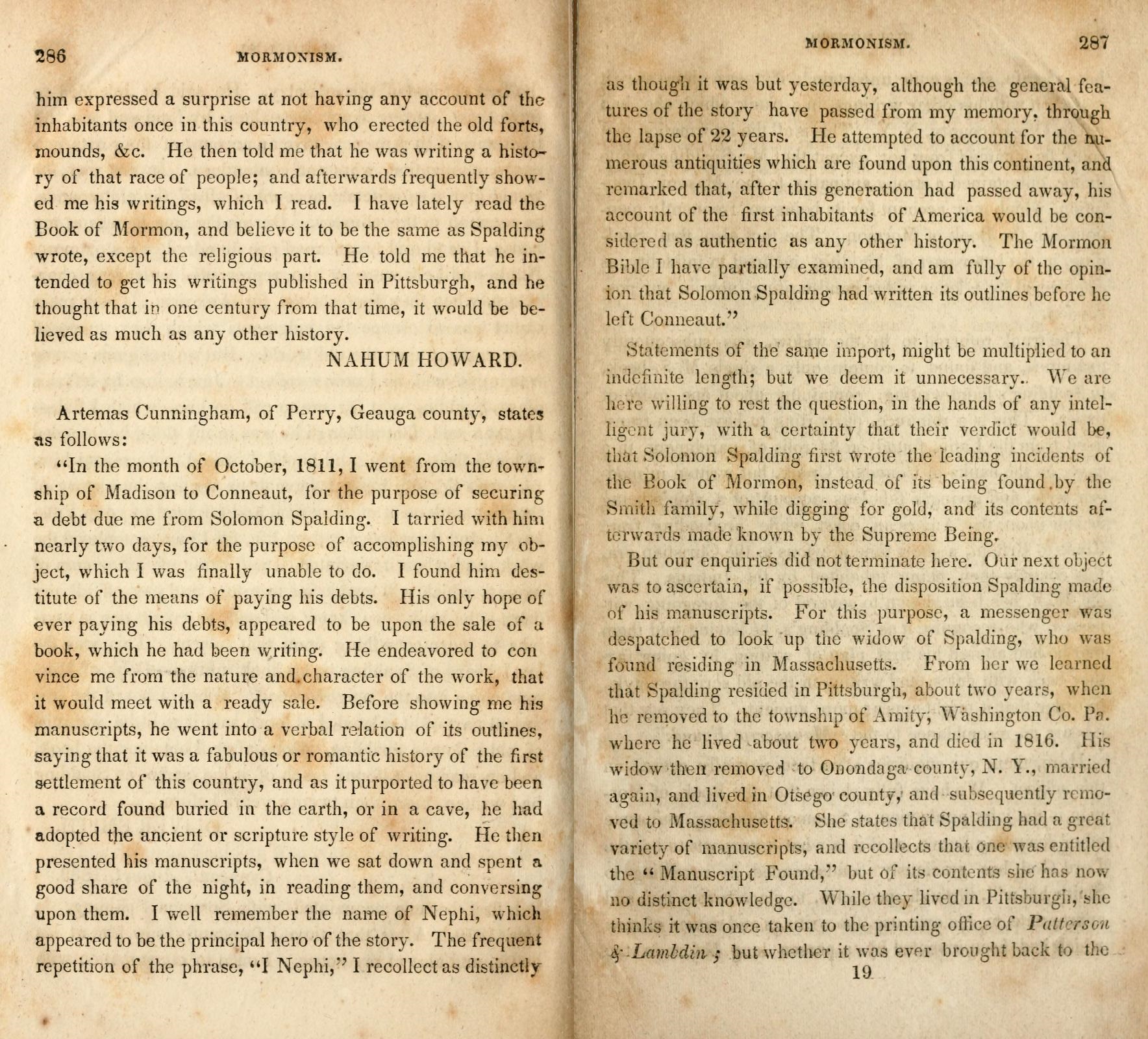
"In the month of October, 1811, I went from the township of Madison to Conneaut, for the purpose of securing a debt due me from Solomon Spalding. I tarried with him nearly two days, for the purpose of accomplishing my object, which I was finally unable to do. I found him destitute of the means of paying his debts. His only hope of ever paying his debts, appeared to be upon the sale of a book, which he had been writing. He endeavored to convince me from the nature and character of the work, that it would meet with a ready sale. Before showing me his manuscripts, he went into a verbal relation of its outlines, saying that it was a fabulous or romantic history of the first settlement of this country, and as it purported to have been a record found buried in the earth, or in a cave, he had adopted the ancient or scripture style of writing. He then presented his manuscripts, when we sat down and spent a good share of the night, in reading them, and conversing upon them. I well remember the name of Nephi, which appeared to be the principal hero of the story. The frequent repetition of the phrase, "I Nephi," I recollect as distinctly as though it was but yesterday, although the general features of the story have passed from my memory, through the lapse of 22 years. He attempted to account for the numerous antiquities which are found upon this continent, and remarked that, after this generation had passed away, his account of the first inhabitants of America would be considered as authentic as any other history. The Mormon Bible I have partially examined, and am fully of the opinion that Solomon Spalding had written its outlines before he left Conneaut." |
|
|
|
|
|
|
E. D. Howe Investigation
|
|
E. D. Howe
|
|
1834
|
|
|
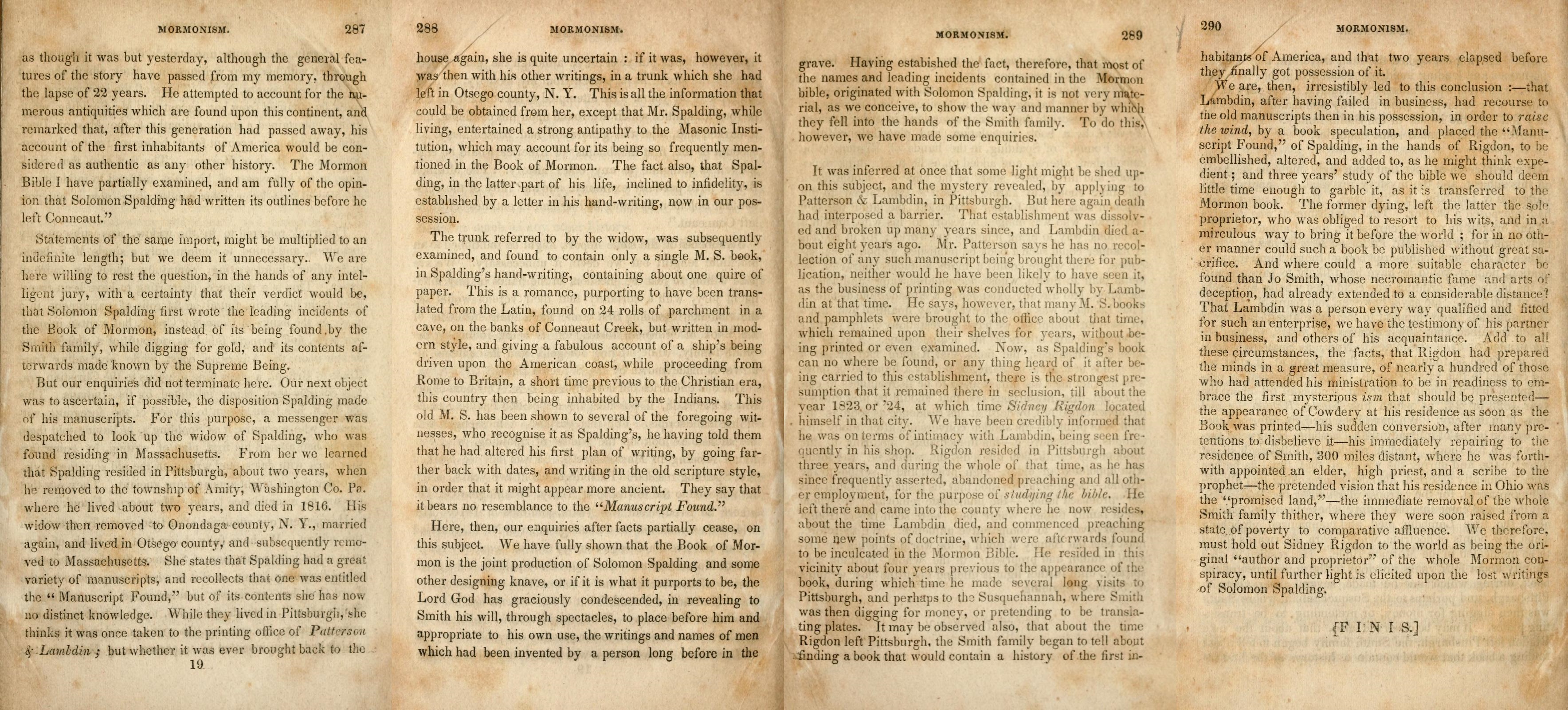
Our next object was to ascertain, if possible, the disposition Spalding made of his manuscripts. For this purpose, a messenger was despatched to look up the widow of Spalding, who was found residing in Massachusetts. From her we learned that Spalding resided in Pittsburgh, about two years, when he removed to the township of Amity, Washington Co. Pa. where he lived about two years, and died in 1816. His widow then removed to Onondaga county, N. Y., married again, and lived in Otsego county, and subsequently removed to Massachusetts. She states that Spalding had a great variety of manuscripts, and recollects that one was entitled the "Manuscript Found," but of its contents she has now no distinct knowledge. While they lived in Pittsburgh, she thinks it was once taken to the printing office of Patterson & Lambdin; but whether it was ever brought back to the house again, she is quite uncertain : if it was, however, it was then with his other writings, in a trunk which she had left in Otsego county, N. Y. This is all the information that could be obtained from her, except that Mr. Spalding, while living, entertained a strong antipathy to the Masonic Institution, which may account for its being so frequently mentioned in the Book of Mormon. The fact also, that Spalding, in the latter part of his life, inclined to infidelity, is established by a letter in his hand-writing, now in our possession.
The trunk referred to by the widow, was subsequently examined, and found to contain only a single M. S. book, in Spalding's hand-writing, containing about one quire of paper. This is a romance, purporting to have been translated from the Latin, found on 24 rolls of parchment in a cave, on the banks of Conneaut Creek, but written in modern style, and giving a fabulous account of a ship's being driven upon the American coast, while proceeding from Rome to Britain, a short time previous to the Christian era, this country then being inhabited by the Indians. This old M. S. has been shown to several of the foregoing witnesses, who recognise it as Spalding's, he having told them that he had altered his first plan of writing, by going father back with dates, and writing in the old scripture style, in order that it might appear more ancient. They say that it bears no resemblance to the "Manuscript Found."...
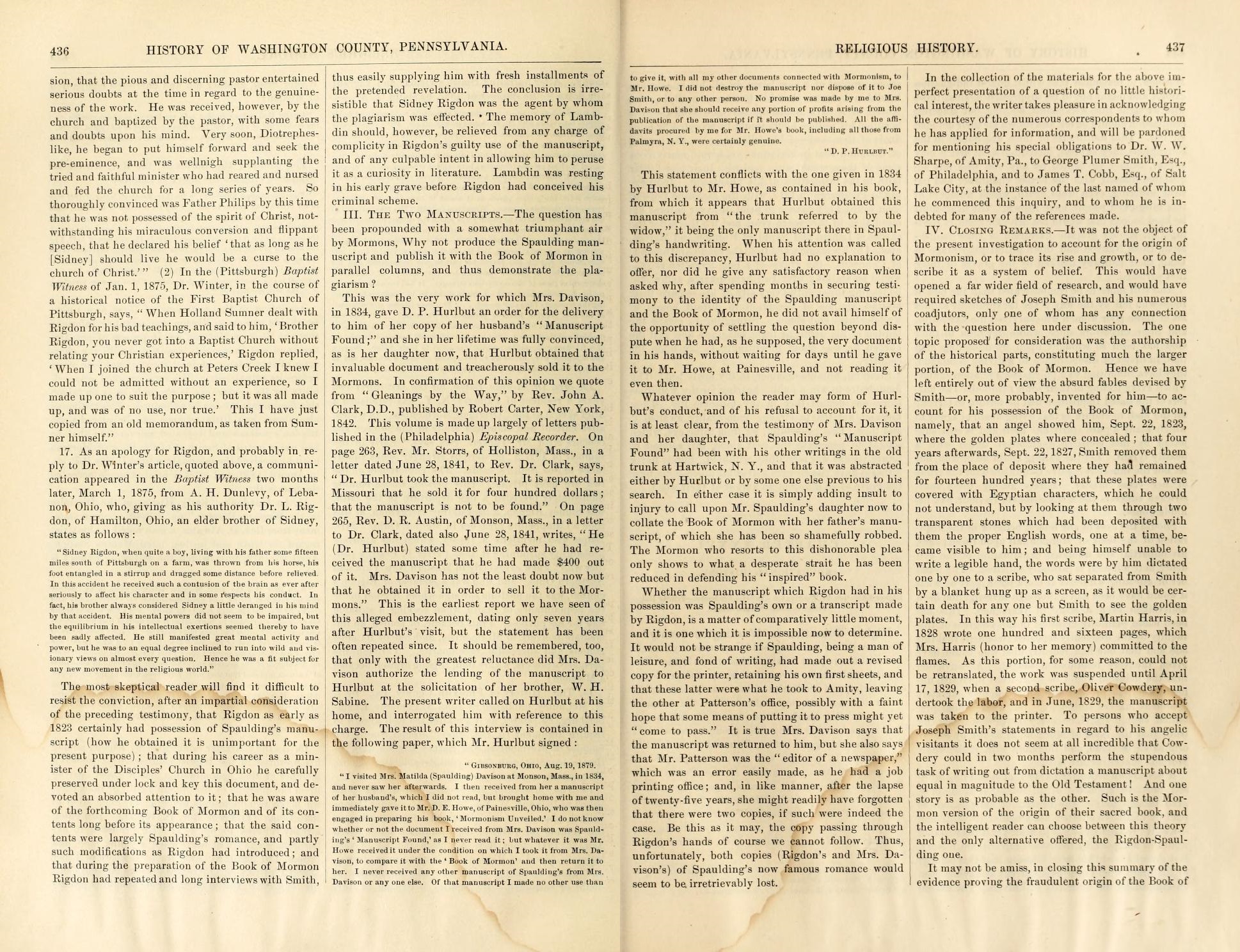
It was inferred at once that some light might be shed upon this subject, and the mystery revealed, by applying to Patterson & Lambdin, in Pittsburgh. But here again death had interposed a barrier. That establishment was dissolved and broken up many years since, and Lambdin died about eight years ago. Mr. Patterson says he has no recollection of any such manuscript being brought there for publication, neither would he have been likely to have seen it, as the business of printing was conducted wholly by Lambdin at that time. He says, however, that many M. S. books and pamphlets were brought to the office about that time, which remained upon their shelves for years, without being printed or even examined. Now, as Spalding's book can no where be found, or any thing heard of it after being carried to this establishment, there is the strongest presumption that it remained there in seclusion, till about the year 1823 or '24, at which time Sidney Rigdon located himself in that city. We have been credibly informed that he was on terms of intimacy of Lambdin, being seen frequently in his shop. Rigdon resided in Pittsburgh about three years, and during the whole of that time, as he has since frequently asserted, abandoned preaching and all other employment, for the purpose of studying the bible. He left there and came into the county where he now resides, about the time Lambdin died, and commenced preaching some new points of doctrine, which were afterwards found to be inculcated in the Mormon Bible. He resided in this vicinity about four years previous to the appearance of the book, during which time he made several long visits to Pittsburgh, and perhaps to the Susquehannah, where Smith was then digging for money, or pretending to be translating plates. It may be observed also, that about the time Rigdon left Pittsburgh, the Smith family began to tell about finding a book that would contain a history of the first inhabitants of America, and that two years elapsed before they finally got possession of it. |
|
|
|
(Note:
More information on Mr. Patterson's statement can be found here)
|
|
|
|
|
|
External Link
|
|
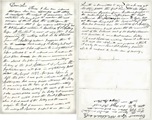
Unsigned draft letter, Solomon Spalding Miscellaneous Papers, New York Public Library
|
|
|
|
|
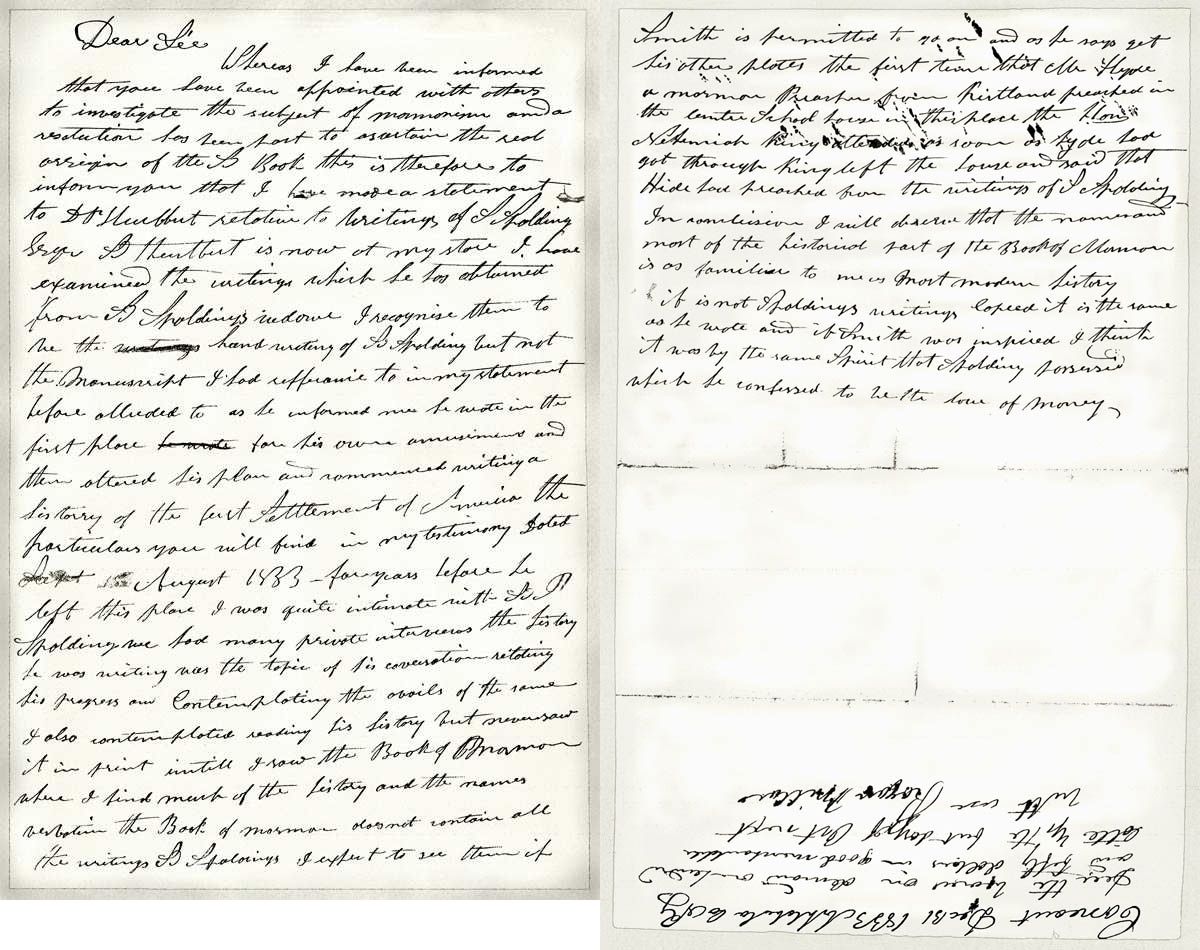
Aaron Wright draft letter
|
|
Aaron Wright
|
|
31 Dec, 1833
|
|
|
Dear Sir
Whereas I have been informed that you have been appointed with others to investigate the subject of mormonism and a resolution has been past to ascertain the real orrigin of the sd Book this is therefore to inform you that I have made a statement to D P Hurlbut relative to writings of S Spalding Esq sd Hurlbut is now at my store I have examined the writings which he has obtained from sd Spaldings widowe I recognise them to be the writings hand writing of sd Spalding but not the manuscript I had refferance to in my statement before alluded to as he informed me he wrote in the first place he wrote for his own amusement and then altered his plan and commenced writing a history of the first Settlement of America the particulars you will find in my testimony Dated Sept 1833 August 1833 -- for years before he left this place I was quite intimate with sd Spalding we had many private interviews the history he was writing was the topic of his conversation relating his progress and Contemplating the avails of the same I also contemplated reading his history but never saw it in print untill I saw the Book of Mormon where I find much of the history and the names verbatim the Book of mormon does not contain all the writings sd Spladings I expect to see them if Smith is permitted to go on and as he says get his other plates the first time that Mr Hyde a mormon Preacher from Kirtland preached in the centre School house in this place the Hon Nehmiah King attended as soon as Hyde had got through King left the house and said that Hide had preached from the writings of S Spalding
In conclusion I will observe that the names and most of the historical part of the Book of Mormon is as familiar to me as Most modern history if if is not Spaldings writings copied it is the same as he wrote and if Smith was inspired I think it was by the same Spirit that Spalding possessed which he confessed to be the love of money
Coneaut Dec 31 1833 Ashtabula Co NY |
|
|
|
|
|
|
Account from Spaulding's Widow
|
|
Matilda Davison
|
|
1 Apr, 1839
|
|
|
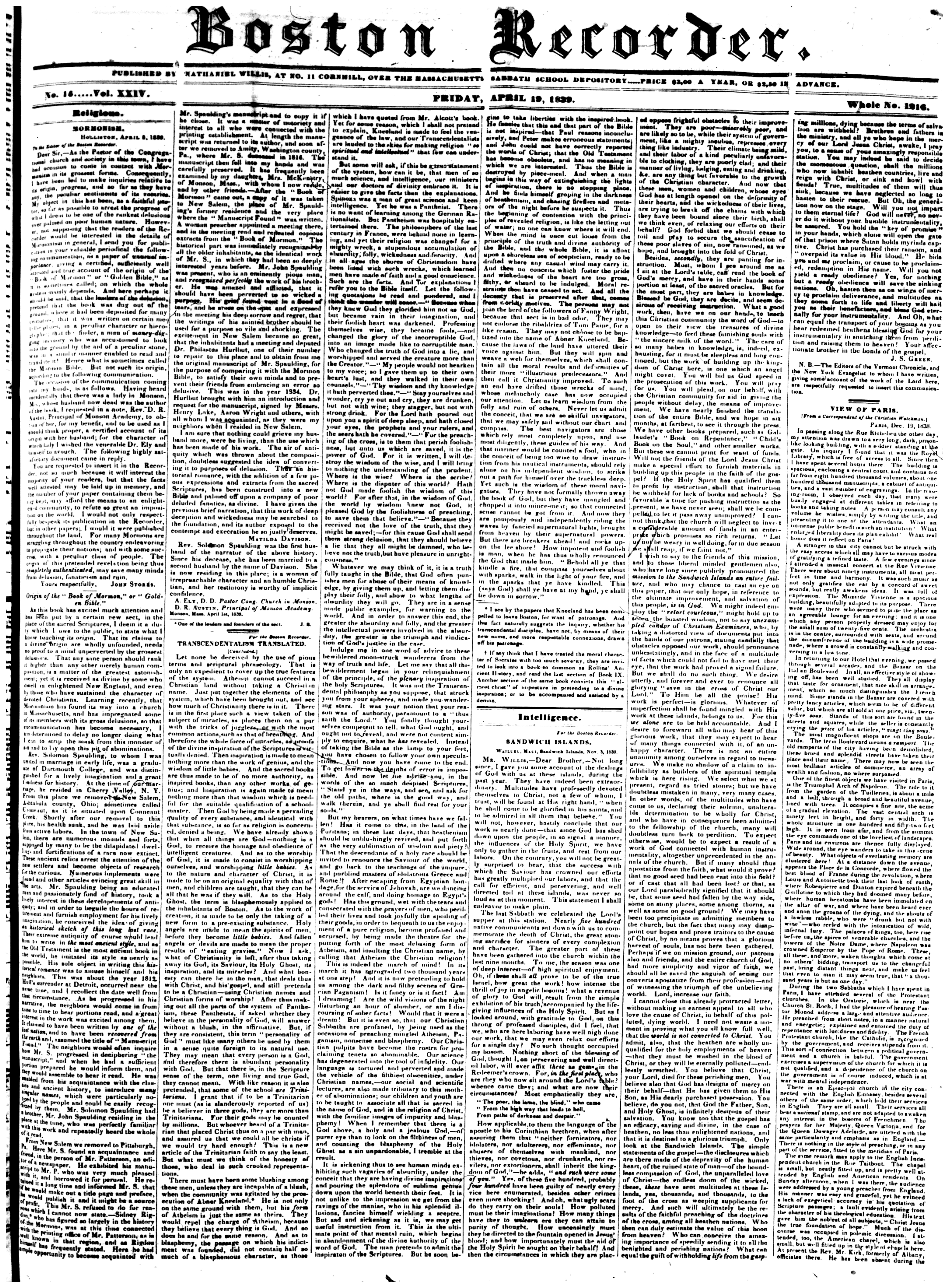
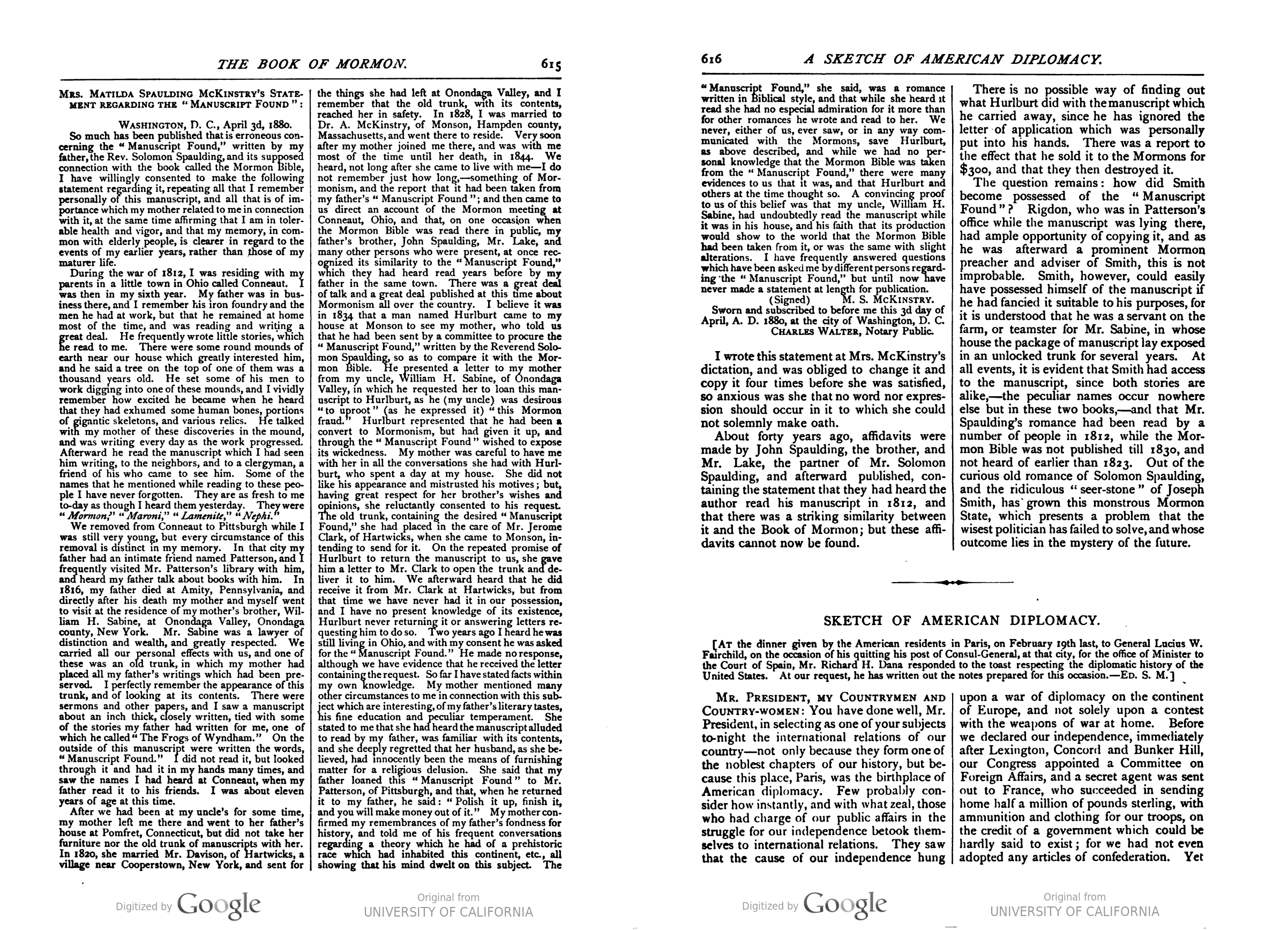
...Rev. Solomon Spaulding, to whom I was united in marriage in early life, was a graduate of Dartmouth College, and was distinguished for a lively imagination and a great fondness for history. At the time of our marriage, he resided in Cherry Valley, N.Y. From this place we removed to New Salem, Ashtabula county, Ohio; sometimes called Conneaut, as it is situated upon Conneaut Creek. Shortly after our removal to this place, his health sunk, and he was laid aside from active labors. In the town of New Salem, there are numerous mounds and forts, supposed by many to be the dilapidated dwellings and fortifications of a race now extinct. These ancient relics arrest the attention of the new settlers, and become objects of research for the curious. Numerous implements were found and other articles evincing great skill in the arts. Mr. Spaulding being an educated man and passionately fond of history, took a lively interest in these developments of antiquity; and in order to beguile the hours of retirement and furnish employment for his lively imagination, he conceived the idea of giving an historical sketch of this long lost race. Their extreme antiquity of course would lead him to write in the most ancient style, and as the Old Testament is the most ancient book in the world, he imitated its style as nearly as possible. His sole object in writing this historical romance was to amuse himself and his neighbors. This was about the year 1812. Hull's surrender at Detroit, occurred near the same time, and I recollect the date well from that circumstance. As he progressed in his narrative, the neighbors would come in from time to time to hear portions read, and a great interest in the work was excited among them. It claimed to have been written by one of the lost nation, and to have been recovered from the earth, and, assumed the title of "Manuscript Found." The neighbors would often inquire how Mr. S. progressed in deciphering "the manuscript," and when he had sufficient portion prepared he would inform them, and they would assemble to hear it read. He was enabled from his acquaintance with the classics and ancient history, to introduce many singular names, which were particularly noticed by the people and could be easily recognized by them. Mr. Solomon Spaulding had a brother, Mr. John Spaulding residing in the place at the time, who was perfectly familiar with this work and repeatedly heard the whole of it read.
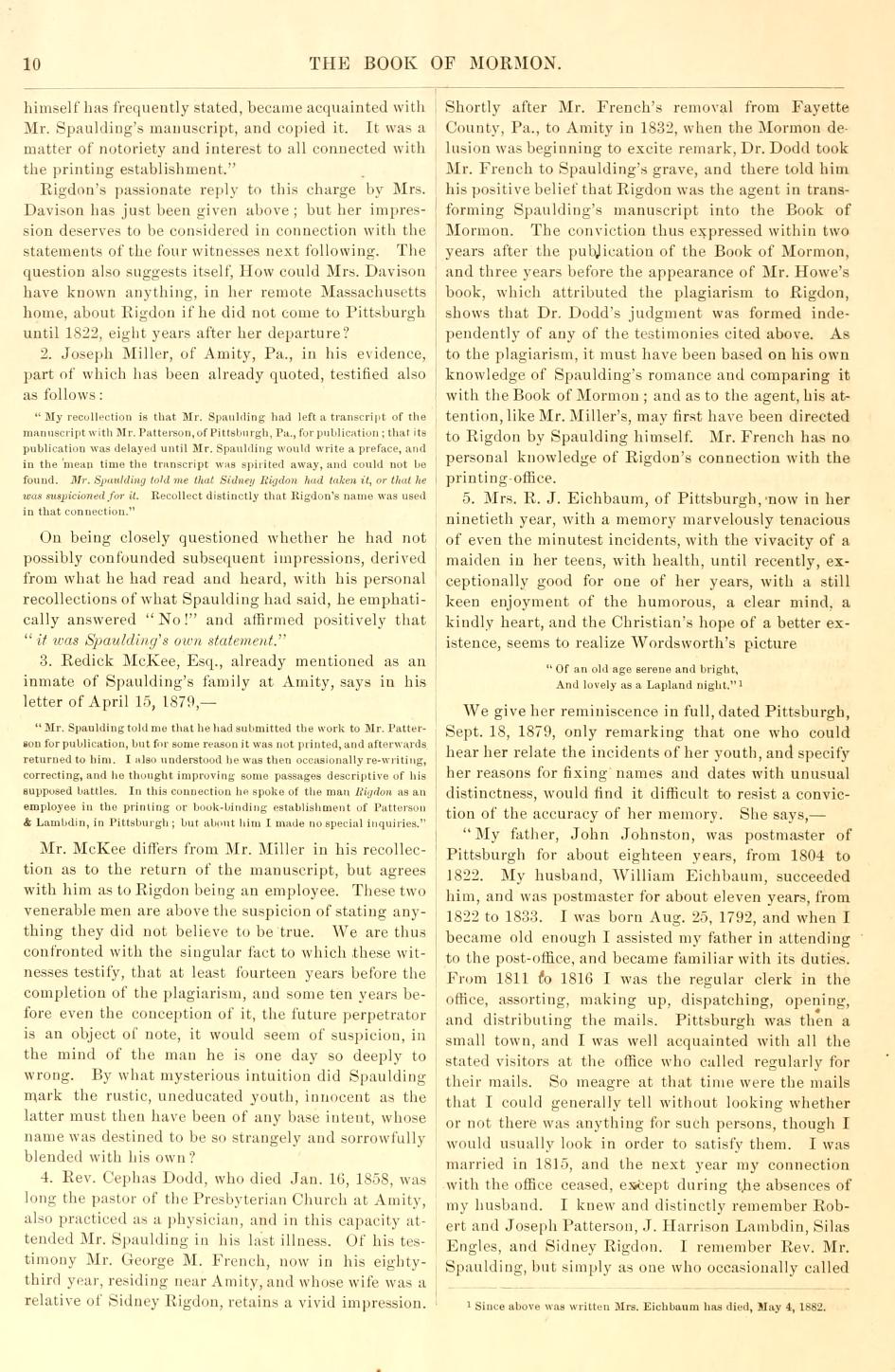
From New Salem we removed to Pittsburgh, Pa. Here Mr. Spaulding found an acquaintance and friend, in the person of Mr. Patterson, an editor of a newspaper. He exhibited his manuscript to Mr. P. who was very much pleased with it, and borrowed it for perusal. He retained it a long time and informed Mr. S. that if he would make out a title page and preface, he would publish it and it might be a source of profit. This Mr. S. refused to do for reasons which I cannot now state. -- Sidney Rigdon,* who has figured so largely in the history of the Mormons, was at this time connected with the printing office of Mr. Patterson, as is well known in that region, and as Rigdon himself has frequently stated. Here he had ample opportunity to become acquainted with Mr. Spaulding's manuscript and to copy it if he chose. It was a matter of notoriety and interest to all who were connected with the printing establishment. At length the manuscript was returned to its author, and soon after we removed to Amity, Washington county, Pa., where Mr. S. deceased in 1816. The manuscript then fell into my hands and was carefully preserved. It has frequently been examined by my daughter, Mrs. McKenstry, of Monson, Mass., with whom I now reside, and by other friends. -- After the "Book of Mormon" came out, a copy of it was taken to New Salem, the place of Mr. Spaulding's former residence and the very place where the "Manuscript Found" was written. A woman preacher appointed a meeting there, and in the meeting read and repeated copious extracts from the "Book of Mormon." The historical part was immediately recognized by all the older inhabitants, as the identical work of Mr. S., in which they had been so deeply interested years before. Mr. John Spaulding was present, who is an eminently pious man, and recognized perfectly the work of his brother. He was amazed and afflicted, that it should have been perverted to so wicked a purpose. His grief found vent in a flood of tears, and he arose on the spot, and expressed to the meeting his deep sorrow and regret, that the writings of his sainted brother should be used for a purpose so vile and shocking. The excitement in New Salem became so great, that the inhabitants had a meeting and deputed Dr. Philastus Hurlbut, one of their number to repair to this place and to obtain from me the original manuscript of Mr. Spaulding, for the purpose of comparing it with the Mormon Bible, to satisfy their own minds, and to prevent their friends from embracing an error so delusive. This was in the year 1834. Dr. Hurlbut brought with him an introduction and request for the manuscript, signed by Messrs. Henry Lake, Aaron Wright and others, with all whom I was acquainted, as they were my neighbors when I resided in New Salem.
I am sure that nothing would grieve my husband more, were he living, than the use which has been made of his work. The air of antiquity which was thrown about the composition, doubtless suggested the idea of converting it to the purposes of delusion. Thus an historical romance, with the addition of a few pious expressions and extracts from the sacred Scriptures, has been construed into a new Bible and palmed off upon a company of poor deluded fanatics, as divine. I have given the previous brief narration, that this work of deep deception and wickedness may be searched to the foundation, and its author exposed to the contempt and execration he so justly deserves. |
|
|
(Note:
A rebuttal to this account was printed by Alexander Badlam in the Quincy Whig on November 16, 1839, which can be read in the Jan 1840 edition of the Times and Seasons here. A response to this rebuttal was published in August, 1840 in John Clark's "Gleanings by the Way," which can be read here.
On Nov 27, 1839, Parley P. Pratt wrote a separate response to Mrs. Davidson's account to the New Era, which can be read in the Jan 1840 edition of the Times and Seasons here. The official response given by Sidney Rigdon is below.)
|
|
|
|
|
|
External Link
|
|
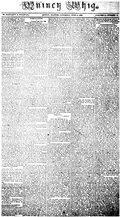
Quincy Whig, June 8, 1839, Vol 2, No 6, columns 2-3
|
|
|
|
|
Response by Sidney Rigdon
|
|
Sidney Rigdon
|
|
27 May, 1839
|
|
|
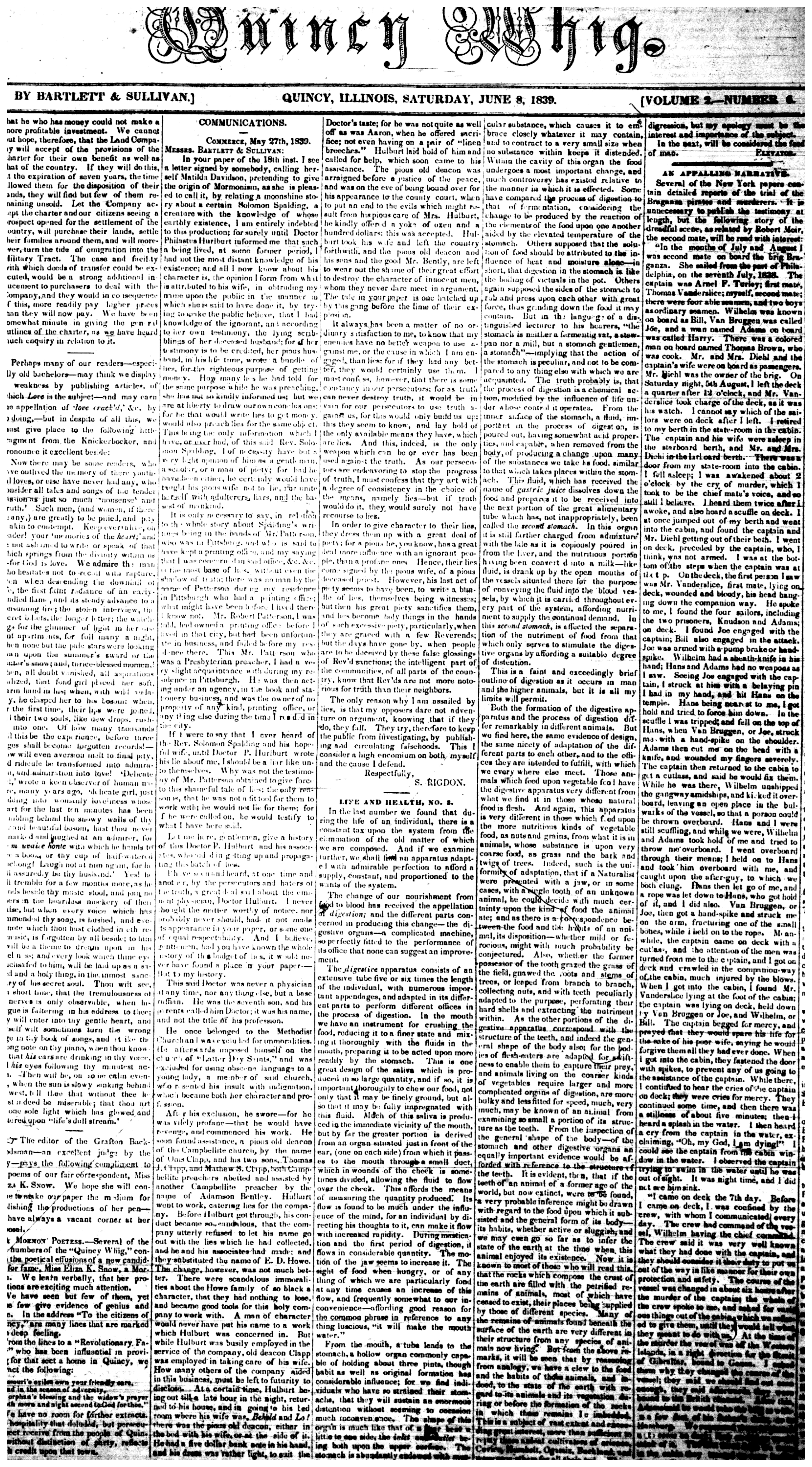
Messrs. Bartlett & Sullivan:
In your paper of the 18th inst. I see a letter signed by somebody, calling herself Matilda Davidson, pretending to give the origin of Mormonism, as she is pleased to call it, by relating a moonshine story about a certain Solomon Spalding, a creature with the knowledge of whose earthly existence, I am entirely indebted to this production; for surely, until Doctor Philastus Hurlburt informed me that such a being lived, at some former period, I had not the most distant knowledge of his existence; and all I now know about his character is, the opinion I form from what is attributed to his wife, in obtruding my name upon the public in the manner in which she is said to have done it, by trying to make the public believe, that I had knowledge of the ignorant, and according to her own testimony, the lying scribblings of her deceased husband; for if her testimony is to be credited, her pious husband, in his life time, wrote a bundle of lies, for the righteous purpose of getting money. How many lies he had told for the same purpose while he was preaching, she has not so kindly informed us; but we are at liberty to draw our own conclusions; for he that would write lies to get money, would also preach lies for the same object. This being the only information which I have, or ever had, of this said Rev. Solomon Spalding, I, of necessity have but a very light opinion of him as a gentleman, a scholar, or a man of piety; for had he been either, he certainly would have taught his pious wife not to lie, nor unite herself with adulterers, liars, and the basest of mankind.
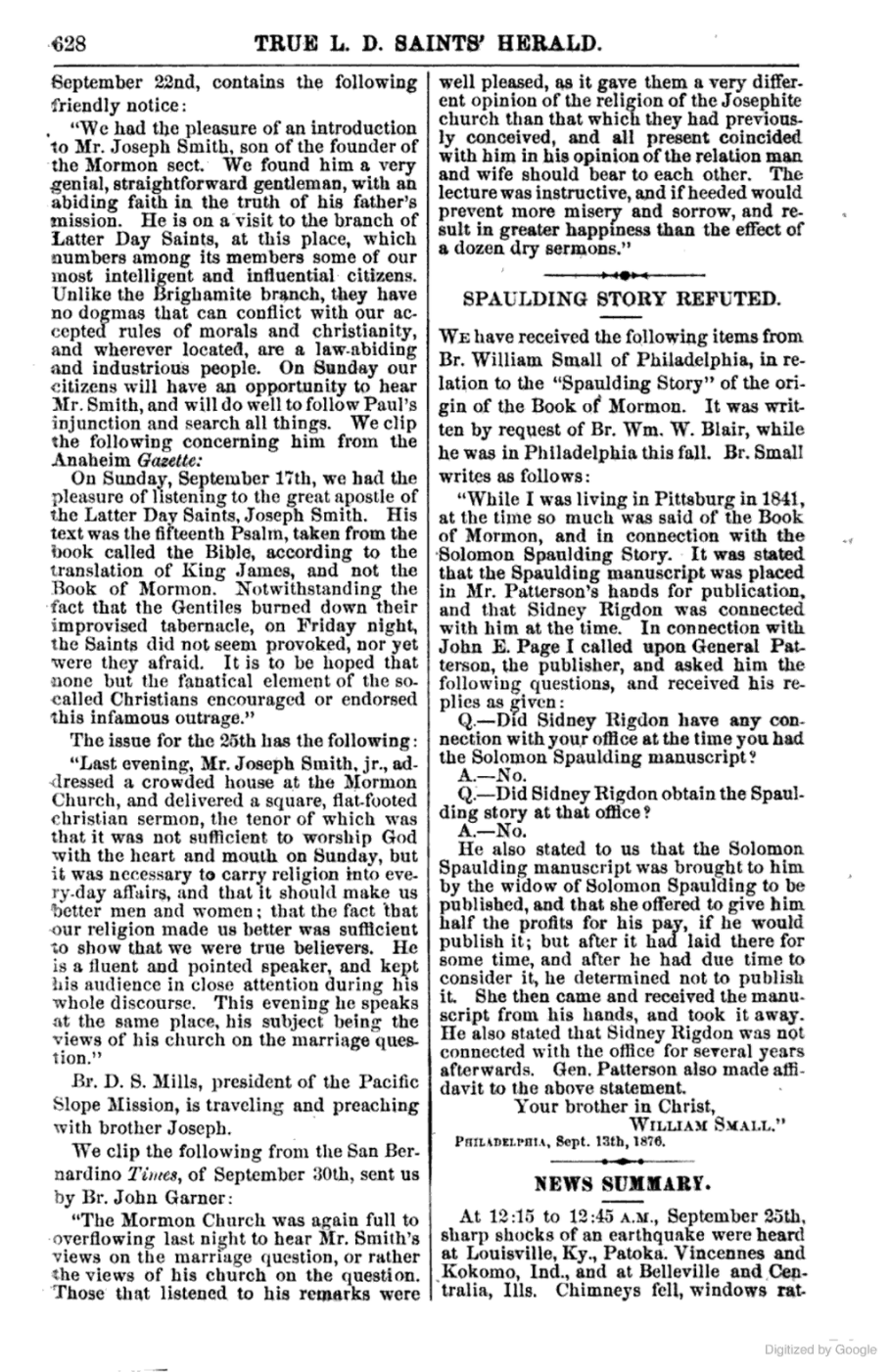
It is only necessary to say, in relation to the whole story about Spalding's writings being in the hands of Mr. Patterson, who was in Pittsburg, and who is said to have kept a printing office, and my saying that I was concerned in said office, &c. &c. is the most base of lies, without even the shadow of truth; there was no man by the name of Patterson during my residence at Pittsburgh who had a printing office; what might have been before I lived there I know not. Mr. Robert Patterson, I was told, had owned a printing office before I lived in that city, but had been unfortunate in business, and failed before my residence there. This Mr. Patterson, who was a Presbyterian preacher, I had a very slight acquaintance with during my residence in Pittsburgh. He was then acting under an agency, in the book and stationery business, and was the owner of no property of any kind, printing office, or any thing else, during the time I resided in the city.
If I were to say that I ever heard of the Rev. Solomon Spalding, and his hopeful wife, until Dr. P. Hurlburt wrote his lie about me, I should be a liar like unto themselves. Why was not the testimony of Mr. Patterson obtained to give force to this shameful tale of lies; the only reason is, that he was not a fit tool for them to work with; he would not lie for them; for if he were called on, he would testify to what I have here said.
Let me here, gentlemen, give a history of this Dr. P. Hulburt and his associates, who aided in getting up and propagating this batch of lies.
I have seen and heard, at one time and another, by the persecutors and haters of the truth, a great deal said about the eminent physician, Doctor Hulburt. I never thought the matter worthy of notice, nor probably ever should, had it not made its appearance in your paper, or some one of equal respectability. And I believe, gentlemen, had you have known the whole history of this budget of lies, it would never have found a place in your paper. --
But to my history.
This said Doctor was never a physician, at any time, nor anything else, but a base ruffian. He was the seventh son, and his parents called him Doctor; it was his name, and not the title of his profession.
He once belonged to the Methodist Church and was excluded for immoralities. He afterwards imposed himself on the Church of "Latter Day Saints," and was excluded for using obscene language to a young lady, a member of said church, who resented his insult with indignation, which became both her character and profession.
After his exclusion, he swore -- for he was vilely profane -- that he would have revenge, and commenced his work. He soon found assistance, a pious old deacon of the Campbellite church, by the name of Onis [sic] Clapp, and his two sons, Thomas J. Clapp and Matthew S. Clapp, both Campbellite preachers, abetted and assisted by another Campbellite preacher by the name of Adamson Bentley. Hulburt went to work, catering lies for the company. Before Hulburt got through, his conduct became so scandalous, that the company utterly refused to let his name go out with the lies which he had collected, and he and his associates had made; and they substituted the name of E. D. Howe. The change, however, was not much better. There were scandalous immoralities about the Howe family of so black a character, that they had nothing to lose, and became good tools for this holy company to work with. A man of character would never have put his name to a work which Hulburt was concerned in. But while Hulburt was busily employed in the service of the company, old deacon Clapp was employed in taking care of his wife... |
|
|
|
|
|
External Link
|
|
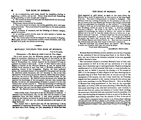
The Millennial Harbinger, Third Series, Alexander Campbell, January 1844, Vol 1, No 1
|
|
|
|
|
Adamson Bentley letter
|
|
Adamson Bentley
|
|
22 Jan, 1841
|
|
|
|
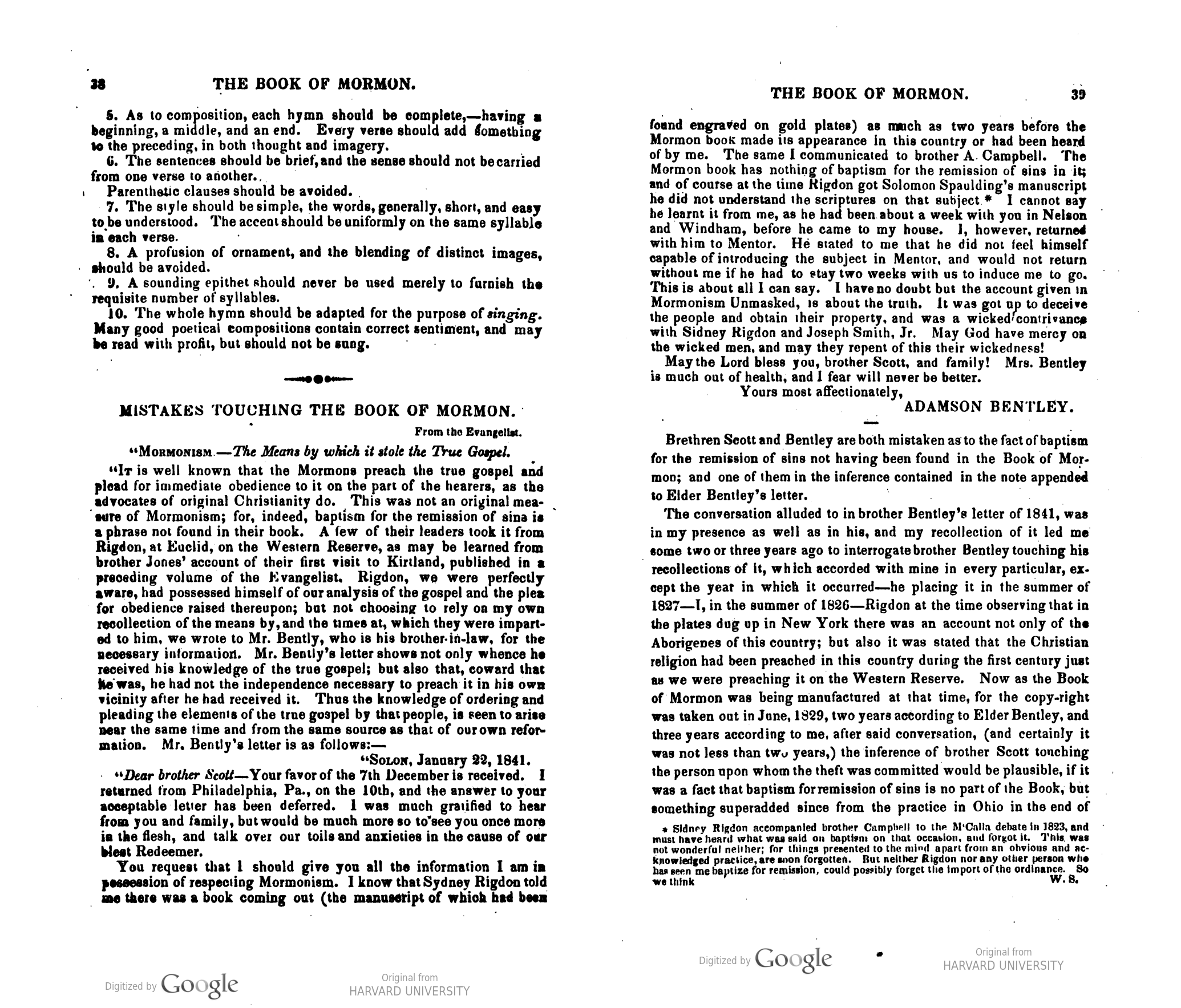
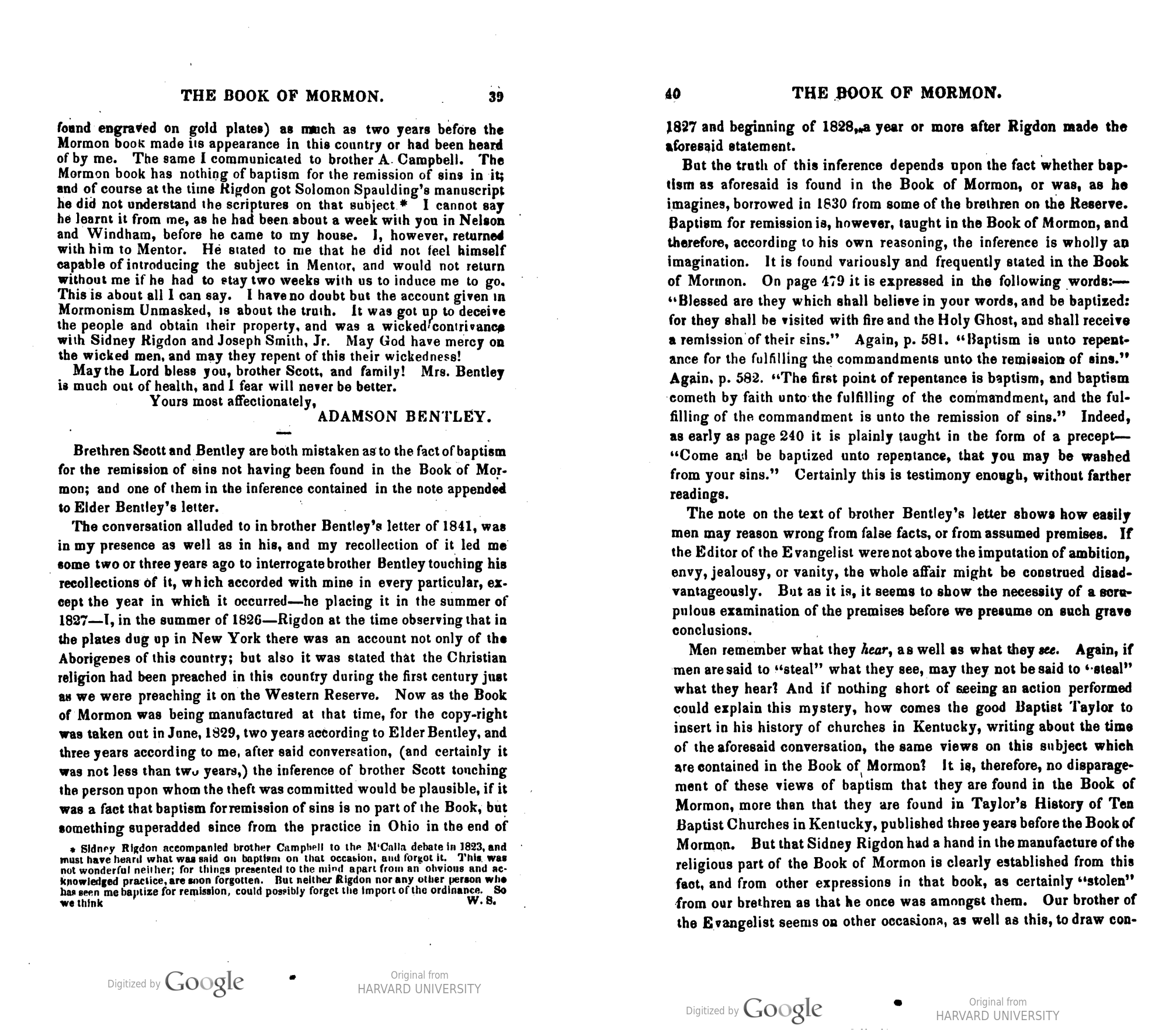
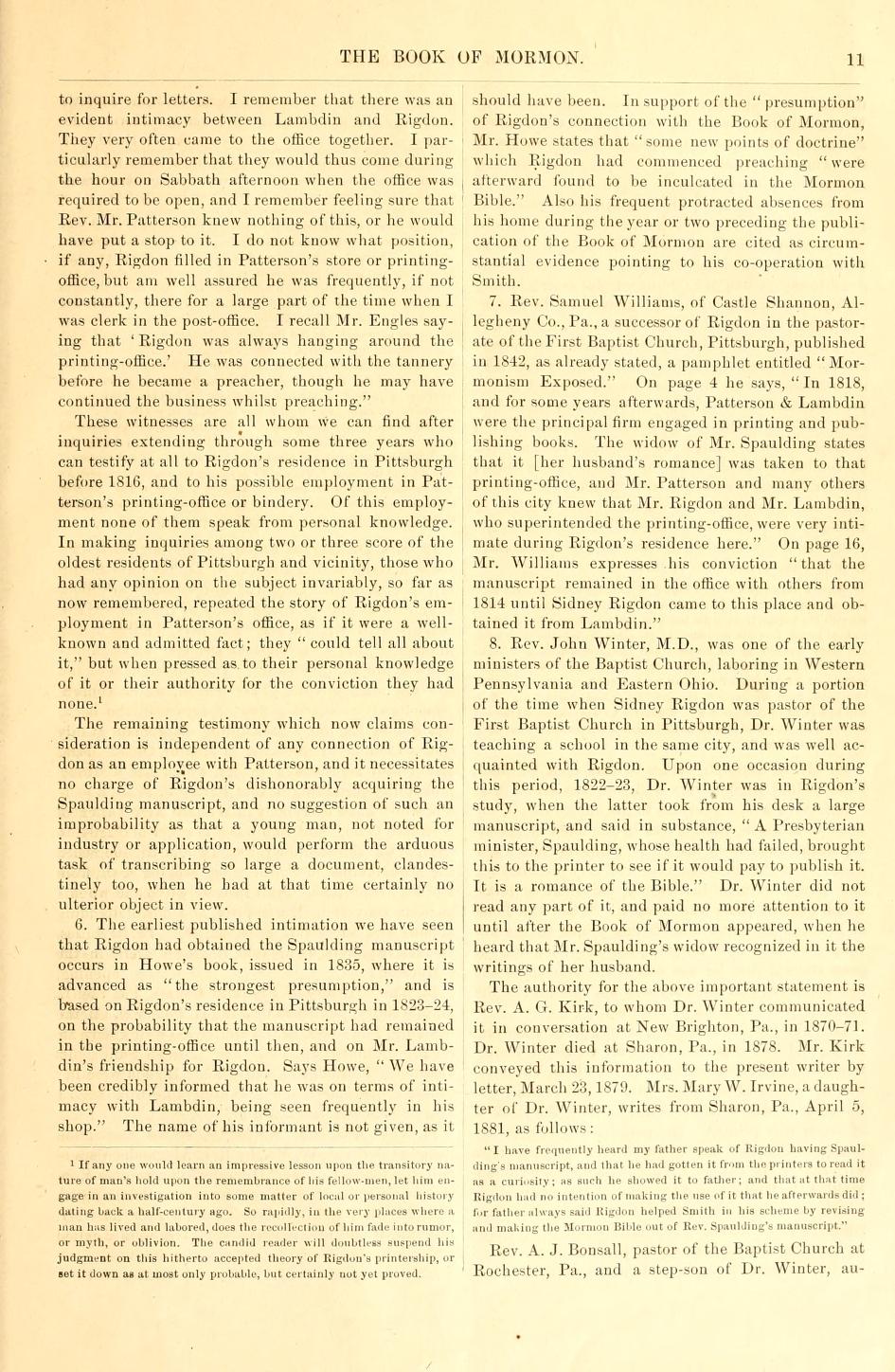
Your request that I should give you all the information I am in possession of respecting Mormonism. I know that Sydney Rigdon told me there was a book coming out (the manuscript of which had been found engraved on gold plates) as much as two years before the Mormon book made its appearance in this country or had been heard of by me. The same I communicated to brother A Campbell. The Mormon book has nothing of baptism for the remission of sins in it; and of course at the time Rigdon got Solomon Spaulding's manuscript he did not understand the scriptures on that subject.* I cannot say he learnt it from me, as he had been about a week with you in Nelson and Windham, before he came to my house. I, however, returned with him to Mentor. He stated to me that he did not feel himself capable of introducing the subject in Mentor, and would not return without me if he had to stay two weeks with us to induce me to go. This is about all I can say. I have no doubt but the account given in Mormonism Unmasked, is about the truth. It was got up to deceive the people and obtain their property, and was a wicked contrivance with Sidney Rigdon and Joseph Smith, Jr. May God have mercy on the wicked men, and may they repent of this their wickedness! |
|
|
|
(Note:
Alexander Campbell and Walter Scott published their support for Bentley's letter, including their own recollections that Rigdon had referred to the Book of Mormon before 1830, in the January 1844 edition of the Millenial Harbinger, which can be read here.)
|
|
|
|
|
|
|
Storm Rosa letter
|
|
Dr. Storm Rosa
|
|
3 Jun, 1841
|
|
|
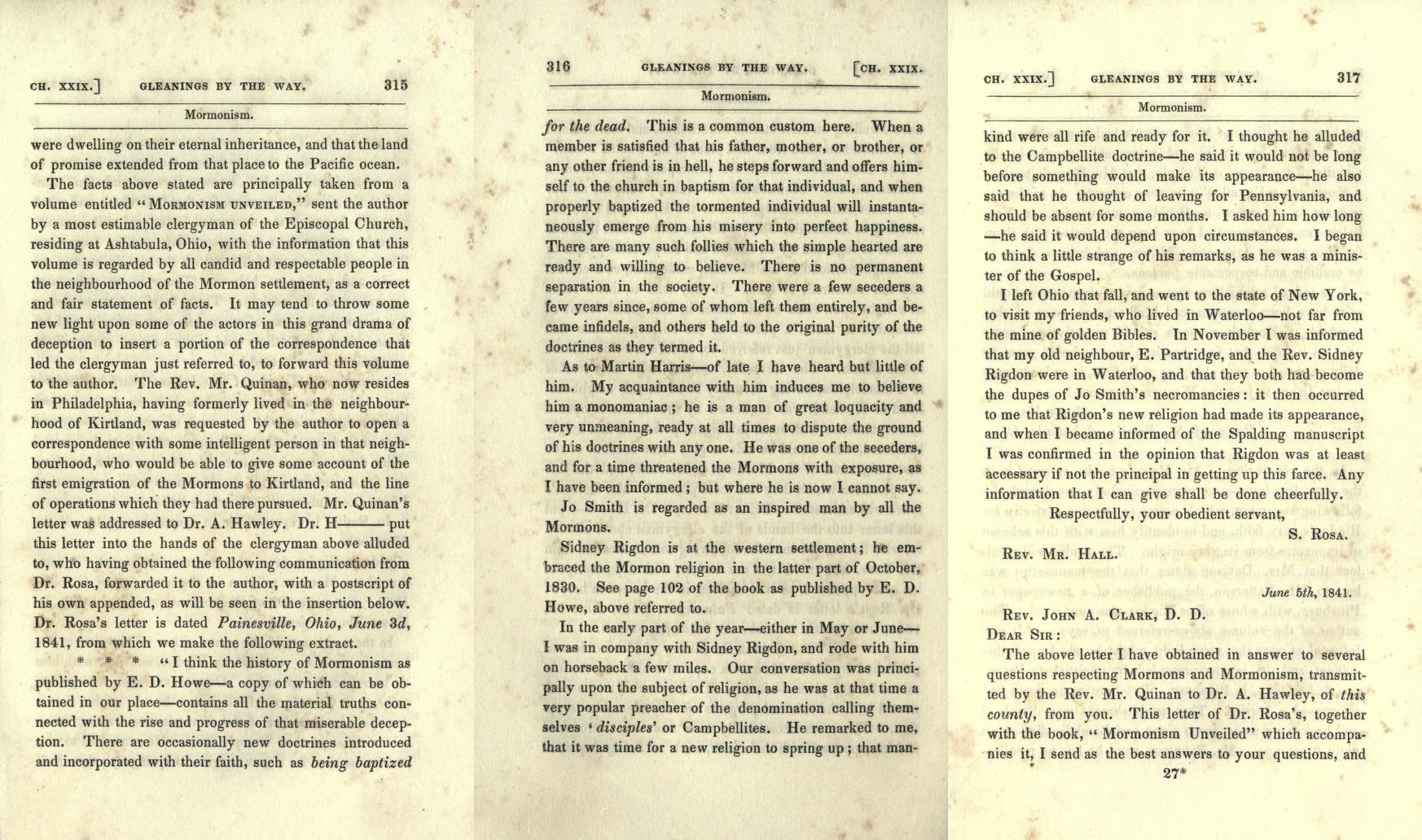
Sidney Rigdon is at the western settlement; he embraced the Mormon religion in the latter part of October, 1830. See page 102 of the book published by E. D. Howe, above referred to.
In the early part of the year -- either May or June -- I was in company with Sidney Rigdon, and rode with him on horseback a few miles. Our conversation was principally upon the subject of religion, as he was at that time a very popular preacher of the denomination calling themselves 'disciples' or Campbellites. He remarked to me, that it was time for a new religion to spring up; that mankind were all rife and ready for it. I thought he alluded to the Campbellite doctrine -- he said it would not be long before something would make its appearance -- he also said that he thought of leaving for Pennsylvania, and should be absent for some months. I asked him how long -- he said it would depend upon circumstances. I began to think a little strange of his remarks, as he was a minister of the Gospel. |
|
|
|
|
|
|
Robert Patterson Letter
|
|
Robert Patterson
|
|
Apr 2, 1842
|
|
|
|
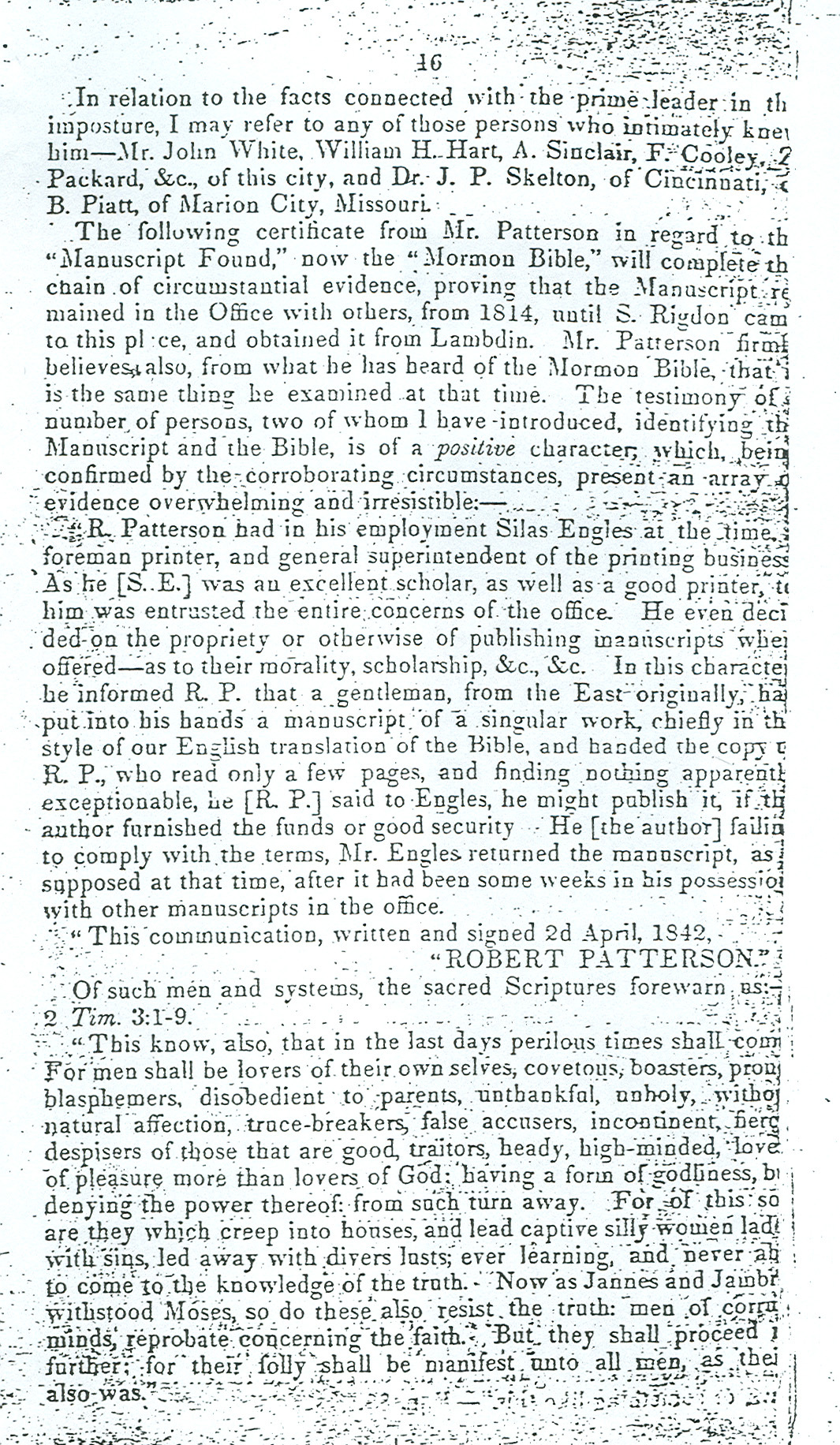
R. Patterson had in his employment Silas Engles at the time a foreman printer, and general superintendent of the printing business. As he (S. E.) was an excellent scholar, as well as a good printer, to him was entrusted the entire concerns of the office. He even decided on the propriety or otherwise of publishing manuscripts when offered -- as to their morality, scholarship, &c., &c. In this character he informed R. P. that a gentleman, from the East originally, had put into his hands a manuscript of a singular work, chiefly in the style of our English translation of the Bible, and handed the copy to R. P., who read only a few pages, and finding nothing apparently exceptionable, he (R. P.) said to Engles, he might publish it, if the author furnished the funds or good security. He (the author) failing to comply with the terms, Mr. Engles returned the manuscript, as I supposed at that time, after it had been some weeks in his possession with other manuscripts in the office. |
|
|
|
|
No Preview Available
|
|
External Link
|
|
The Spaulding Story, Concerning the Origin of the Book of Mormon, by John E. Page, 1843, pgs 7-8
|
|
|
|
|
Statement by Sidney Rigdon's Brother and Brother-in-Law
|
|
Carvil Rigdon & Peter Boyer
|
|
Jan 27, 1843
|
|
|
The following statement of facts in relation to the birth, life, education, and occupation of Sidney Rigdon, Minister of the gospel of Jesus Christ, in the Church of the Latter Day Saints, is taken from the family records, as kept by his parents and by the subscribers.
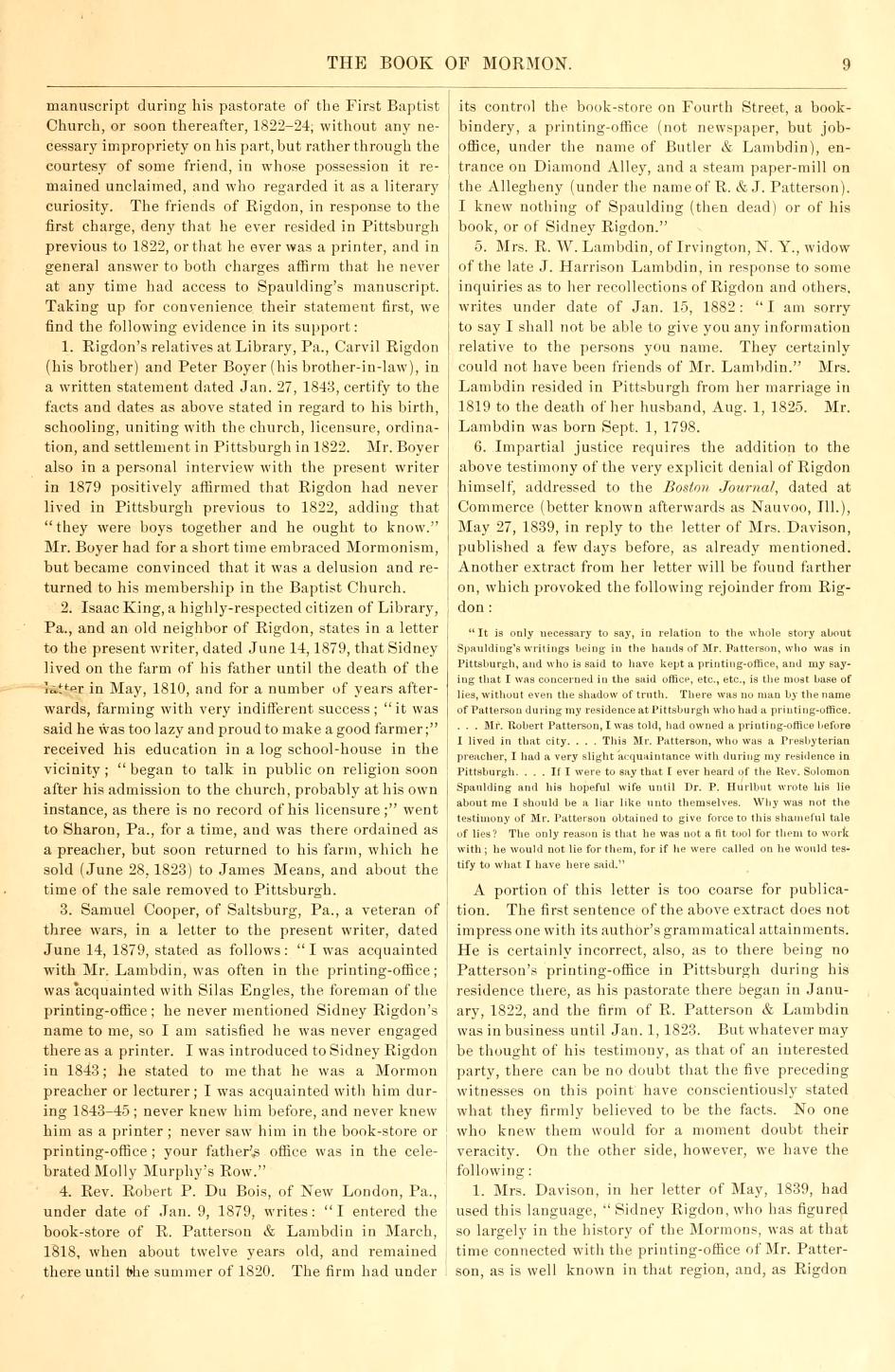
He (S. Rigdon) was born on his father's farm. Piny Fork of Peter's Creek, St. Clair township. Alleghany Co., Pa., Feb., 19, 1793, where he lived till the winter of 1818 and 1819,* and followed farming and received a common English education. In the fall of 1817 he professed religion, † and joined the regular Baptist Church of that place, and in the winter of 1818 and '19 he went to Beaver Co., Pa., where he studied divinity with a Baptist preacher by the name of Clark, and was licensed to preach by the Conoquenessing Church (time not recollected) and went from there to Warren, Ohio, and was ordained a regular Baptist preacher, and returned to Pittsburgh in the winter of 1821 and '22, and took the care of the First Regular Baptist Church, and there continued to preach till the Baptist Association met in Pittsburgh, (precise time not recollected, but we think about the fall of 1824) at which time they brought some charges against him for not being sound in the faith; brought him to trial, but denied him the liberty of speaking in self-defence, and he declared a non-fellowship with them, and began to preach Campbellism. And he, and they that joined with him got the liberty of the Court House, there they held their meetings, and he and his brother-in-law, Mr. Brooks, followed the tanning business till the winter of 1827-'28, when he (S. Rigdon) moved somewhere into the Western Reserve, in Ohio, and there continued to preach till the Latter Day Saints came to that part of the country, and he joined them, and continues to be an elder in that church (of Latter Day Saints, called Mormons.
In confirmation of the above statements, we hereby subscribe our names.
CARVIL RIGDON,
PETER BOYER.
* 1819 is the year that Mrs. McKinstry, the daughter of Mr. S. Spaulding, says she read her father's romance for diversion, when she was 12 years old, and her mother, who is now Mrs. Matilda Davison, says that Mr. S. Spaulding wrote the romance in 1812. She is particular on this point, it being the year of Hull's surrender.
† 1817 being the time of S. Rigdon's professing religion, is one year after the death of Mr. Spaulding, as Mrs. Davison says that he died in 1816. "The manuscript then fell into my hands and was carefully preserved; it has frequently been examined by my daughter, Mrs. McKinstry, of Monson, Mass., with whom I now reside, and by other friends." Question: when did S. Rigdon ever see the Spaulding manuscript? I answer never! NO NEVER!! NEVER!!! |
|
|
|
(Note:
No images of the original 1843 publication of this booklet are available online. Only 2 or 3 copies have survived. A copy of the 1866 republication can be read at this link.)
|
|
|
|
|
|
External Link
|
|
The Millennial Harbinger, Third Series, Alexander Campbell, January 1844, Vol 1, No 1
|
|
|
|
|
Alexander Campbell statement
|
|
Alexander Campbell
|
|
1844
|
|
|
|
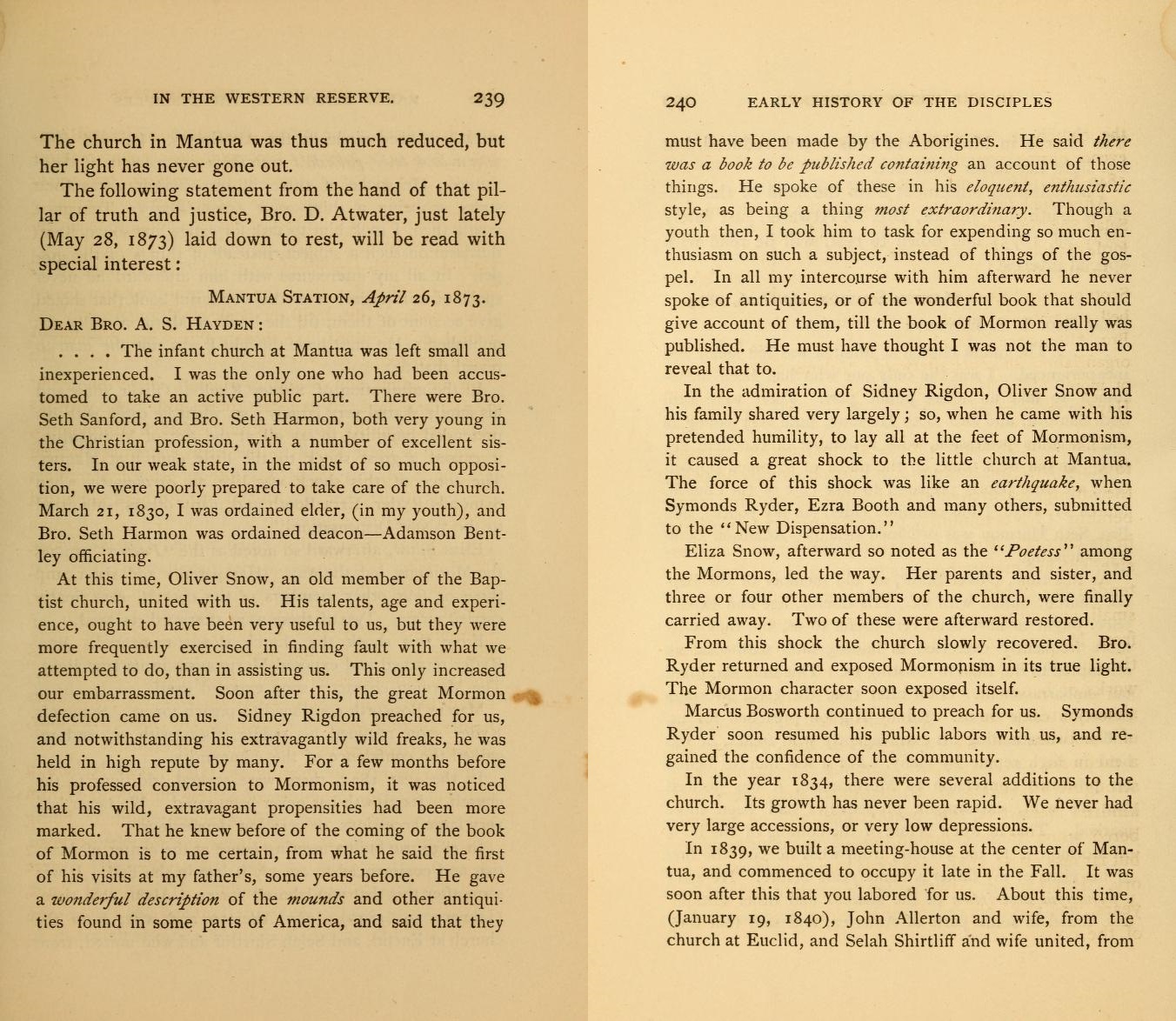
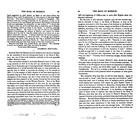
The conversation alluded to in brother Bentley's letter of 1841, was in my presence as well as in his, and my recollection of it led me some two or three years ago to interrogate brother Bentley touching his recollections of it, which accord with mine in every particular, except the year in which it occurred -- he placing it in the summer of 1827 -- I, in the summer of 1826 -- Rigdon at the time observing that in the plates dug up in New York there was an account not only of the Aborigines of this country but also it was stated that the Christian religion had been preached in this country during the first century just as we were preaching it on the Western Reserve. Now as the Book of Mormon was being manufactured at that time, for the copy-right was taken out in June, 1829, two years according to Elder Bentley, and three years according to me, after said conversation, (and certainly it was not less than two years,) the inference of brother Scott touching the person upon whom the theft was committed would be plausible, if it was a fact that baptism for remission of sins is no part of the Book, but something superadded since from the practice in Ohio in the end of 1827 and beginning of 1828, a year or more after Rigdon made the aforesaid statement. |
|
|
|
|
|
External Link
|
|
The Spalding Memorial, by Samuel Jones Spalding, 1872, pgs 160-162
|
|
|
|
|
Letter from Solomon Spaulding's Brother
|
|
Josiah Spalding
|
|
Jan 6, 1855
|
|
|
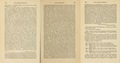
EASTFORD, Jan. 6 1855.
REV. SIR: -
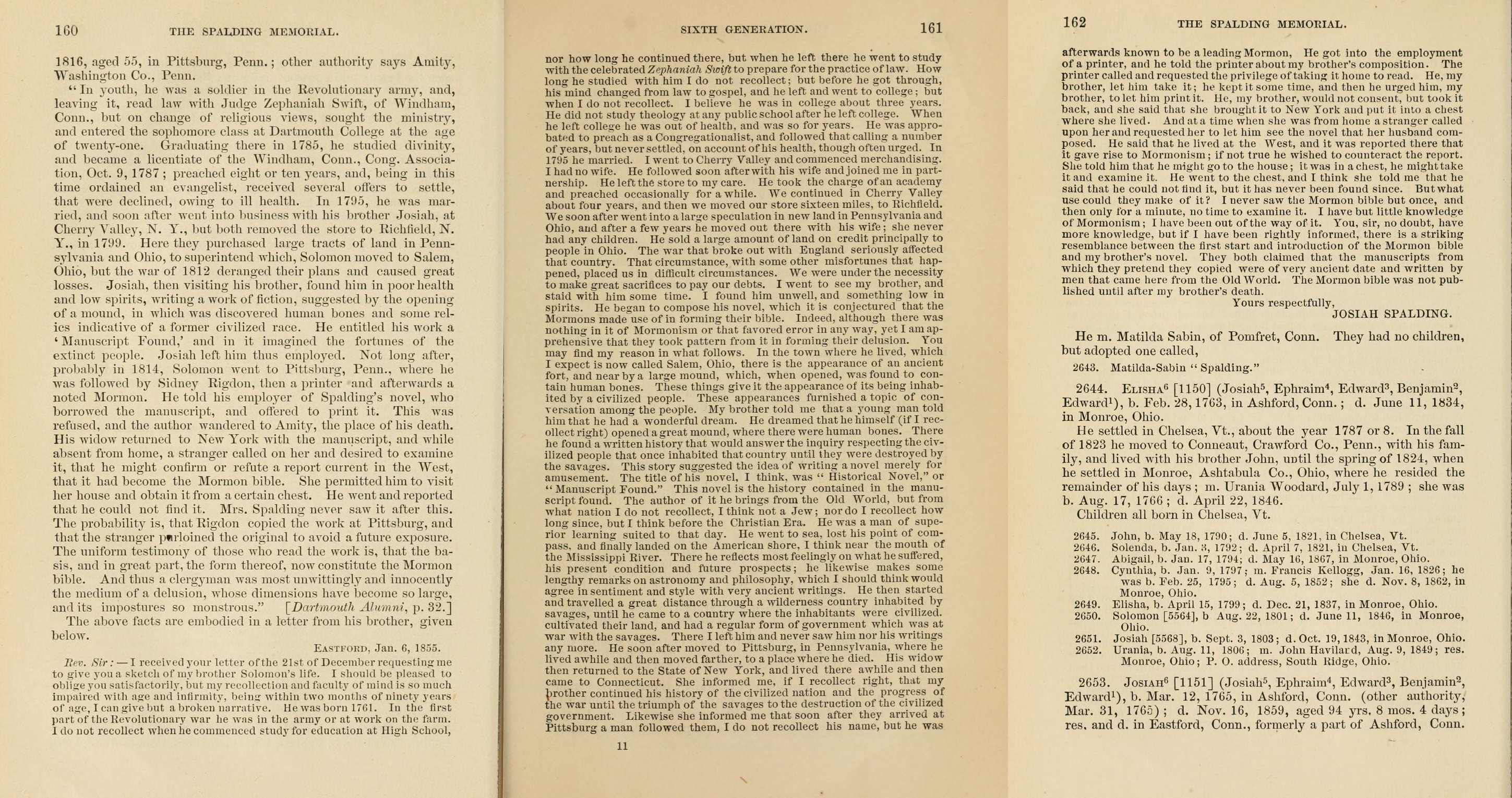
I received your letter of the 21st of December requesting me to give you a sketch of my brother Solomon's life. I should be pleased to oblige you satisfactorily, but my recollection and faculty of mind is so much impaired with age and infirmity, being within two months of ninety years of age, I can give but a broken narrative.
He was born 1761. In the first part of the Revolutionary war he was in the army or at work on the farm. I do not recollect when he commenced study for education at High School, nor how long he continued there; but when he left there he went to study with the celebrated Zephaniah Swift to prepare for the practice of law. How long he studied with him I do not recollect; but before he got through, his mind changed from law to gospel and he left and went to college; but when I do not recollect. I believe he was in college about three years. He did not study theology at any public school after he left college.
When he left college he was out of health, and was so for years. He was approbated to preach as a Congregationalist, and followed that calling a number of years, but never settled, on account of his health, though often urged. In 1795 he married. I went to Cherry Valley and commenced merchandising. I had no wife. He followed soon after with his wife and joined me in partnership. He left the store to my care. He took the charge of an academy and preached occasionally for a while. We continued in Cherry Valley about four years, and then we moved our store sixteen miles, to Richfield. We soon after went into a large speculation in new land in Pennsylvania and Ohio, and after a few years he moved out there with his wife; she never had any children. He sold a large amount of land on credit, principally to people in Ohio.
The war that broke out with England seriously affected that country. That circumstance, with some other misfortunes that happened, placed us in difficult circumstances. We were under the necessity to make great sacrifices to pay our debts. I went to see my brother and staid with him some time. I found him unwell, and somewhat low in spirits. He began to compose his novel, which it is conjectured that the Mormons made use of in forming their bible. Indeed, although there was nothing in it of Mormonism or that favored error in any way, yet I am apprehensive that they took pattern from it in forming their delusion. You may find my reason in what follows. In the town where he lived, which I expect is now called Salem, Ohio, there is the appearance of an ancient fort, and near by a large mound, which, when opened, was found to contain human bones. These things gave it the appearance of its being inhabited by a civilized people. These appearances furnished a topic of conversation among the people. My brother told me that a young man told him that he had a wonderful dream. He dreamed that he himself (if I recollect right) opened a great mound, where there were human bones. There he found a written history that would answer the inquiry respecting the civilized people that once inhabited that country until they were destroyed by the savages. This story suggested the idea of writing a novel merely for amusement. The title of his novel, I think, was "Historical Novel," or "Manuscript Found." This novel is the history contained in the manuscript found. The author of it he brings from the Old World, but from what nation I do not recollect; I think not a Jew; nor do I recollect how long since, but I think before the Christian Era. He was a man of superior learning suited to that day. He went to sea, lost his point of compass, and finally landed on the American shore; I think near the mouth of the Mississippi River. There he reflects most feelingly on what he suffered, his present condition and future prospects; he likewise makes some lengthy remarks on astronomy and philosophy, which I should think would agree in sentiment and style with very ancient writings. He then started and traveled a great distance through a wilderness country inhabited by savages, until he came to a country where the inhabitants were civilized, cultivated their land, and had a regular form of government, which was at war with the savages. There I left him and never saw him nor his writings any more.
He soon after moved to Pittsburg, in Pennsylvania, where he lived awhile and then moved farther, to a place where he died. His widow then returned to the State of New York, and lived there awhile and then came to Connecticut. She informed me, if I recollect right, that my brother continued his history of the civilized nation and the progress of the war until the triumph of the savages to the destruction of the civilized government. Likewise she informed me that soon after they arrived at Pittsburg a man followed them, I do not recollect his name, but he was afterwards known to be a leading Mormon. He got into the employment of a printer, and he told the printer about my brother's composition. The printer called and requested the privilege of taking it home to read. He, my brother, let him take it; he kept it some time, and then he urged him, my brother, to let him print it. He, my brother, would not consent, but took it back, and she said that she brought it to New York and put it into a chest where she lived. And at a time when she was from home a stranger called upon her and requested her to let him see the novel that her husband composed. He said that he lived at the West, and it was reported there that it gave rise to Mormonism; if not true he wished to counteract the report. She told him that he might go to the house; it was in a chest, he might take it and examine it.
He went to the chest, and I think she told me that he said that he could not find it, but it has never been found since, But what use could they make of it? I never saw the Mormon bible but once, and then only for a minute, no time to examine it. I have but little knowledge of Mormonism; I have been out of the way of it. You, sir, no doubt, have more knowledge; but if I have been rightly informed, there is a striking resemblance between the first start and introduction of the Mormon bible and my brother's novel. They both claimed that the manuscripts from which they pretend they copied were of very ancient date and written by men that came here from the old world. The Mormon bible was not published until after my brother's death.
Yours respectfully,
JOSIAH SPALDING. |
|
|
|
|
|
External Link
|
|
"Life story of Sidney Rigdon", by his son, John W. Rigdon, pg 193
|
|
|
|
|
Sidney Rigdon Statement to his son about the Book of Mormon.
|
|
John W. Rigdon
|
|
1867
|
|
|
|
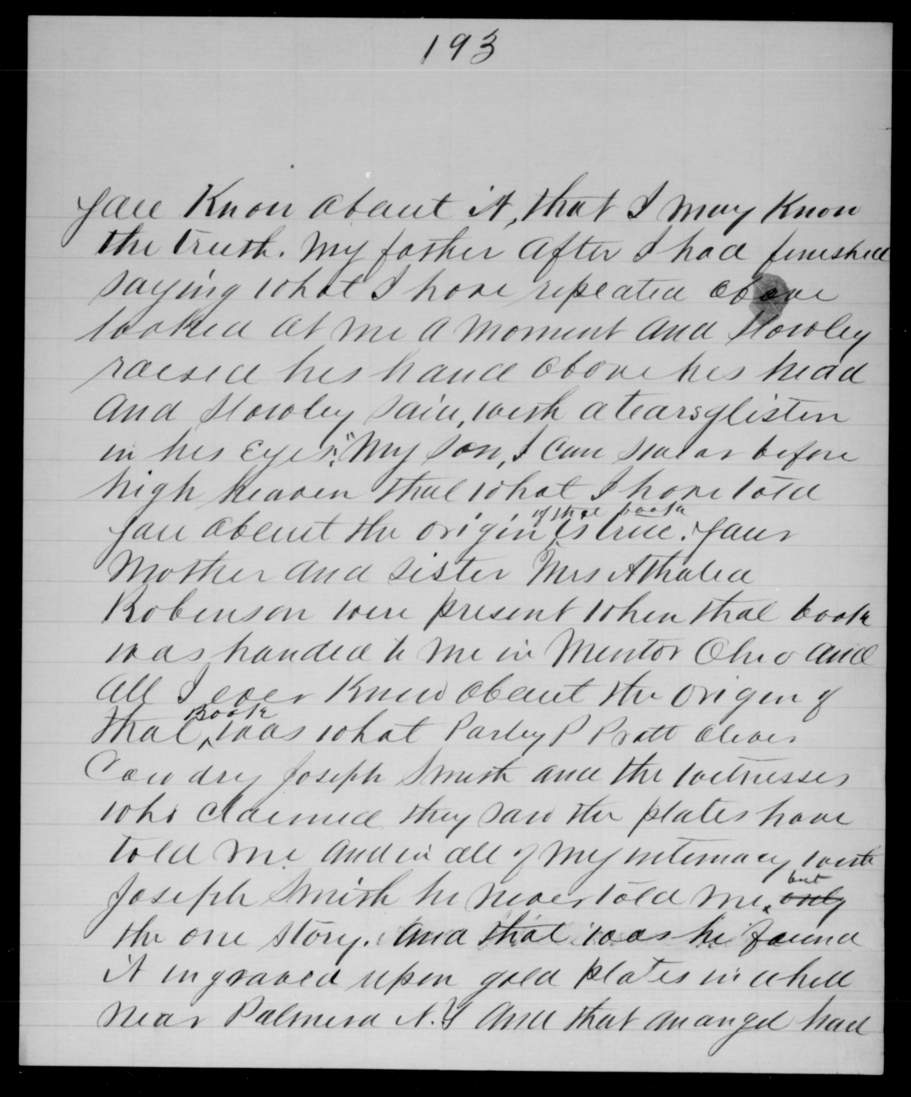
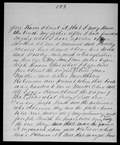
My father, after I had finished saying what I have repeated above, looked at me a moment, raised his hand above his head and slowly said, with tears glistening in his eyes: "My son, I can swear before high heaven that what I have told you about the origin of that book is true. Your mother and sister, Mrs. Athalia Robinson, were present when that book was handed to me in Mentor, Ohio, and all I ever knew about the origin of that book was what Parley P. Pratt, Oliver Cowdery, Joseph Smith and the witnesses who claimed they saw the plates have told me, and in all of my intimacy with Joseph Smith he never told me but one story. |
|
|
|
|
|
External Link
|
|
Origin, rise, and progress of Mormonism, Pomeroy Tucker, 1867, pgs 28, 75, 81-82, 120-126
|
|
|
|
|
Pomeroy Tucker Account
|
|
Pomeroy Tucker
|
|
1867
|
|
|
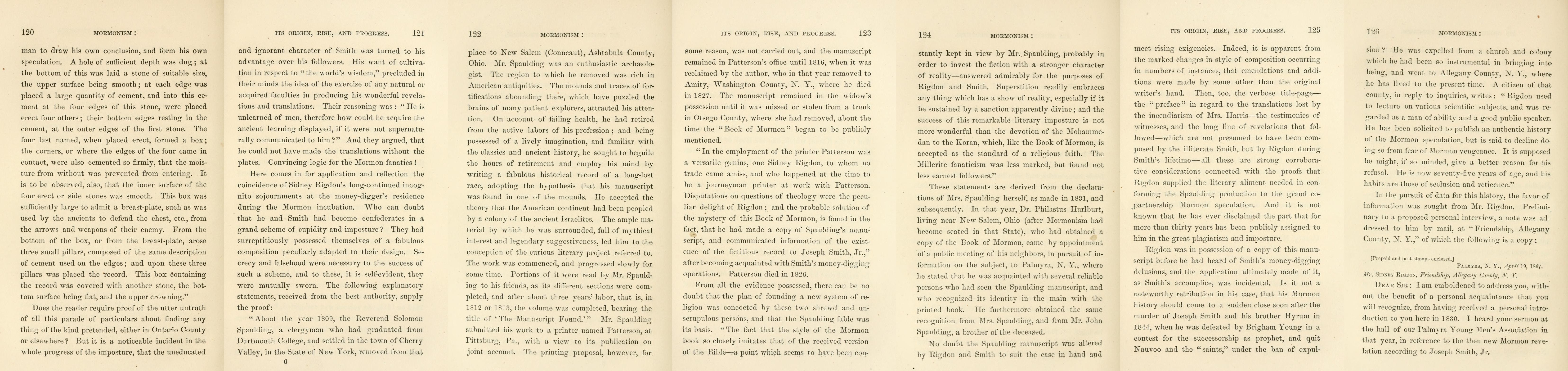
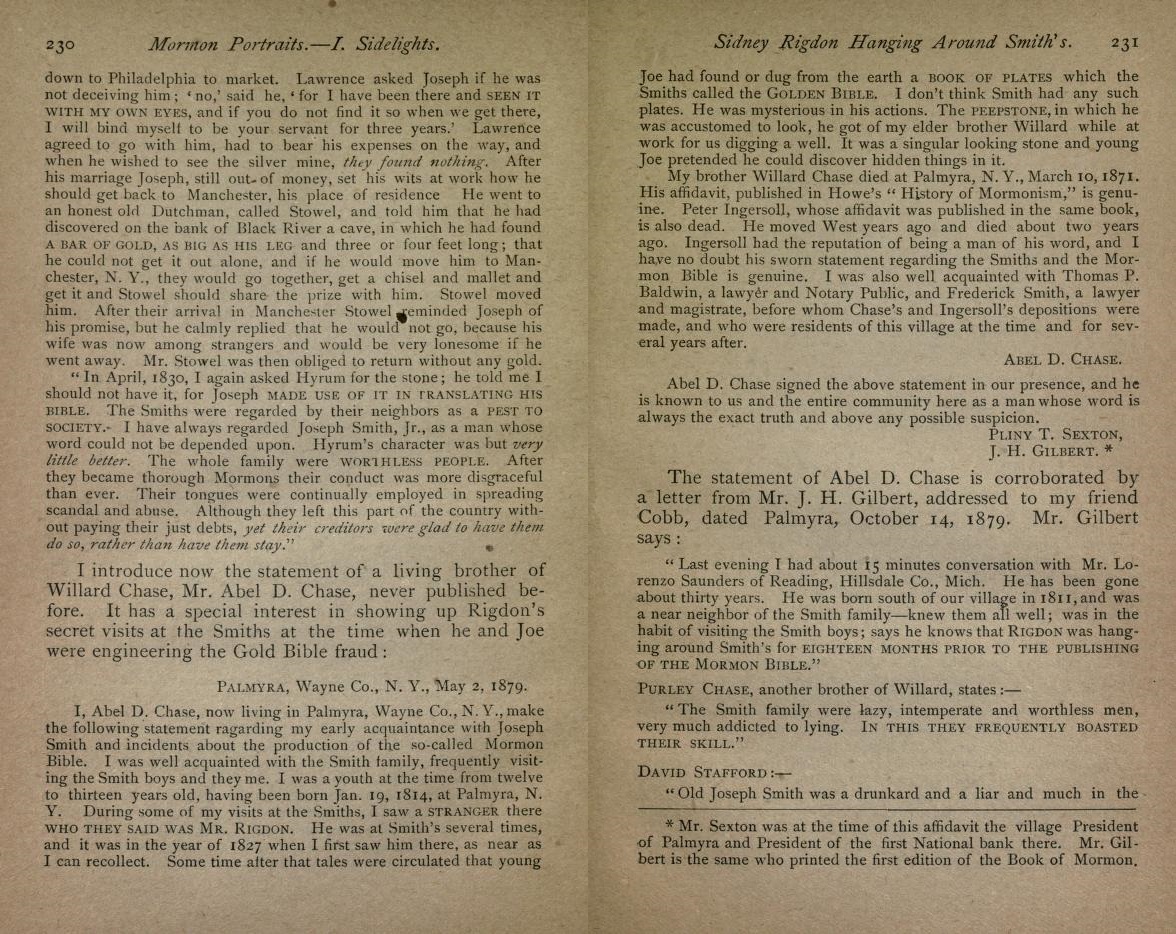
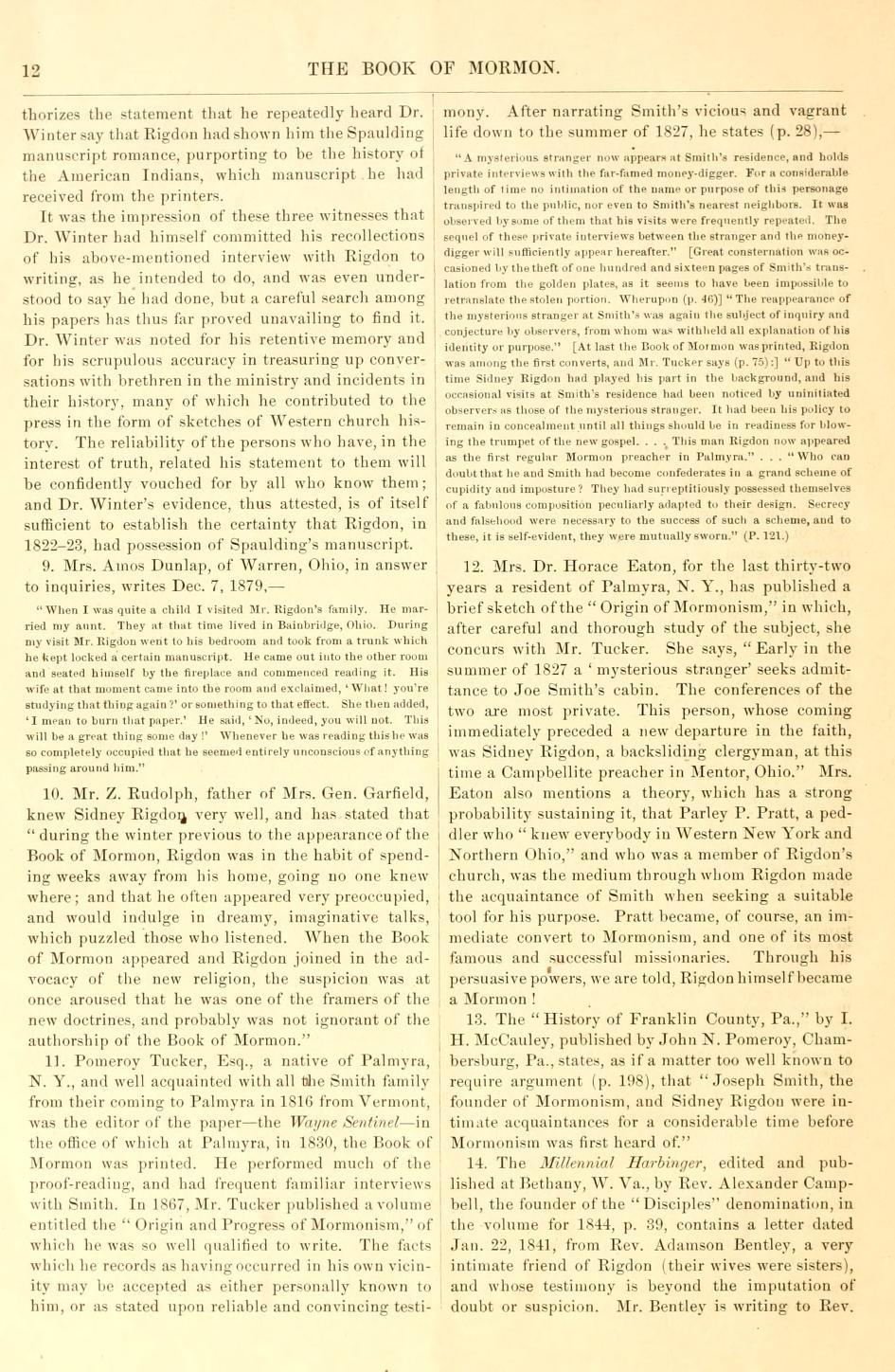
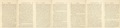
This review comes down to the summer of 1827. A mysterious stranger now appears at Smith's residence, and holds private interviews with the far-famed money-digger. For a considerable length of time no intimation of the name or purpose of this personage transpired to the public, not even to Smith's nearest neighbors. It was observed by some of them that his visits were frequently repeated. The sequel of these private interviews between the stranger and the money-digger will sufficiently appear hereafter....
...Up to this time Sidney Rigdon had played his part in the background and his occasional visits at Smith's residence had been noticed by uninitiated observers as those of the mysterious stranger. It had been his policy to remain in concealment until all things should be in readiness for blowing the trumpet of the new gospel... This man Rigdon now appeared as the first regular Mormon preacher in Palmyra. Martin Harris was his forerunner, and relieved him of his incognito position...
...Rigdon had been an occasional sojourner at Smith's for a year or more, though the reader may fail to perceive what this circumstance had to do with the case...
...it is a noticeable incident in the whole progress of the imposture, that the uneducated and ignorant character of Smith was turned to his advantage over his followers. His want of cultivation in respect to "the world's wisdom," precluded in their minds the idea of the exercise of any natural or acquired faculties in producing his wonderful revelations and translations. Their reasoning was: "He is unlearned of men, therefore how could he acquire the ancient learning displayed, if it were not supernaturally communicated to him? And they argued, that he could not have made the translations without the plates. Convincing logic for Mormon fanatics!
Here comes in for application and reflection the coincidence of Sidney Rigdon's long-continued incognito sojournments at the money-digger's residence during the Mormon incubation. Who can doubt that he and Smith had become confederates in a grand scheme of cupidity and imposture? They had surreptitiously possessed themselves of a fabulous composition peculiarly adapted to their design. Secrecy and falsehood were necessary to the success of such a scheme, and to these, it is self-evident, they were mutually sworn. The following explanatory statements, received from the best authority, supply the proof:
"About the year 1809, the Reverend Solomon Spaulding, a clergyman who had graduated from Dartmouth College, and settled in the town of Cherry Valley, in the State of New York, removed from that place to New Salem (Conneaut), Ashtabula County, Ohio. Mr. Spaulding was an enthusiastic archaeologist. The region to which he removed was rich in American antiquities. The mounds and traces of fortifications abounding there, which have puzzled the brains of many patient explorers, attracted his attention. On account of failing health, he had retired from the active labors of his profession; and being possessed of a lively imagination, and familiar with the classics and ancient history, he sought to beguile the hours of retirement and employ his mind by writing a fabulous historical record of a long-lost race, adopting the hypothesis that his manuscript was found in one of the mounds. He accepted the theory that the American continent had been peopled by a colony of the ancient Israelites. The ample material by which he was surrounded, full of mythical interest and legendary suggestiveness, led him to the conception of the curious literary project referred to. the work was commenced, and progressed slowly for some time. Portions of it were read by Mr. Spaulding to his friends, as its different sections were completed, and after about three years' labor, that is, in 1812 or 1813, the volume was completed, bearing the title of 'The Manuscript Found.'"
Mr. Spaulding submitted his work to a printer named Patterson, at Pittsburgh, Pa., with a view to its publication on joint account. The printing proposal, however, for some reason, was not carried out, and the manuscript remained in Patterson's office until 1816, when it was reclaimed by the author, who in that year removed to Amity, Washington County, N. Y., where he died in 1827. The manuscript remained in the widow's possession until it was missed or stolen from a trunk in Otsego County, where she had removed, about the time the "Book of Mormon" began to be publicly mentioned.
"In the employment of the printer Patterson was a versatile genius, one Sidney Rigdon, to whom no trade came amiss, and who happened at the time to be a journeyman printer at work with Patterson. Disputations on questions of theology were the peculiar delight of Rigdon; and the probable solution of the mystery of this Book of Mormon, is found in the fact, that he had made a copy of Spaulding's manuscript, and communicated information of the existence of the fictitious record to Joseph Smith, Jr.," after becoming acquainted with Smith's money-digging operations. Patterson died in 1826.
From all the evidence possessed, there can be no doubt that the plan of founding a new system of religion was concocted by these two shrewd and unscrupulous persons, and that the Spaulding fable was its basis. "The fact that the style of the Mormon book so closely imitates that of the received version of the Bible -- a point which seems to have been constantly kept in view by Mr. Spaulding, probably in order to invest the fiction with a stronger character of reality -- answered admirably for the purposes of Rigdon and Smith. Superstition readily embraces any thing which has a show of reality, especially if it be sustained by a sanction apparently divine; and the success of this remarkable literary imposture is not more wonderful than the devotion of the Mohammedan to the Koran, which, like the Book of Mormon, is accepted as the standard of a religious faith. The Millerite fanaticism was less marked, but found not less earnest followers."
These statements are derived from the declaration of Mrs. Spaulding herself, as made in 1831, and subsequently. In that year, Dr. Philastus Hurlburt, living near New Salem, Ohio (after Mormonism had become seated in that State), who had obtained a copy of the Book of Mormon, came by appointment of a public meeting of his neighbors, in pursuit of information on the subject, to Palmyra, N. Y., where he stated that he was acquainted with several reliable persons who had seen the Spaulding manuscript, and who recognized its identity in the main with the printed book. He furthermore obtained the same recognition from Mrs. Spaulding, and from Mr. John Spaulding, a brother of the deceased.
No doubt the Spaulding manuscript was altered by Rigdon and Smith to suit the case in hand and meet rising exigencies. Instead, it is apparent from the marked changes in style of composition occurring in numbers of instances, that emendations and additions were made by some other than the original writer's hand. Then too, the verbose title-page -- the incendiarism of Mrs. Harris -- the testimonies of witnesses, and the long line of revelations that followed -- which are not presumed to have been composed by the illiterate Smith, but by Rigdon during Smith's lifetime -- all these are strong corroborative considerations connected with the proofs that Rigdon supplied the literary aliment needed in conforming the Spaulding production to the grand co-partnership Mormon speculation. And it is not known that he has ever disclaimed the part that for more than thirty years has been publicly assigned to him in the great plagiarism and imposture.
Rigdon was in possession of a copy of this manuscript before he had heard of Smith's money-digging delusions, and the application ultimately made of it, as Smith's accomplice, was incidental. It is not a noteworthy retribution in his case, that his Mormon history should come to a sudden close after the murder of Joseph Smith and his brother Hyrum in 1844, when he was defeated by Brigham Young in a contest for the successorship as prophet, and quit Nauvoo and the "saints," under the ban of expulsion? He was expelled from a church and colony which he had been so instrumental in bringing into being, and went to Allegany County, N. Y., where he has lived to the present time. A citizen of that county, in reply to inquiries writes: "Rigdon used to lecture on various scientific subjects, and was regarded as a man of ability and a good public speaker. He has been solicited to publish an authentic history of the Mormon speculation, but is said to decline doing so from fear of Mormon vengeance. It is supposed he might, if so minded, give a better reason for his refusal. He is now seventy-five years of age, and his habits are those of seclusion and reticence." |
|
|
|
|
No Preview Available
|
|
External Link
|
|
The Washington Reporter, May 13, 1868, Vol 59, No 40
|
|
|
|
|
Jesse Hamilton Statement on location of Spaulding's Death
|
|
Rev. Jesse Wells Hamilton
|
|
May 6, 1868
|
|
|
Messrs. Editors: -- Appleton & Co., of New York, lately published a book on the "Rise and Progress of Mormonism." The author -- Mr. Tucker -- takes the same view with Elder Hyde who published a work on Mormonism some time ago. They both state that Solomon Spalding, a clergyman, of feeble health, wrote a book which was never published by him or his authority -- that after his death Joseph Smith, the Mormon prophet, by dishonest means, got hold of this manuscript and published it as the Mormon Bible. This is their theory and it is doubtless the correct one.
Elder Hyde says that Mr. Spalding came to Pittsburgh in 1812, and after two years he removed to Amity, Washington county, Pa., where he died in 1816. Mr. Tucker also says that he died in 1816, but that his death took place at Amity, Washington county, New York. Now this may be an error of the types, and if so the publisher should correct it. If it be not an error of the types, I would call attention to the fact that Elder Hyde is right and Mr. Tucker wrong in this particular.
Now for the facts. That Mr. Spalding died at Amity, Washington county, Pa., is beyond dispute. He was buried in the Presbyterian grave yard in that place. His grave is frequently pointed out to strangers who visit the village. It was marked by a head and foot stone of a somewhat sandy texture which crumbles when exposed for a long time. The head stone has fallen but the foot stone is yet standing, and on it are marked the initials of Mr. Spalding's name. Some of the older people in the neighborhood remember to have seen Mr. Spalding. It is said he was fond of reading select passages of his romance to any who would listen.
I write for the integrity of history. If Mr. Spalding lived and died in Amity, Pennsylvania, let it be known. If he wrote a romance for pastime, which became the basis of the Mormon heresy, it should be known. There is nothing more certain than that Solomon Spalding, a clergyman, a fine scholar, a man of bankrupt fortune, of feeble health, and of an imaginative turn of mind, who wrote a romance in Bible style, did live and die in Amity, Washington county, Pa. |
|
|
|
(Note:
The referenced work by an Elder Hyde was John Hyde's Mormonism,
Its Leaders and Designs published in 1857. Pomeroy Tucker acknowledged the error in this subsequent edition of the paper.)
|
|
|
|
|
No Preview Available
|
|
External Link
|
|
The Washington Reporter, May 20, 1868, Vol 59, No 41
|
|
|
|
|
Joseph Miller First Statement
|
|
Joseph Miller, Sr.
|
|
May 18, 1868
|
|
|
Messrs. Editors: -- Having noticed in your paper of the 13th inst., a communication in reference to Solomon Spaulding, I thought it might be interesting to your readers to hear something more in respect to the death of a man who has unintentionally deceived many persons.
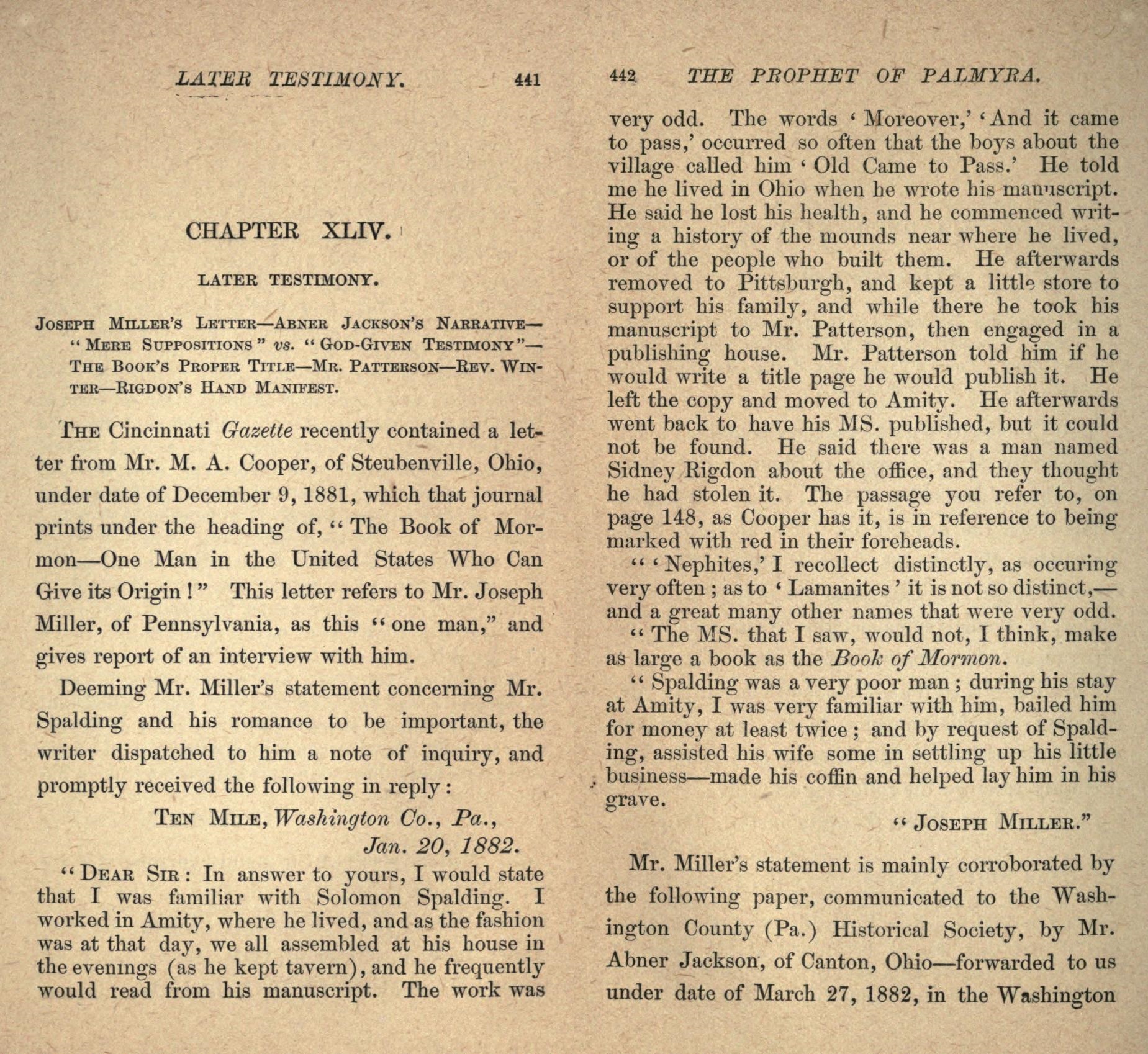
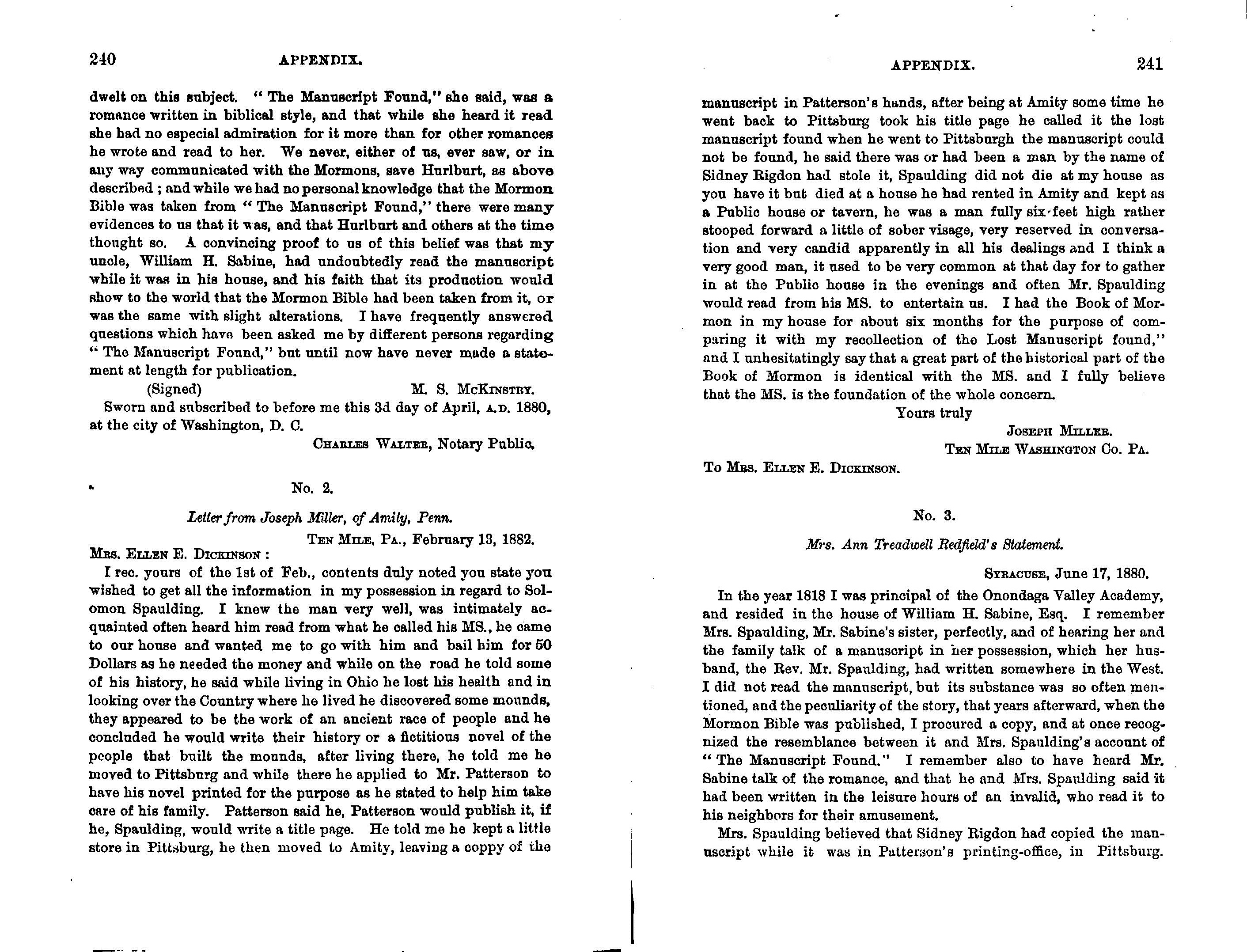
I was well acquainted with Solomon Spaulding. He came to Amity, I think, in the summer of 1815. He lived in the house now occupied by Obadiah Clutter, and kept a public house. He told me that he had formerly lived at or near New Lisbon, Ohio; that while there he had lost his health and had written what he called his "manuscript." It was in the style of a novel, well written, and I and others would frequently set and listen to his reading of it. His manuscript was written on loose sheets of paper with a pen.
I nursed him in his last sickness, made his coffin, and Thomas Vennum and myself bailed his wife Matilda in the administration of his estate, as will appear by the records of the Orphans' Court for the winter of 1817. |
|
|
|
|
No Preview Available
|
|
External Link
|
|
The Washington Reporter, April 7, 1869, Vol 60, No 25
|
|
|
|
|
Joseph Miller Second Statement
|
|
Joseph Miller, Sr.
|
|
Mar 26, 1869
|
|
|
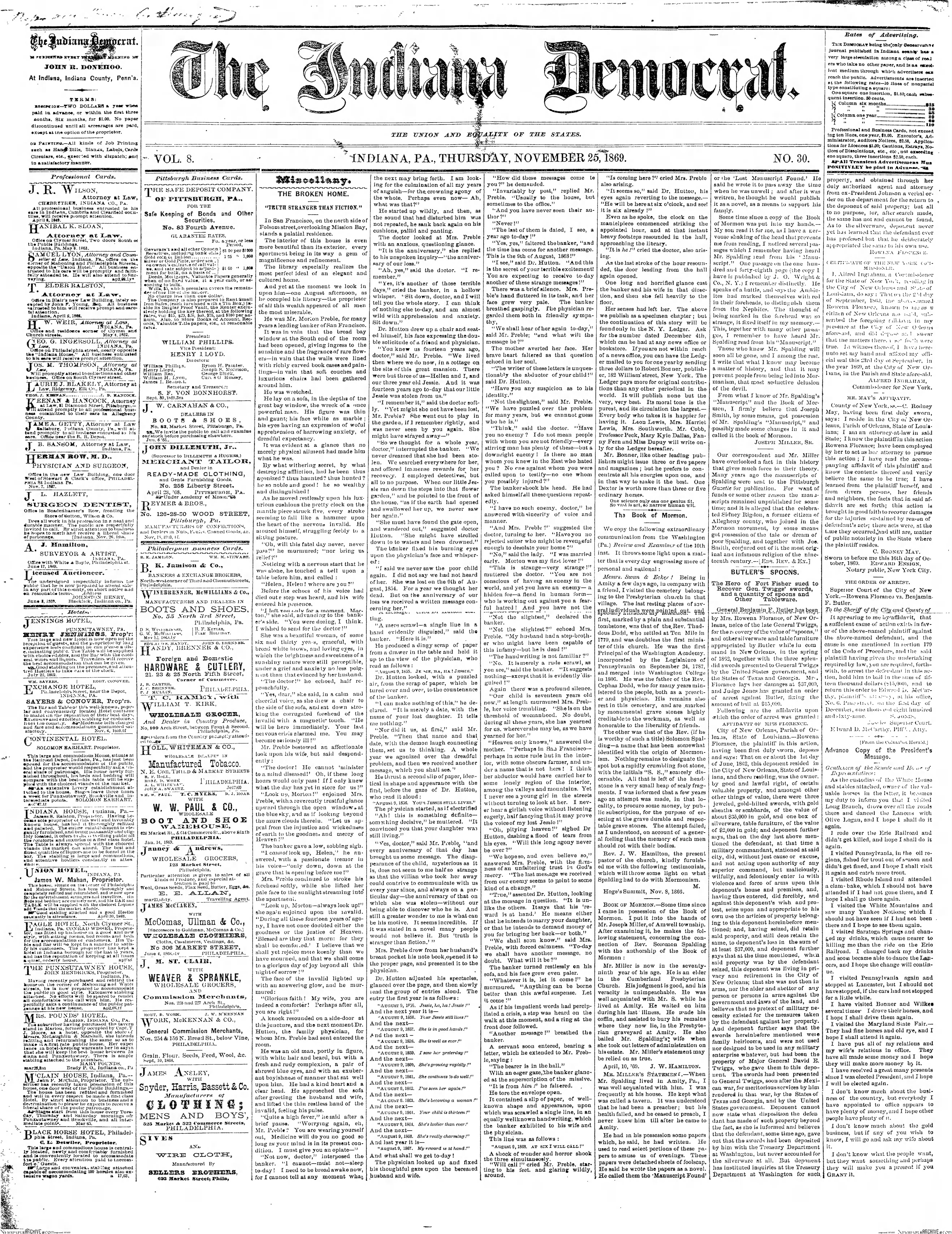
When Mr. Spalding lived in Amity, Pa., I was well acquainted with him. I was frequently at his house. He kept what was called a tavern. It was understood that he had been a preacher, but his health failed him and he ceased to preach. I never knew him to preach after he came to Amity.
He had in his possession some papers which he said he had written. He used to read select portions of these papers to amuse us of evenings.
These papers were detached sheets of foolscap. He said he wrote the papers as a novel. He called it the "Manuscript Found," or "the Lost Manuscript Found." He said he wrote it to pass away the time when he was unwell; and after it was written he thought he would publish it as a novel, as a means to support his family.
Some time since, a copy of the Book of Mormon came into my hands. My son read it for me, as I have a nervous shaking of the head that prevents me from reading. I noticed several passages which I recollect having heard Mr. Spalding read from his "Manuscript." One passage, on page 148 (the copy I have is published by J. O. Wright & Co., New York) I remember distinctly. He speaks of a battle, and says the Amalekites had marked themselves with red on their foreheads to distinguish them from the Nephites. The thought of being marked on the forehead with red, was so strange, it fixed itself in my memory. This together with other passages, I remember to have heard Mr. Spalding read from his "Manuscript."
Those who knew Mr. Spalding will soon all be gone and I among the rest. I write that what I know may become a matter of history; and that it may prevent people from being led into Mormonism, that most seductive delusion of the devil.
From what I know of Mr. Spalding's "Manuscript" and the Book of Mormon, I firmly believe that Joseph Smith, by some means, got possession of Mr. Spalding's "Manuscript," and possibly made some changes in it and called it the "Book of Mormon." |
|
|
|
|
No Preview Available
|
|
External Link
|
|
The Washington Reporter, April 21, 1869, Vol 60, No 27
|
|
|
|
|
Redick McKee Statement
|
|
Redick McKee
|
|
Apr 14, 1869
|
|
|
Messrs. Editors: -- Here on business with the Government, I have accidentally found, in the Wheeling Intelligence of the 8th inst., an article copied from your paper, under the caption, "Who wrote the book of Mormon?" The statement of Joseph Miller, Sr., enclosed in the communication of your correspondent, J. W. Hamilton, carries me back in memory, to scenes and occurrences of my youth, at the pleasant old village of Amity, in your county, and are corroborative in some measure, of their conjecture as to the real author of that curious production, the "Mormon Bible."
With a view to throw some additional light upon a subject, which in the future, if not at present, may possess historical importance, I have concluded to employ a leisure hour in giving you some of my recollections, touching the "Lost history found," and its author.
In the fall of 1814 I arrived in the village of "good will," and for 18 or 20 months, sold goods in the store previously occupied by Mr. Thomas Brice. It was on the Main street, a few rods West of Spalding's tavern, where I was a boarder.
With both Mr. Solomon Spalding and his wife, I was quite intimately acquainted. He was regarded as an amiable, inoffensive, intelligent old gentleman, of some sixty winters; and as having been formerly a teacher or professor in some eastern Academy or College, but I was not aware of his having been a preacher or called "Reverend." He was afflicted with a rupture, which made locomotion painful, and confined him much to his house. They possessed but little of this world's goods; and, as I understood, selected Amity as a residence, because it was a healthy and inexpensive place to live in.
I recollect quite well Mr. Spalding spending much time in writing on sheets of paper (torn out of an old book), what purported to be a veritable history of the nations or tribes who inhabited Canaan when, or before, that country was invaded by the Israelites, under Joshua. He described, with great particularity, their numbers, customs, modes of life; their wars, stratagems, victories, and defeats, &c. His style was flowing and grammatical, though gaunt and abrupt; very like the story of the "Maccabees" and other apocryphal books, in the old bibles. He called it "Lost History Found," -- "Lost Manuscript," or some such name; not disguising that it was wholly a work of the imagination, written to amuse himself, and without any immediate view to publication.
I read, or heard him read, many wonderful and amusing passages from different parts of his professed historical records; and was struck with the minuteness of his details and the apparent truthfulness and sincerity of the author. Defoe's veritable Robinson Crusoe, was not more reliable!
I have an indistinct recollection of the passage referred to by Mr. Miller, about the Amalekites making a cross with red paint on their foreheads, to distinguish them from their enemies in the confusion of battle; but the manuscript was full of equally ludicrous descriptions. After my removal to Wheeling, in 1818, I understood (from Dr. Cephas Dodd, perhaps), that Mr. Spalding had died, and his widow had returned to her friends in northern Ohio, or western New York. She would naturally take the manuscript with her. Now, it was in northern Ohio, probably in Lake or Ashtabula County, that the first Mormon prophet, or impostor, Jo. Smith, lived and published what he called the "Book of Mormon," or the "Mormon Bible." It is quite probable therefore, that, with some alterations, the "Book of Mormon" was in fact the "Lost Book," or "Lost History Found," of my old landlord, Solomon Spalding, of Amity, Washington county, Pennsylvania. |
|
|
|
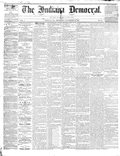
|
|
External Link
|
|
The Indiana Democrat, Indiana, PA, November 25, 1869, Vol 8, No 30, pg 1
|
|
|
|
|
Mention of Publication Attempt
|
|
The Indiana Democrat
|
|
Nov 25, 1869
|
|
|
|
Our correspondent and Mr. Miller have overlooked a fact in this history that gives much force to their theory. Many years ago the manuscripts of Spalding were sent to the Pittsburgh Gazette for publication. For want of funds or some other reason the manuscripts remained unpublished for some time; and it is alleged that the celebrated Sidney Rigdon, a former citizen of Allegheny county, who joined in the Mormon movement, by some means got possession of the tale or dream of poor Spalding, and together with Joe, Smith, conjured out of it the most original and infamous religion of the nineteenth century. -- (Eds. Rev. & Ex.) |
|
|
|
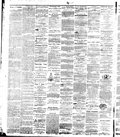
|
|
External Link
|
|
Bangor Daily Whig & Courier, January 23, 1872, Vol 39, No 20
|
|
|
|
|
Presbyterian Banner Statement
|
|
The Presbyterian Banner
|
|
Jan 17, 1872
|
|
|
|
The Presbyterian banner says: "A project is on foot to erect a monument over the grave of the Rev. Mr. Spaulding, in Amity churchyard, Washington County, Pennsylvania, who wrote for his own amusement, and that of his friends, the romance which afterwards became the 'Book of Mormon.' Mr. Spaulding placed the manuscript in the hands of the late Rev. Robert Patterson, father of one of the editors of this paper, who was then engaged in the publishing business, and while it was in this establishment, it was copied by Sidney Rigdon, then in his employ, by whom it was afterwards conveyed to Joseph Smith. |
|
|
|
(Note:
No images of the original article are available online. Our image and text come from the January 23, 1872 edition of the Bangor Daily Whig & Courier.)
|
|
|
|
|
|
External Link
|
|
Early History of the Disciples, by Amos S. Hayden, 1875, pgs 239-240
|
|
|
|
|
Darwin Atwater Letter
|
|
Darwin Atwater
|
|
Apr 26, 1873
|
|
|
...March 21, 1830, I was ordained elder, (in my youth), and Bro. Seth Harmon was ordained deacon - Adamson Bentley officiating.
At this time, Oliver Snow, an old member of the Baptist church, united with us. His talents, age and experience, ought to have been very useful to us, but they were more frequently exercised in finding fault with what we attempted to do, than in assisting us. This only increased our embarrassment. Soon after this, the great Mormon defection came on us. Sidney Rigdon preached for us, and notwithstanding his extravagantly wild freaks, he was held in high repute by many. For a few months before his professed conversion to Mormonism, it was noticed that his wild, extravagant propensities had been more marked. That he knew before of the coming of the book of Mormon is to me certain, from what he said the first of his visits at my father's, some years before. He gave a wonderful description of the mounds and other antiquities found in some parts of America, and said that they must have been made by the Aborigines. He said there was a book to be published containing an account of those things. He spoke of these in his eloquent, enthusiastic style, as being a thing most extraordinary. Though a youth then, I took him to task for expending so much enthusiasm on such a subject, instead of things of the gospel. In all my intercourse with him afterward he never spoke of antiquities, or of the wonderful book that should give account of them, till the book of Mormon really was published. He must have thought I was not the man to reveal that to. |
|
|
|
|
|
External Link
|
|
The Saints' Herald, 15 Oct, 1876, Vol 23, No 20, pg 628
|
|
|
|
|
William Small Recollection of 1841 meeting with Robert Patterson
|
|
William Small
|
|
Sep 13, 1876
|
|
|
While I was living in Pittsburgh in 1841, at the time so much was said of the Book of Mormon, and in connection with the Solomon Spaulding Story. It was stated that the Spaulding manuscript was placed in Mr. Patterson's hands for publication, and that Sidney Rigdon was connected with him at the time. In connection with John E. Page I called upon General Patterson, the publisher, and asked him the following questions, and received his replies as given:
Q. -- Did Sidney Rigdon have any connection with your office at the time you had the Solomon Spaulding manuscript?
A. -- No.
Q. -- Did Sidney Rigdon obtain the Spaulding story at that office?
A. -- No.
He also stated to us that the Solomon Spaulding manuscript was brought to him by the widow of Solomon Spaulding to be published, and that she offered to give him half the profits for his pay, if he would publish it; but after it had laid there for some time, and after he had due time to consider it, he determined not to publish it. She then came and received the manuscript from his hands, and took it away. He also stated that Sidney Rigdon was not connected with the office for several years afterwards. Gen. Patterson also made affidavit to the above statement.
Your brother in Christ,
WILLIAM SMALL. |
|
|
|
|
No Preview Available
|
|
External Link
|
|
Pittsburgh Telegraph, July 18, 1876, Vol 4
|
|
|
|
|
Sidney Rigdon Obituary
|
|
Pittsburgh Telegraph
|
|
Jul 18, 1876
|
|
|
|
The early history of Mormonism is intimately blended with the history of this county and of Western Pennsylvania, the Book of Mormon -- the bible of the polygamists -- having been printed in this city, and two of the most noted founders of the "twin relic" having had "a local habitation and a name" in our midst. Solomon Spalding, the author of the Book of Mormon, lived in this city from 1812 to 1814, when he removed to Amity, Washington County, where he died and was buried. Sidney Rigdon, who died in Friendship, Alleghany County, N. Y., on Friday last, was born in St. Clair Township, this county, Feb. 19, 1793. The manuscript of the Book of Mormon was set up in a printing office in Pittsburg in 1812, with which young Rigdon was connected. Soon after getting possession of a copy of Spalding's manuscript he left the printing office and became a preacher of doctrines peculiar to himself and very similar to those afterward incorporated into the Book of Mormon. He gained a small number of converts to his views, when about 1829 he became associated with Joseph Smith. It is asserted that through Rigdon's agency Smith became possessed of a copy of Spalding's manuscript. Smith and Rigdon then set about to establish a Church having at first vague and confused ideas as to its nature and design, but with the Book of Mormon as their text and authority, they began to preach this new gospel; and Smith's family and a few of his associates, together with some of Rigdon's followers, were soon numerous enough to constitute the Mormon Church, as it was styled by the people around them, or the Latter Day Saints, as they presently began to call themselves. The Church was organized in Manchester, New York, in 1830. |
|
|
|
(Note:
This obituary, along with others similar to it, received wide recirculation in other newspapers at the time.)
|
|
|
|
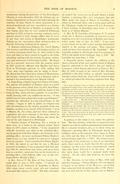
|
|
External Link
|
|
Who Wrote the Book of Mormon?, by Robert Patterson, 1882, pg 9
|
|
|
|
|
Robert P. Da Bois Letter
|
|
Robert P. Da Bois
|
|
Jan 9, 1879
|
|
|
|
Rev, Robert P. Du Bois, of New London, Pa., under date of Jan. 9; 1879, writes: "I entered the book-store of R. Patterson & Lambdin in March, 1818, when about twelve years old, and remained there until the summer of 1820, The firm had under its control. the book-store on Fourth Street, a book-bindary, a printing office (not newspaper, but job-office, under the name of Butler & Lambdin), entrance on Diamond Alley, and a steam paper-mill on the Allegheny (under the name of R. & J. Patterson). I knew nothing of Spaulding (then dead) or of his book, or of Sidney Rigdon." |
|
|
|
|
No Preview Available
|
|
External Link
|
|
The Daily Evening Reporter, February 5, 1879, Vol 3, No 781
|
|
|
|
|
Joseph Miller Third Statement
|
|
Joseph Miller, Sr.
|
|
Jan 30, 1879
|
|
|
I was well acquainted with Mr. Spaulding while he lived in Amity, Pa. I would say he was 55 to 60 years of age; in person, tall and spare, and considerably stooped, caused in part, I think, from a severe rupture. His hair was quite gray. He was chaste in language and dignified in manner, becoming his profession. I never heard him preach, think he never preached at A.; said he had quit preaching on account of ill health. He kept a public house or tavern of the character common at that day. He died of dysentery in 1816, (in the fall, I think), after an illness of six or eight weeks. Dr. Chephas Dodd attended him.
I watched with him many nights during this illness. After he died I made his coffin and superintended his burial. One night when near his end, he told me he thought he should die, and requested me to assist his wife in settling his estate; accordingly I, with Col. Thomas Venom went on her bond as administratrix, and I helped her close it up.
Mrs. Spaulding was intelligent and of pleasing manners, with fair complexion, and say, from 35 to 40 years of age.
A child of fair complexion and about 14 years of age, lived with them here, think she was their daughter as she bore the Spaulding name.
Mr. S. was poor but honest. I endorsed for him twice to borrow money. His house was a place of common resort especially in the evening. I was prosecuting my trade (carpenter) in the village and frequented his house. Mr. S. seemed to take delight in reading from his manuscript (written on foolscap) for the entertainment of his frequent visitors, heard him read most, if not all of it, and had frequent conversations with him about it.
Sometime ago, I had in my possession, for about six months, the book of Mormon and heard most of it read during the time. I was always forcibly struck with the similarity of the portions of it which purported to be of supernatural origin to the quaint style and peculiar language that had made so deep an impression on my mind when hearing the manuscript read by Mr. S. For instance, the very frequent repetition of the phrase, "and it came to pass." Then on hearing read the account from the book of the battle between the Amalekites and the Nephites, in which the soldiers of one army had placed a red mark on their foreheads to distinguish them from their enemies, it seemed to reproduce in my mind not only the narrative, but the very words as they had been impressed on my mind by the reading of Spaulding's manuscript.
The object of Mr. S. in writing the manuscript found as I understood, was to employ an invalid's lovely imagination, and to supply a romantic history of those last [sic - lost?] races or tribes, whose true history remains buried with their dust beneath those mysterious mounds, so common in a large portion of our country.
Its publication seemed to be an after thought, most likely suggested by pecuniary embarrassment. My recollection is that Mr. S. had left a transcript of the manuscript with Mr. Patterson, of Pittsburgh, Pa., for publication, that its publication was delayed until Mr. S. would write a preface, and in the mean time the transcript was spirited away and could not be found. Mr. S. told me that Sidney Rigdon had taken it, or that he was suspicioned for it. Recollect distinctly that Rigdon's name was used in that connection.
The longer I live the more firmly I am convinced that Spaulding's MS. was appropriated and largely used in getting up the Book of Mormon. I believe, that leaving out of the book the portion that may be easily recognised as the work of Joe Smith and his accomplices that Solomon Spaulding may be truly said to be its author. I have not a doubt of it.
If my life has been prolonged, that I might assist in exposing so base a fraud, and if I shall be permitted to see this abominable delusion dispelled, I shall console myself with the thought that I have not lived in vain. |
|
|
|
(Note:
This account, made "in substance," was relayed to the reported by Miller's "old life long friend" Dr. William W. Sharp after an interview they had together. No images appear to be available online. Please contact us if you have any information.)
|
|
|
|
|
No Preview Available
|
|
External Link
|
|
Pittsburgh Telegraph, Feb. 8, 1879, No 1799
|
|
|
|
|
Recollection of Early Sidney Rigdon Sermon
|
|
Anonymous Correspondent
|
|
Feb 7, 1879
|
|
|
It is not far from sixty years since these sermons were preached, and, to this day, I picture the man in my memory, as he stood in the pulpit pouring forth the strains of fervid eloquence to a house full to repletion, as if it were only yesterday.
One Sunday he preached three sermons from the following text (quoting from memory, I may not give the exact language of scripture) "And in the days of these kings shall the God of Heaven set up a kingdom that shall not be left to the hands of other people, but it shall break in pieces all other kingdoms and shall stand forever." No one ever tired under him, although he would preach more than an hour.
After he turned Mormon it was supposed that he had something of the kind in his mind when he preached from that text. Be this as it may, they were three excellent sermons. I would like to know how many of those living at this day heard him on these occasions? Oh how many thousands are now sleeping in our "silent cities of the dead" who were among the busy ones thronging our thoroughfares in the days of Sidney Rigdon! |
|
|
|
(Note:
Sidney Rigdon served in the church described above from 1822 and 1823.)
|
|
|
|
|
No Preview Available
|
|
External Link
|
|
Presbyterian Banner, Wednesday, February 12, 1879, Vol 65, No 24
|
|
|
|
|
John A. McKinstry Statement
|
|
Presbyterian Banner
|
|
Feb 12, 1879
|
|
|
To the testimony of which the above is a brief sketch, the following facts may be added as not devoid of interest in connection with the history of this colosal fraud:
Mr. McKinstry, a son of the late Dr. McKinstry of Monson, Mass., and the grandson of Rev. S. Spaulding, says that his grandmother came East from Ohio to live with her daughter at Monson many years ago, bringing the manuscript of his grandfather's romance with her. Before her death a plausible young man from Boston came to see and get the Spaulding writing. It was a time of considerable excitement concerning the Mormons, and he claimed to represent some Christian people who wanted to expose Mormonism. He therefore begged the loan of the manuscript for publication. Much against the wishes of Mrs. Dr. McKinstry, the daughter of Mrs. Spaulding (now Davidson) she consented to let her husband's unpublished romance be taken away. Nothing was ever heard of it again, and the family have always considered that the bland young gentleman was an agent of Brigham Young to destroy this convincing evidence that Joe Smith's Mormon Bible was of very earthly origin.
The widow of Mr. Spaulding and her daughter, Mrs. Dr. McKinstry, had compared the Mormon Bible with the romance of the "Manuscript Found," and stated that they were essentially the same -- that the similarity was so overwhelming as to leave no doubt on their minds but that Joe Smith or Sidney Rigdon had copied it in full and made out of it bodily, the divine revelation -- as a special revelation from God on plates of gold engraven by his own hand -- and that after being translated they were taken back to heaven.
The Springfield (Mass.) Republican gives its testimony in these words: The story of how the Rev. Mr, Spaulding came to prepare his romance, which Mr. McKinstry remembers as a child to have seen, is very interesting. Mr. Spaulding was out of the active ministry in Ohio, and employed his leisure moments in weaving a romance. It was at the time when the Mound Builders were creating wild excitement and interest -- the implements of cookery and war being unearthed showing the existence of a forgotten race. This furnished the inspiration for the chronicles of the story writen. He entitled the production the "Manuscript Found," the idea being that the romance written by Mr. Spaulding was dug up out of one of the mounds in the region. It was a history of Ancient America, not all written at once, but as leisure and fancy occurred to him, Mr. Spaulding would add to it. His writing was no secret in the neighborhood. In that then frontier region, with few opportunities for literary enjoyment. Rev. Mr. Spaulding was prevailed upon to read to his neighbors. It was written in Bible phraseology and made as quaintly old as possible, so as to carry out the idea of its alleged mound origin. |
|
|
|
|
|
External Link
|
|
Pittsburgh Commercial Gazette, Feb 17, 1879, Vol 93, No 176
|
|
|
|
|
Sidney Rigdon Tannery Claim
|
|
Y
|
|
Feb 15, 1879
|
|
|
To the Editors of the Commercial Gazette:
Your "Question of Authorship," relating to the origin of Mormonism, in today's issue, leads me to drop you this item. So far back as 1822 the firm of Patterson & Lambdin, (a shade of doubt about the last name of the firm) did business as Publishers, Bookbinders and Booksellers, at the southeast corner of the Diamond and Market street. At the same time Sidney Rigdon, tanner and currier, had his tan-yard and shop on Penn street, on the lot running from Penn avenue to Allegheny above Ninth street. The shop stood where the Drs. Dicksons' office now is. In 1841 the administrators of my father's estate found among the papers an unpaid note bearing Rigdon's signature. It was not long after 1822 that Rigdon was reported to have gone to Eastern Ohio.
After the Book of Mormon had appeared, it was remembered by many who read it, and by the members of Mr. Spaulding's family, that parts of it were a reproduction of a manuscript which had been sent to the Patterson firm. I think this firm went out of the publishing part of their business about that time. Putting these things together, it is likely that, in the business transactions between book-binder and tanner, Sidney Rigdon took the Spaulding manuscript to Ohio, and he became the real, whilst Joseph Smith was the ostensible originator of the Mormon fraud. Rigdon was for a time one of the "Twelve Apostles" of that system, but never gave his assent to its teachings on polygamy. He visited Pittsburgh between 1844 and 1850. As a singular coincidence, in 1841, one of the early residents of Pittsburgh told me that she was at a meeting in a Baptist church in Pittsburgh, and on that evening, Sidney Rigdon and Alexander Campbell both dissolved their connection with the Baptist denomination. The influence of both, as founders of schools of religious thought, has been widely extended, although of very different notions and tendencies.
Y.
PARNASSUS, PA., Feb 15, 1879. |
|
|
|
(Note:
A currier prepared leather for special use by treating the rawhide with certain chemicals, trimming it to a uniform thickness, and polishing its outer surface.)
|
|
|
|
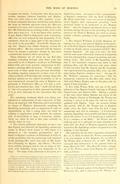
|
|
External Link
|
|
Who Wrote the Book of Mormon?, by Robert Patterson, 1882, pg 11
|
|
|
|
|
A. G. Kirk recollection of John Winter
|
|
A. G. Kirk
|
|
March 23, 1879
|
|
|
Rev. John Winter, M.D., was one of the early ministers of the Baptist Church, laboring in Western Pennsylvania, and Eastern Ohio. During a portion of the time when Sidney Rigdon was pastor of the First Baptist Church in Pittsburgh, Dr. Winter was teaching a school in the same city, and was well acquainted with Rigdon. Upon one occasion during this period, 1822-23, Dr. Winter was in Rigdon's study, when the latter took from his desk a large manuscript and said in substance, "A Presbyterian minister, Spaulding, whose health had failed, brought this to the printer to see if it would pay to publish it. It is a romance of the Bible." Dr. Winter did not read any part of it, and paid no more attention to it until after the Book of Mormon appeared, when he heard that Mr. Spaulding's widow recognized in it the writings of her husband.
The authority for the above statement is Rev. A. G. Kirk, to whom Dr. Winter communicated it in a conversation at New Brighten, Pa., in 1870-71. Dr. Winter died at Sharon, Pa., in 1878. Mr. Kirk conveyed this information to the present writer by letter, March 23, 1879. |
|
|
|
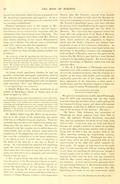
|
|
External Link
|
|
Who Wrote the Book of Mormon?, by Robert Patterson, 1882, pgs 6 & 10
|
|
|
|
|
Redick McKee 1879 Letter
|
|
Redick McKee
|
|
Apr 15, 1879
|
|
|
Mr. Spaulding told me that he had submitted the work to Mr. Patterson for publication, but for some reason it was not printed, and afterwards returned to him. I also understood he was then occasionally re-writing, correcting, and he thought improving some passages descriptive of his supposed battles. In this connection he spoke of the man Rigdon as an employee in the printing or book-binding establishment of Patterson & Lambdin, in Pittsburgh; but about him I made no special inquiries...
...There can be no doubt that the Book of Mormon was founded on and largely copied from the vigorous romance of Solomon Spaulding. |
|
|
|
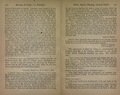
|
|
External Link
|
|
Joseph Smith the Prophet His Family and His Friends, pgs 230-231
|
|
|
|
|
Abel Chase Statement
|
|
Abel D. Chase
|
|
May 2, 1879
|
|
|
|
I, Abel D. Chase, now living in Palmyra, Wayne Co., N.Y., make the following statement regarding my early acquaintance with Joseph Smith and the incidents about the production of the so-called Mormon Bible. I was well acquainted with the Smith family, frequently visiting the Smith boys and they me. I was a youth at the time from twelve to thirteen years old, having been born Jan. 19, 1814, at Palmyra, N. Y. During some of my visits at the Smiths, I saw a STRANGER there WHO THEY SAID WAS MR. RIGDON. He was at Smith's several times, and it was in the year of 1827 when I first saw him there, as near as I can recollect. Some time after that tales were circulated that young Joe had found or dug from the earth a BOOK OF PLATES which the Smiths called the GOLDEN BIBLE. |
|
|
|
|
|
|
External Link
|
|
Who Wrote the Book of Mormon?, by Robert Patterson, 1882, pg 9
|
|
|
|
|
Isaac King Letter
|
|
Isaac King
|
|
Jun 14, 1879
|
|
|
|
Isaac King, a highly-respected citizen of Library, Pa., and an old neighbor of Rigdon, states in a letter to the present writer, dated June 14, 1879, that Sidney lived on the farm of his father until the death of the latter in May, 1810, and for a number of years afterwards, farming with very indifferent success; "it was said he was too lazy and proud to make a good farmer;" received his education in a log school-house in the vicinity; "began to talk in public on religion soon after his admission to the church, probably at his own instance, as there is no record of his licensure;" went to Sharon, Pa., for a time, and was there ordained as a preacher, but soon returned to his farm, which he sold (June 26, 1823) to James Means, and about the time of the sale removed to Pittsburgh. |
|
|
|
|
|
|
External Link
|
|
Who Wrote the Book of Mormon?, by Robert Patterson, 1882, pg 9
|
|
|
|
|
Samuel Cooper Letter
|
|
Samuel Cooper
|
|
Jun 14, 1879
|
|
|
|
Samuel Cooper, of Saltsburg, Pa., a veteran of three wars, in a letter to the present writer, dated June 14, 1879, stated as follows: "I was acquainted with Mr. Lambdin, was often in the printing-office; was acquainted with Silas Engles, the foreman of the printing-office; he never mentioned Sidney Rigdon's name to me, so I am satisfied he was never engaged there as a printer. I was introduced to Sidney Rigdon in 1843; he stated to me that he was a Mormon preacher or lecturer; I was acquainted with him during 1843-45; never knew him before, and never knew him as a printer; never saw him in the book-store or printing office; your father's office was in the celebrated Molly Murphy's Row." |
|
|
|
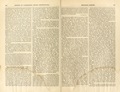
|
|
External Link
|
|
History of Washington County, Pennsylvania, Boyd Crumrine, 1882, pgs 436-7
|
|
|
|
|
Hurlbut Letter on "Mormonism Unvailed" Documents
|
|
Doctor Philastus Hurlbut
|
|
Aug 19, 1879
|
|
|
|
I visited Mrs. Matilda (Spaulding) Davison at Monson, Mass., in 1834, and never saw her afterward. I then received from her a manuscript of her husband's, which I did not read, but brought home with me, and immediately gave it to Mr. E. D. Howe, of Painesville, Ohio, who was then engaged in preparing his book -- "Mormonism Unvailed." I do not know whether or not the document I received from Mrs. Davison was Spaulding's "Manuscript Found," as I never read it entire, and it convinced me that it was not the Spaulding manuscript; but whatever it was, Mr. Howe received it under the condition on which I took it from Mrs. Davison -- to compare it with the "Book of Mormon," and then to return it to her. I never received any other manuscript of Spaulding's from Mrs. Davison, or any one else. Of that manuscript I made no other use than to give it, with all my other documents connected with Mormonism, to Mr. Howe. I did not destroy the manuscript nor dispose of it to Joe Smith, or to any other person. No promise was made by me to Mrs. Davison that she should receive any portion of the profits arising from the publication of the manuscript, if it should be published. All the affidavits procured by me for Mr. Howe's book, including all those from Palmyra, N. Y., were certainly genuine. |
|
|
|
(Note:
This letter was originally published in the Pittsburgh Leader in early 1880, but no images of that periodical are available online. Our source comes from an 1882 reproduction in Crumrine's 1882 History of Washington County, Pennsylvania.)
|
|
|
|
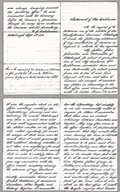
|
|
External Link
|
|
Spalding Studies Library, Special Collection, Communications to Robert Patterson, Jr., Rebecca Johnston Eichbaum (1792-1882) Statement of September 18, 1879
|
|
|
|
|
Rebecca J. Eichbaum Statement
|
|
Rebecca J. Eichbaum
|
|
Sep 18, 1879
|
|
|
Statement of Mrs. Eichbaum.
At the request of R. Patterson, one of the editors of the "Presbyterian Banner," Pittsburgh, I make the following statement of my recollections of persons in regard to whom he has inquired.
My father, John Johnston, was Postmaster of Pittsburgh for about 18 years, from 1804 to 1822. My husband, Wm. Eichbaum, succeeded him and was Postmaster for about 11 years, from 1822 to 1833. I was born August 25th 1792; and when I became old enough, I assisted my father in attending to the Post-office, and became familiar with its duties. From 1811 to 1816 I was the regular clerk in the office, assorting, making up, dispatching, opening and distributing the mails. Pittsburgh was then a small town and I was well acquainted with all the stated visitors at the office, who called regularly for mail. So meager at that time were the mails that I could generally tell without looking whether or not there was anything for such persons, though I would usually look in order to satisfy them. I was married in 1815, and the next year my connection with the office ceased, excepting during the absences of my husband.
I knew and distinctly remember Robert and Joseph Patterson, J. Harrison Lambdin, Silas Engles, and Sidney Rigdon. I remember Rev. Mr. Spaulding, but simply as one who occasionally called to inquire for letters. I remember that there was an evident intimacy between Lambdin and Rigdon. They very often came to the office together. I particularly remember that they would thus come during the hour on Sabbath afternoon when the office was required to be open, and I remember feeling sure that Rev. Mr. Patterson knew nothing of this or he would have put a stop to it. I do not know what position, if any, Rigdon filled in Patterson & Lambdin's store or printing-office, but am well assured he was frequently, if not constantly, there for a large part of the time when I was clerk in the Post-office. I recall Mr. Engles' saying that "Rigdon was always hanging around the printing-office." He was connected with the tannery before he became a preacher, though he may have continued the business whilst preaching.
R. J. Eichbaum
Pittsburgh Sept. 18th 1879.
This is the original of Mrs Eichbaums statement as after published. It was by Patterson given to James Cobb, Salt Lake City - A.T.S. |
|
|
|
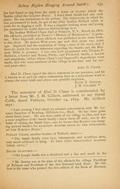
|
|
External Link
|
|
Joseph Smith the Prophet His Family and His Friends, 1886, pg 231
|
|
|
|
|
John H. Gilbert Letter to James Cobb
|
|
John H. Gilbert
|
|
Oct 14, 1879
|
|
|
|
Last evening, I had about 15 minutes conversation with Mr. Lorenzo Saunders of Reading, Hillsdale Co. Mich. He has been gone about thirty years. He was born south of our village in 1811, and was a near neighbor of the Smith family – knew them all well; was in the habit of visiting the Smith boys; says he knows that RIGDON was hanging around Smith's for EIGHTEEN MONTHS PRIOR TO THE PUBLISHING OF THE MORMON BIBLE. |
|
|
|
(Note:
With regard to this meeting, Gilbert said in a letter to Thomas Gregg dated June 19, 1881, "When I asked Mr. S. if he knew whether Rigdon was hanging around Smith previous to the publication of the M. B., he said, “Yes, at least eighteen months before.” There was no hesitancy about it." That letter was published in The True origin of the Book of Mormon, and can be read here.)
|
|
|
|
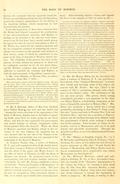
|
|
External Link
|
|
Who Wrote the Book of Mormon?, by Robert Patterson, 1882, pg 12
|
|
|
|
|
Letter from Mrs. Amos Dunlap
|
|
Mrs. Amos Dunlap
|
|
Dec 7, 1879
|
|
|
|
When I was quite a child I visited Mr. Rigdon's family. He married my aunt. They at that time lived in Bainbridge, Ohio. During my visit Mr. Rigdon went to his bedroom and took from a trunk which he kept locked a certain manuscript. He came out into the other room and seated himself by the fireplace and commenced reading it. His wife at that moment came into the room and exclaimed, 'What! you're studying that thing again?' or something to that effect. She then added, 'I mean to burn that paper.' He said, 'No, indeed, you will not. This will be a great thing some day!' Whenever he was reading this he was so completely occupied that he seemed entirely unconscious of anything passing around him. |
|
|
|
|
No Preview Available
|
|
External Link
|
|
Letter to E. E. Dickinson, Jan. 2. 1880, RLDS archives, P-13, f2286
|
|
|
|
|
Letter from Matilda Spaulding McKinstry to Ellen Dickinson
|
|
Matilda Spalding McKinstry
|
|
Jan 2, 1880
|
|
|
Dear Madam
Yours of the 6th inst received, and in reply I will say, 1st that the article in the paper to which you refer is correct, and it is true that my mother and myself did carefully compare the so called, "Book of Mormon," with the romance written by my father entitled "The Manuscript found," and were convinced that the "Book of Mormon was a copy of my father's work more or less disfigured from beginning to end by the founders of Mormonism, the better to adapt it to their purposes that of a pretended revelation. An incontestible proof of the origin of the "Book of Mormon" is manifest in the fact that the "Manuscript Found" was completed about 1813. The names persons tribes &c were peculiar to the author, being his invention in fact. It names of Mormon and his son Moroni figures conspicuously. About 1830 the Book of Mormon appeared and contained the identical names as fictitious history of "The Manuscript Found which could have been procured from no other source. Soon after this meeting were held by the Mormons at New Salem. Many attended out of curiosity among others my father's brother, who at once recognized the "Book of Mormon" as the writing of his brother 2nd I most emphatically deny that the Mormons have any statement from my mother or myself as they claim. If any purposing to be such exists it is a forgery. 3rd While my father resided at Pittsburg the "Manuscript" was borrowed by one "Patterson" who owned a large book establishment and printing office. "Sidney Rigdon" was at that time employed at this office and we have always believed that he copied it then and there. Personally I know nothing of the character of the founders of Mormonism, neither can I give you the address of any one from whom you could obtain the desired information.
Respectfully yours M. S. McKinstry
Monson, Mass. |
|
|
|
(Note:
McKinstry was the daughter of Solomon Spaulding. No images of this letter are available online. Please contact us if you have any information.)
|
|
|
|
|
|
External Link
|
|
Scribner's Monthly, August 1880, Vol 20, No 4, Pgs 615-16
|
|
|
|
|
Extended Account by Matilda Spaulding McKinstry
|
|
Matilda Spalding McKinstry
|
|
Apr 3, 1880
|
|
|
So much has been published that is erroneous concerning the "Manuscript Found," written by my father, the Rev. Solomon Spaulding, and its supposed connection with the book, called the Mormon Bible, I have willingly consented to make the following statement regarding it, repeating all that I remember personally of this manuscript, and all that is of importance which my mother related to me in connection with it, at the same time affirming that I am in tolerable health and vigor, and that my memory, in common with elderly people, is clearer in regard to the events of my earlier years, rather than those of my maturer life.
During the war of 1812, I was residing with my parents in a little town in Ohio called Conneaut. I was then in my sixth year. My father was in business there, and I remember his iron foundry and the men he had at work, but that he remained at home most of the time and was reading and writing a great deal. He frequently wrote little stories, which he read to me. There were some round mounds of earth near our house which greatly interested him, and he said a tree on the top of one of them was a thousand years old. He set some of his men to work digging into one of these mounds, and I vividly remember how excited he became when he heard that they had exhumed some human bones, portions of gigantic skeletons, and various relics. He talked with my mother of these discoveries in the mound, and was writing every day as the work progressed. Afterward he read the manuscript which I had seen him writing, to the neighbors and to a clergyman, a friend of his, who came to see him. Some of the names that he mentioned while reading to these people I have never forgotten. They are as fresh to me to-day as though I heard them yesterday. They were "Mormon," "Maroni," "Lamenite," "Nephi."
We removed from Conneaut to Pittsburgh while I was still very young, but every circumstance of this removal is distinct in my memory. In that city my father had an intimate friend named Patterson, and I frequently visited Mr. Patterson's library with him, and heard my father talk about books with him. In 1816 my father died at Amity, Pennsylvania, and directly after his death my mother and myself went to visit at the residence of my mother's brother William H. Sabine, at Onondaga Valley, Onondaga County, New York. Mr. Sabine was a lawyer of distinction and wealth, and greatly respected. We carried all our personal effects with us, and one of these was an old trunk, in which my mother had placed all my father's writings which had been preserved. I perfectly remember the appearance of this trunk, and of looking at its contents. There were sermons and other papers, and I saw a manuscript, about an inch thick, closely written, tied with some of the stories my father had written for me, one of which he called, "The Frogs of Wyndham." On the outside of this manuscript were written the words, "Manuscript Found." I did not read it, but looked through it and had it in my hands many times, and saw the names I had heard at Conneaut, when my father read it to his friends. I was about eleven years of age at this time.
After we had been at my uncle's for some time, my mother left me there and went to her father's house at Pomfret, Connecticut, but did not take her furniture nor the old trunk of manuscripts with her. In 1820 she married Mr. Davison, of Hartwicks, a village near Cooperstown, New York, and sent for the things she had left at Onondaga Valley, and I remember that the old trunk, with its contents, reached her in safety. In 1828, I was married to Dr. A. McKinstry of Monson, Hampden county, Massachusetts, and went there to reside. Very soon after my mother joined me there, and was with me most of the time until her death in 1844. We heard, not long after she came to live with me -- I do not remember just how long -- something of Mormonism, and the report that it had been taken from my father's "Manuscript Found;" and then came to us direct an account of the Mormon meeting at Conneaut, Ohio, and that, on one occasion, when the Mormon Bible was read there in public, my father's brother, John Spaulding, Mr. Lake and many other persons who were present, at once recognized its similarity to the "Manuscript Found," which they had heard read years before by my father in the same town. There was a great deal of talk and a great deal published at this time about Mormonism all over the country. I believe it was in 1834 that a man named Hurlburt came to my house at Monson to see my mother, who told us that he had been sent by a committee to procure the "Manuscript Found" written by the Reverend Solomon Spaulding, so as to compare it with the Mormon Bible. He presented a letter to my mother from my uncle, William H. Sabine, of Onondaga Valley, in which he requested her to loan this manuscript to Hurlburt, as he (my uncle) was desirous "to uproot" (as he expressed it) "this Mormon fraud." Hurlburt represented that he had been a convert to Mormonism, but had given it up, and through the "Manuscript Found," wished to expose its wickedness. My mother was careful to have me with her in all the conversations she had with Hurlburt, who spent a day at my house. She did not like his appearance and mistrusted his motives; but, having great respect for her brother's wishes and opinions, she reluctantly consented to his request. The old trunk, containing the desired "Manuscript Found," she had placed in the care of Mr. Jerome Clark of Hartwicks, when she came to Monson, intending to send for it. On the repeated promise of Hurlburt to return the manuscript to us, she gave him a letter to Mr. Clark to open the trunk and deliver it to him. We afterwards heard that he had received it from Mr. Clark, at Hartwicks, but from that time we have never had it in our possession, and I have no present knowledge of its existence, Hurlburt never returning it or answering letters requesting him to do so. Two years ago I heard he was still living in Ohio, and with my consent he was asked for the "Manuscript Found." He made no response although we have evidence that he received the letter containing the request. So far I have stated facts within my own knowledge. My mother mentioned many other circumstances to me in connection with this subject which are interesting, of my father's literary tastes, his fine education and peculiar temperament. She stated to me that she had heard the manuscript alluded to read by my father, was familiar with its contents, and she deeply regretted that her husband, as she believed, had innocently been the means of furnishing matter for a religious delusion. She said that my father loaned this "Manuscript Found" to Mr. Patterson, of Pittsburgh, and that when he returned it to my father, he said: "Polish it up, finish it, and you will make money out of it." My mother confirmed my remembrances of my father's fondness for history, and told me of his frequent conversations regarding a theory which he had of a prehistoric race which had inhabited this continent, etc., all showing that his mind dwelt on this subject. The "Manuscript Found," she said, was a romance written in Biblical style, and that while she heard it read she had no especial admiration for it more than for other romances he wrote and read to her. We never, either of us, ever saw, or in any way communicated with the Mormons, save Hurlburt, as above described, and while we had no personal knowledge that the Mormon Bible was taken from the "Manuscript Found," there were many evidences to us that it was, and that Hurlburt and others at the time thought so. A convincing proof to us of this belief was that my uncle, William H. Sabine, had undoubtedly read the manuscript while it was in his house, and his faith that its production would show to the world that the Mormon Bible had been taken from it, or was the same with slight alterations. I have frequently answered questions which have been asked me by different persons regarding the "Manuscript Found," but until now have never made a statement at length for publication. |
|
|
|
|
No Preview Available
|
|
External Link
|
|
Deseret Evening News, 28 Sep, 1881
|
|
|
|
|
Ann Treadwell Statement
|
|
Ann Treadwell Redfield
|
|
Jun 17, 1880
|
|
|
In the year 1818 I was principal of the Onondaga Valley Academy, and resided in the house of William H. Sabine, Esq. I remember Mrs. Spaulding, Mr. Sabine's sister perfectly, and hearing her and the family talk of a manuscript in her possession, which her husband, the Rev. Mr. Spaulding, had written somewhere in the West. I did not read the manuscript, but its substance was so often mentioned, and the peculiarity of the story, that years afterward, when the Mormon Bible was published, I procured a copy, and at once recognized the resemblance between it and Mrs. Spaulding's account of 'The Manuscript Found.' I remember also to have heard Mr. Sabine talk of the romance, and that he and Mrs. Spaulding said it had been written in the leisure hours of an invalid, who read it to his neighbors for their amusement.
Mrs. Spaulding believed that Sidney Rigdon had copied the manuscript while it was in Patterson's printing office, in Pittsburgh. She spoke of it with regret. I never saw her after her marriage to Mr. Davison of Hartwick.
Ann Treadwell Redfield. |
|
|
|
(Note:
No images of the original article are available online. Our source and link reference the 1885 publication "New light on Mormonism" by Ellen E. Dickinson, pgs 240-241. Please contact us if you have any further information.)
|
|
|
|
|
No Preview Available
|
|
External Link
|
|
Letter to James T. Cobb, Aug. 31. 1880, Wisconsin Schroeder Collection, Box 2, folder 1
|
|
|
|
|
Letter from Matilda Spaulding McKinstry to James Cobb
|
|
Matilda Spaulding McKinstry
|
|
Aug 31, 1880
|
|
|
Mr. Cobb. Sir.
I never before heard or understood that my father assumed to have found metal plate from which he translated "Manuscript Found" or that he was guided by a vision.
I have no recollection of ever seeing "Smith," or that he ever worked for my "Uncle Sabine," and if he had, he would have had no access to any portion of Mr. Sabine's house, as his kind help occupied a special dwelling.
I distinctly recollect visiting a library with my father which my mother told me was `Mr Patterson's;" the building was a large one, and over the door was a bust of what seemed to me at that time, as a beautiful lady, & impressed my childish fancy. I distinctly remember seeing in a chair in the center of the room, a large, heavy built man of florid complexion There was an other person in the room, and my father had a long conversation with him. Hurlbut may have received in addition to "Manuscript Found" some fragment. tied up with the bundle, which fragment he passed over to Mr. Howe, retaining the one of real importance for personal use.
Mr. Patterson, if you remember visited Mr Hurlbut armed with written authority from myself and children for the delivery of the document in question, and I feel that any communication from my self to "Mr H" would be of no avail. If he stole the papers, he would not criminate himself by owning it.
In conclusion, I would say, that all I know, or can recollect, in regard to the whole matter, is comprised in my sworn statement in the "Scribner Article," and that nothing further was authorized or suggested by me.
Respectfully Yours,
M. S. McKinstry |
|
|
|
(Note:
No images of this letter are available online. Please contact us if you have any information.)
|
|
|
|
|
No Preview Available
|
|
External Link
|
|
The Daily Evening Reporter, January 7, 1881, Vol 4, No 1383
|
|
|
|
|
Abner Jackson's Statement
|
|
Abner Jackson
|
|
Dec 20, 1880
|
|
|
It is a fact well established that the book called the Book of Mormon, had its origin from a romance that was written by Solomon Spaulding, in Conneaut, a small village in Ashtabula County, Ohio, about A. D. 1812. Spaulding was a highly educated man about six feet high, of rather slender build, with a dark complexion, black eyes, black hair, rather slow of speech, never trifling, pleasant in conversation, but seldom laughing aloud. His deportment was grave and dignified in society, and he was much respected by those of his acquaintance. He was a clergyman of the Presbyterian order, and for a time a settled pastor in the city of New York. So said his brother John Spaulding and others in the neighborhood, who heard him preach. It was said that failing health caused him to resign the pastorate. He then came to Richfield, Otsego County, New York, and started a store, near where my father lived, about the beginning of the present century.
Spaulding contracted for large tracts of land along the shore of Lake Erie, on each side of the State line, in both Pennsylvania and Ohio. My father exchanged with him the farm on which he lived in Otsego County, New York, for land in Erie county, Pa., where the town of Albion now stands, and moved on it A.D. 1805. It was then a dense forest. Shortly after my father moved, Spaulding sold his store in Richfield, and moved to Conneaut, Ashtabula county, Ohio, and built a forge on Conneaut Creek, two miles from Conneaut Harbor and two miles from the State line. In building this he failed, sold out, and about the beginning of the year 1812, commenced to write his famous romance called by him "The Manuscript Found."
This romance, Mr. Spaulding brought with him on a visit to my father, a short time before he moved from Conneaut to Pittsburgh. At that time I was confined to the house with a lame knee, and so I was in company with them and heard the conversation that passed between them. Spaulding read much of his manuscript to my father, and in conversation with him, explained his views of the old fortifications in this country, and told his Romance. A note in Morse's Geography suggested it as a possibility that our Indians were descendants of the lost tribes of Israel. Said Morse, they might have wandered through Asia up to Behring's Strait, and across the Strait to this continent. Besides there were habits and ceremonies among them that resembled some habits and ceremonies among the Israelites of that day. Then the old fortifications and earth mounds, containing so many kinds of relics and human bones, and some of them so large, altogether convinced him that they were a larger race and more enlightened and civilized than are found among the Indians among us at this day. These facts and reflections prompted him to write his Romance, purporting to be a history of the lost tribes of Israel.
He begins with their departure from Palestine or Judea, then up through Asia, points out their exposures, hardships, and sufferings, also their disputes and quarrels. especially when they built their craft for passing over the Straits. Then after their landing he gave an account of their divisions and subdivisions under different leaders, but two parties controlled the balance. One of them was called the Righteous, worshipers and servants of God. These organized with prophets, priests, and teachers, for the education of their children, and settled down to cultivate the soil, and to a life of civilization. The others were Idolaters. They contended for a life of idleness; in short, a wild, wicked, savage life.
They soon quarreled, and then commenced war anew, and continued to fight, except at very short intervals. Sometimes one party was successful and sometimes the other, until finally a terrible battle was fought, which was conclusive. All the Righteous were slain, except one, and he was Chief Prophet and Recorder. He was notified of the defeat in time by Divine authority; told where, when and how to conceal the record, and He would take care that it should be preserved, and brought to light again at the proper time, for the benefit of mankind. So the Recorder professed to do, and then submitted to his fate. I do not remember what that fate was. He was left alone of his party. I do not remember that anything more was said of him.
Spaulding's Romance professed to find the Record where the Recorder concealed it, in one of those mounds, one of which was but a few rods from Spaulding's residence. Soon after this visit, Spaulding moved to Pittsburgh, and took his manuscript to the Pittsburgh Gazette office, intending to have it printed, but in this he failed. My brother, J. J. Jackson, was a recruiting officer in the U. S. Army, and stationed at Pittsburgh at that time. Being well acquainted with Spaulding and his lady he soon found them, and in his letters home would inform us how they were getting along. The last account he gave us of them was that he was selling pictures and she was sewing up clothing for the soldiers. The next we heard of them was by report. Spaulding moved to Amity, Washington County, Pa., and soon after died and was buried there. His wife and daughter went to her brother, Lawyer Sabine, Onondaga Valley, Onondaga, Co., N.Y. When I was returning from Clarksburg, W.Va., to my home in New Brighton, Beaver Co., Pa., A. D. 1840, I passed through Amity, hunted the grave of Spaulding and copied from the headstone the following inscription:
IN MEMORY OF
Solomon Spaulding, who departed this life Oct. 20th, A.D., 1816, aged 55 years.
"Kind cherubs guard the sleeping clay,
Until the great decision day.
And saints complete in glory rise,
To share the triumphs of the skies."
Spaulding frequently read his manuscript to the neighbors and amused them as he progressed with his work. He wrote it in Bible style, "And it came to pass" occurred so often that some called him "old come to pass."
So much for Spaulding's Romance; now for the Book of Mormon.
The first account of the Book of Mormon that I saw, was a notice in my father's newspaper, stating that Joseph Smith, Jr., professed having dreamed that an angel had appeared to him and told him to go and search in a place he named in Palmyra, N. Y., and he would find a gold-leaf Bible. Smith was incredulous and did not go until the second or third time he dreamed the same dream. Then he said he went and, to his surprise, he found the golden Bible, according to his dreams. But it was written in a language so ancient that none could be found able either to read it or tell in what language it was written. Sometime after another statement appeared, that an angel had consented to read and interpret it to Joseph Smith, and he should report it to a third person who should write it in plain English, so that all might read the new Bible and understand its import. Some time after, in 1830, the book was published at Palmyra, N. Y., called a "New Revelation: the Book of Mormon." This purports to be a history of the lost tribes of the Children of Israel. It begins with them just where the romance did, and it follows the romance very closely. It is true there are some verbal alterations and additions, enlarging the production somewhat, without changing its main features. The Book of Mormon follows the romance too closely to be a stranger. In both, many persons appear having the same name; as Maroni, Mormon, Nephites, Moroni, Lama, Nephe, and others.
Here then we are presented with Romance, second, called the Book of Mormon, telling the same story of the same people, traveling from the same plain, in the same way, having the same difficulties and destination, with the same wars, same battles, and same results, with thousands upon thousands slain. Then see the Mormon account of the last battle, at Cumorah, where all the righteous were slain. They were called the Nephites, the others were called Lamanites (see Moroni's account of the closing scene) "and it came to pass that a great battle was fought at Cumorah. The Lamanites slew all the Nephites" (except Moroni), and he said "I will write and hide up the Recorder [sic] in the earth, and whither I go it mattereth not." Book of Mormon, page 344, third American edition. How much this resembles the closing scene in the "Manuscript Found." The most singular part of the whole matter is, that it follows the Romance so closely, with this difference: the first claims to be a romance; the second claims to be a revelation of God, a new Bible! When it was brought to Conneaut and read there in public, old Esq. Wright heard it, and exclaimed, "'Old come to pass' has come to life again." Here was the place where Spaulding wrote and read his manuscript to the neighbors for their amusement and 'Squire Wright had often heard him read from his Romance. This was in 1832, sixteen years after Spaulding's death. This 'Squire Wright lived on a farm just outside of the little village. I was acquainted with him for twenty-five years. I lived on his farm when I was a boy and attended school in the village. I am particular to notice these things to show that I had an opportunity of knowing what I am writing about.
After I commenced writing this article, I heard that an article in Scribner's Monthly, for August, 1880, on the "Book of Mormon," contained a note and affidavit of Mrs. Matilda S. McKinstry, Solomon Spaulding's only child, stating that she remembered her father's Romance. I sent at once for the Monthly, and on the 613, 614, 615 and 616 pages, found the article and her testimony. Her statement from the commencement, until they moved to Pittsburgh, in all essential particulars I know to be true. She relates those acts as they occurred |
|
|
|
(Note:
No images of this paper are available online. It was reproduced in 1890 in Thomas Gregg's "The Prophet of Palymra," pages 444-450, which can be read here. Please contact us if you have any further information.)
|
|
|
|
|
No Preview Available
|
|
External Link
|
|
Anti-Mormon Tracts No. 9, 1906, pgs 12-14
|
|
|
|
|
Judge William Lang Letter
|
|
Judge W. Lang
|
|
Nov 5, 1881
|
|
|
Tiffin, O., November 5, 1881.
Dear Sir: - Your note of the 1st inst. I found upon my desk when I returned home this evening, and I hasten to answer. Once for all I desire to be strictly understood when I say to you that I cannot violate any confidence of a friend, though he be dead.
This I will say, that Mr. Cowdery never spoke of his connection with the Mormons to anybody except to me. We were intimate friends.
The plates were never translated and could not be, were never intended to be. What is claimed to be a translation is the "Manuscript Found" worked over by Cowdery. He was the best scholar amongst them. Rigdon got the original at the job-printing office in Pittsburg, as I have stated. I often expressed my objection to the frequent repetition of "And it came to pass," to Mr. Cowdery, and said that a true scholar ought to have avoided that, which only provoked a smile from Cowdery. Without going into detail or disclosing a confided word, I say to you that I do know, as well as can now be known, that Cowdery revised the "manuscript," and Smith and Rigdon approved of it before it became the "Book of Mormon."
I have no knowledge of what became of the original. Never heard Cowdery say as to that.
Smith was killed while Cowdery lived here. I well remember the effect upon his countenance when he read the news in my presence. He immediately took the paper over home to read to his wife. On his return to the office we had a long conversation on the subject, and I was surprised to hear him speak with so much kindness of a man that had so wronged him as Smith did. It elevated him greatly in my already high esteem, and proved to me more than ever the nobility of his nature. Cowdery never gave me a full history of the troubles of the Mormons in Missouri and Illinois, but I am sure that the doctrine of polygamy was advocated by Smith and opposed by Cowdery.
Then when they became rivals for the leadership, Smith made use of this opposition by Cowdery, to destroy his popularity and influence, which finally culminated in the mob that demolished Cowdery's house the night when he fled.
This Whitmer you speak of must be the brother-in-law of Cowdery, whose wife was a Whitmer. It may be true that Whitmer has the original MS.
Now as to whether Cowdery ever "openly denounced Mormonism," let me say this to you: No man ever knew better than he how to keep one's own counsel. He would never allow any man to drag him into a conversation on the subject. Cowdery was a Democrat and a most powerful advocate of the principles of the party on the stump. For this he became the target of the Whig stumpers and press, who denounced him as a Mormon and made free use of Cowdery's certificate at * the end of the Mormon Bible to crush his influence. He suffered great abuse for this, while he lived here, on that account.
In the second year of his residence here, he and his family attached themselves to the Methodist Protestant Church, where they held fellowship to the time they left for Elkhorn.
I have now said about all that I feet at liberty to say on these points, and hope it may aid you some in your researches. If Mrs. Cowdery is still living, I would be glad to learn her post office address, so as to enable me to write to her.
You have now the substance of all I remember on the subject and if it proves of any benefit to your enterprise (to which I wish you success), you are certainly welcome. I could only answer your questions in the manner I did, because some of them were not susceptible of a direct answer by me.
Respectfully yours,
W. LANG.
|
|
|
(Note:
This letter was printed in 1906 in Grayson Kentucky by Reverend Robert B. Neal as part of a tract called "Anti-Mormon Tracts No. 9." William Lang was an apprentice under Oliver Cowdery in Tiffin Ohio from 1840 to 1842, and died on Jan 21, 1893. No copies of the original letter are known to be extant, and no images of the Neal tracts are available online. Although addressed to Thomas Gregg, no references to Lang or this letter are found in Gregg's 1890 work "The Prophet of Palmyra."
This letter was reprinted in 1914 in The True Origin of the Book of Mormon, which can be read here. Other documents printed by Neal are suspected to be forgeries.)
|
|
|
|
|
|
|
External Link
|
|
Who Wrote the Book of Mormon?, by Robert Patterson, 1882, pg 11
|
|
|
|
|
John Winter's Daughter's Recollection
|
|
Mary W. Irvine
|
|
Apr 5, 1881
|
|
|
|
I have frequently heard my father speak of Rigdon having Spaulding's manuscript, and that he had gotten it from the printers to read it as a curiousity; as such he showed it to father; and that at that time Rigdon had no intention of making the use of it that he afterwards did; for father always said Rigdon helped Smith in his scheme bg revising and making the Mormon Bible out of Rev. Spaulding's manuscript. |
|
|
|
|
|
|
External Link
|
|
Who Wrote the Book of Mormon?, by Robert Patterson, 1882, pg 9
|
|
|
|
|
Statement by Lambdin's Widow
|
|
Rachel Wilbur Lambdin
|
|
Jan 15, 1882
|
|
|
|
Mrs. R. W. Lambdin, of Irvington, N.Y., widow of the late J. Harrison Lambdin, in response to some inquiries as to her recollections of Rigdon and others, writes under date of Jan. 15, 1882: "I am sorry to say I shall not be able to give you any information relative to the persons you name. They certainly could not have been friends of Mr. Lambdin." Mrs. Lambdin resided in Pittsburgh from her marriage in 1819 to the death of her husband, Aug. 1, 1825. Mr. Lambdin was born Sept. 1, 1798. |
|
|
|
|
|
External Link
|
|
The Prophet of Palmyra, Thomas Gregg, 1890, pgs 441-442
|
|
|
|
|
Joseph Miller Letter to Thomas Gregg
|
|
Joseph Miller
|
|
Jan 20, 1882
|
|
|
TEN MILE, Washington Co., Pa.,
Jan. 20, 1882.
DEAR SIR: In answer to yours, I would state that I was familiar with Solomon Spaulding. I worked in Amity, where he lived, and as the fashion was at that day, we all assembled at his house in the evenings (as he kept tavern), and he frequently would read from his manuscript. The work was very odd. The words 'Moreover,' 'And it came to pass,' occurred so often that the boys about the village called him 'Old Came to Pass.' He told me he lived in Ohio when he wrote his manuscript. He said he lost his health, and he commenced writing a history of the mounds near where he lived, or of the people who built them. He afterwards removed to Pittsburgh, and kept a little store to support his family, and while there he took his manuscript to Mr. Patterson, then engaged in a publishing house. Mr. Patterson told him if he would write a title page he would publish it. He left the copy and moved to Amity. He afterwards went back to have his MS. published, but it could not be found. He said there was a man named Sidney Rigdon about the office, and they thought he had stolen it. The passage you refer to, on page 148, as Cooper has it, in his reference to being marked with red in their foreheads.
'Nephites,' I recollect distinctly, as occurring very often; as to 'Lamanites' it is not so distinct, -- and a great many other names that were very odd.
The MS that I saw, would not, I think, make as large a book as the Book of Mormon.
Spalding was a very poor man; during his stay at Amity, I was very familiar with him, bailed him for money at least twice; and by request of Spalding, assisted his wife in settling up his little business -- made his coffin and helped lay him in his grave.
JOSEPH MILLER. |
|
|
|
|
|
External Link
|
|
New light on Mormonism, by Ellen E. Dickinson, 1885, pgs 240-241
|
|
|
|
|
Joseph Miller Letter to Ellen Dickinson
|
|
Joseph Miller
|
|
Feb 13, 1882
|
|
|
TEN MILE, PA., February 13, 1882.
MRS. ELLEN E. DICKINSON:
I rec. yours of the 1st of Feb., contents duly noted you state you wished to get all the information in my possession in regard to Solomon Spaulding. I knew the man very well, was intimately acquainted often heard him read from what he called his MS., he came to our house and wanted me to go with him and bail him for 50 Dollars as he needed the money and while on the road he told some of his history, he said while living in Ohio he lost his health and in looking over the Country where he lived he discovered some mounds, they appeared to be the work of an ancient race of people and he concluded he would write their history or a fictitious novel of the people that built the mounds, after living there, he told me he moved to Pittsburg and while there he applied to Mr. Patterson to have his novel printed for the purpose as he stated to help him take care of his family. Patterson said he, Patterson would publish it, if he, Spaulding, would write a title page. He told me he kept a little store in Pittsburg, he then moved to Amity, leaving a copy of the manuscript in Patterson's hands, after being at Amity some time he went back to Pittsburg took his title page he called it the lost manuscript found when he went to Pittsburgh the manuscript could not be found, he said there was or had been a man by the name of Sidney Rigdon had stole it, Spaulding did not die at my house as you have it but died at a house he had rented in Amity and kept as a Public house or tavern, he was a man fully six-feet high rather stooped forward a little of sober visage, very reserved in conversation and very candid apparently in all his dealings and I think a very good man, it used to be very common at that day for to gather in at the Public house in the evenings and often Mr. Spaulding would read from his MS. to entertain us. I had the Book of Mormon in my house for about six months for the purpose of comparing it with my recollection of the Lost Manuscript found," and I unhesitatingly say that a great part of the historical part of the Book of Mormon is identical with the MS. and I fully believe that the MS. is the foundation of the whole concern.
Your truly
JOSEPH MILLER |
|
|
|
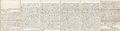
|
|
External Link
|
|
Letter to Rev. Robert Patterson, Oct. 14. 1882, currently in the possession of Dale R. Broadhurst
|
|
|
|
|
Isaac Craig Letter
|
|
Isaac Craig
|
|
Oct 14, 1882
|
|
|
Rev. Robt. Patterson,
Dear Sir:
I have received the History of Washington county sometime ago, but had not, on account of the condition my eyes are in, read your account of the origin of the Book of Mormon. To comply with your request I had it read to me last night, and I think you have made good use of the materials at hand, and I believe the spirit in which it is written is the proper one to command the attention of honest Mormons.
Mrs. Eichbaum's statement to you is a surprise to me for two reasons. I. Because I called on her to learn if she could throw any light on the matter and she could give me none. This was a year or two before the date you assign for her statement -- Sept. 18, 1879. II. The intimacy she says existed between Lambdin and Rigdon. In all my investigation I never found any one who knew of this. All impressed me with the belief that it was Silas Engles with whom Rigdon was intimate. That Rigdon had a small tannery on Penn street, near Hand, for the manufacture of book-binders sheep-skins, and supplying these to the office brought him in contact with Engles. This impression I obtained from John Sandersen, an old time butcher, who sold sheep pelts to Rigdon.
I am sorry you used Redick McKee's statement, for the reason that he subsequently made another, which conflicts with that you use; and the Mormons can use it with considerable effect to show how unreliable he is.
Samuel Cooper's statement that "your father's office was in the celebrated Molly Murphys Row" otherwise "Clapboard Row" is new to me. I never heard of it being any other place than 4th street. Cooper whom you say was "a veteran of three wars" never smelled powder. The nearest he ever came to it was at Black Rock where they all showed the white feather. I knew him well, and was fond of listening to his yarns; but when I grew older I discovered that he was good at pulling the long-bow. |
|
|
|
|
No Preview Available
|
|
External Link
|
|
Presbyterian Banner, November 15, 1882, Vol 68, No 12
|
|
|
|
|
Redick McKee Interview with Matilda McKinstry
|
|
Redick McKee
|
|
Nov 6, 1882
|
|
|
On Tuesday last (Oct. 31st) I visited Mrs. McKinstry at the house of her son-in-law, Col. Seaton, and found her an intelligent, active, healthy woman, now in her 77th year. She appeared highly gratified at meeting with me after a separation of 66 or 67 years. Her recollections of early incidents at Amity, where we met daily during the almost two years I boarded in her father's family, are very fresh in her mind, and she recalled many little occurrences which have escaped my memory. Once was my giving her her first horseback ride, sitting behind me, &c.
The only thing in relation to the lost 'Manuscript' within her recollection of which you have not already learned is her remembering to have heard her mother say that, before they left Pittsburgh, she accompanied her husband to the store of Mr. Patterson and heard a conversation in relation to the publication of the 'Manuscript.' There were two Mr. Pattersons present, one an elderly gentleman, with a remarkably mild, pleasant countenance, and much more robust than the other. The more slender Mr. Patterson told Mr. Spaulding that he had read several chapters of the 'Manuscript' and was struck favorably with its curious descriptions and its likeness to the ancient style of the Old Testament Scriptures. He thought it would be well to publish it, as it would attract attention and meet with a ready sale. He suggested, however, that Mr. Spaulding should write a brief preface, and perhaps a chapter or two in concluding the romance, giving a little more elaborate description of the Indian mounds in Ohio. Her mother thought he was engaged in doing that at the time I was living with the family at Amity. This is confirmatory of my own recollections. |
|
|
|
(Note:
No images of this paper are available online. Please contact us if you have any information.)
|
|
|
|
|
|
|
External Link
|
|
Who Wrote the Book of Mormon?, by Robert Patterson, 1882, pg 10
|
|
|
|
|
Recollection Regarding Cephas Dodd
|
|
Robert Patterson
|
|
1882
|
|
|
Rev. Cephas Dodd, who died Jan. 16, 1858, was long the pastor of the Presbyterian Church at Amity. He also practiced as a physician, and in this capacity, attended Mr. Spaulding in his last illness. Of his testimony Mr. George M. French, now in his eighty-third year, residing near Amity, and whose wife was a relative of Sidney Rigdon, retains a vivid impression.
Shortly after Mr. French's removal from Fayette County, Pa., to Amity in 1832, when the Mormon delusion was beginning to excite remark, Dr. Dodd took Mr. French to Spaulding's grave, and there told him his positive belief that Rigdon was the agent in transforming Spaulding's manuscript into the Book of Mormon. The conviction thus expressed within two years after the publication of the Book of Mormon, and three years before the appearance of Mr. Howe's book, which attributed the plagiarism to Rigdon, shows that Dr. Dodd's judgement was formed independently of any of the testimonies cited above. As to the plagiarism, it must have been based on his own knowledge of Spaulding's romance and comparing it with the Book, of Mormon; and as to the agent, his attention, like Mr. Miller's, may first have been directed to Rigdon by Spaulding himself. Mr. French has no personal knowledge of Rigdon's connection with the printing-office. |
|
|
|
|
|
External Link
|
|
Who Wrote the Book of Mormon?, by Robert Patterson, 1882, pgs 11-12
|
|
|
|
|
A. J. Bonsall Recollection of John Winter
|
|
Robert Patterson
|
|
1882
|
|
|
|
Rev. A. J. Bonsall, pastor of the Baptist Church at Rochester, Pa,, and a stepson of Dr. Winter, authorizes the statement that he repeatedly heard Dr. Winter say that Rigdon had shown him the Spaulding manuscript romance, purporting to be the history of the American Indians, which manuscript he had received from the printers. |
|
|
|
|
|
|
External Link
|
|
Who Wrote the Book of Mormon?, by Robert Patterson, 1882, pg 12
|
|
|
|
|
Z. Rudolph Recollection
|
|
Robert Patterson
|
|
1882
|
|
|
|
Mr. Z. Rudolph, father of Mrs. Gen. Garfield, knew Sidney Rigdon very well, and has stated that "during the winter previous to the appearance of the Book of Mormon, Rigdon was in the habit of spending weeks away from his home, going no one knew where; and that he often appeared very preoccupied and would indulge in dreamy, imaginative talks, which puzzled those who listened. When the Book of Mormon appeared and Rigdon joined in the advocacy of the new religion, the suspicion was at once aroused that he was one of the framers of the new doctrines, and probably was not ignorant of the authorship of the Book of Mormon." |
|
|
|
(Note:
Possibly published in the New York Evangelist, December 23, 1880)
|
|
|
|
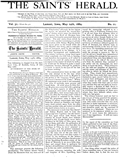
|
|
External Link
|
|
Presbyterian Banner, February 13, 1884, Vol 70, No 25
|
|
|
|
|
James Jeffery Statement
|
|
James Jeffery
|
|
Jan 29, 1884
|
|
|
I know more about the Mormons than any man east of the Alleghenies, although I have given no attention to the matter for twenty-five years. I did not know I was in possession of any information concerning the Book of Mormon unknown to others. I supposed that as Rigdon was so open with me, he had told others the same things.
Forty years ago I was in business in St. Louis. The Mormons then had their temple in Nauvoo, Ill. I had business transactions with them. Sidney Rigdon I knew very well. He was general manager of the affairs of the Mormons.
Rigdon, in hours of conversation told me a number of times there was in the printing office with which he was connected in Ohio, a manuscript of Rev. Spaulding, tracing the origin of the Indian race from the lost tribes of Israel; that this manuscript was in the office for several years; that he was familiar with it; that Spaulding had wanted it printed, but had not the money to pay for the printing; that he (Rigdon) and Joe Smith used to look over the manuscript and read it over Sundays.
Rigdon and Smith took the manuscript and said -- "I'll print it," and went off to Palmyra, N. Y.
I never knew the information was of any importance -- thought others were aware of these facts. I do not now think the matter is of any importance. It will not injure Mormonism. That is an "ism," and chimes in with the wishes of certain classes of people. Nothing will put it down but the strong arm of the law. Otherwise it will go on forever, like Tennyson's "Brook."
This is the substance of what I remember about the matter. |
|
|
|
(Note:
No images of the original in the Presbyterian Banner are available online. Our image and external link come from volume 31, number 21 of The Saints' Herald, dated May 24th, 1884.)
|
|
|
|
|
No Preview Available
|
|
External Link
|
|
The Leader, Pittsburgh, Sunday May 18, 1884
|
|
|
|
|
Sidney Rigdon Deathbed Statement
|
|
The Leader
|
|
May 18, 1884
|
|
|
|
Learning that a daughter of Rigdon was living in Pittsburg, a reporter called on her yesterday, and at first she declined to say anything at all on the subject, but finally, on the scribe promising not to use her name - she is married - she said: "...I will say this, that my father, who had the respect of all who knew him, and at a time when he had but little hope of living from one day to another, said to the clergymen around him, of which there was a number belonging to various denominations: these were his words: "As I expect to die and meet my Maker, I know nothing about where the manuscript of the Mormon Bible came from." |
|
|
|
(Note:
No images of this paper are available online. Please contact us if you have any information.)
|
|
|
|
|
No Preview Available
|
|
External Link
|
|
Lorenzo Saunders, Interviewed by William H. Kelley, 20 September 1884, 1-7, "Miscellany," RLDS Church Library-Archives, Independence, Missouri.
|
|
|
|
|
William H. Kelley Interview of Lorenzo Saunders
|
|
William H. Kelley
|
|
Sep 17, 1884
|
|
|
Q. Did you ever See Sidney Rigdon in the neighborhood where you lived previous to the 1830?
A. In March 1827 about the middle of the month, I went over to Joe Smiths to eat sugar; and as I went over I saw five or six men standing and talking. One was well dressed. They were about twenty rods from Smith's house.
Q. Did you know their names.
A. Yes. It was Peter Ingersol, Samuel Lawrence, George Proper, the old Man Rockwell- Father of Port Rockwell and the well dressed man. They stood ten rods from the road. When I got to the house Harrison told me it was Sidney Rigdon. i.e. The well dressed man.
Q. Did you see him after that previous to the year 1830.
A. Yes, I saw him in the fall- 1827- just before Joseph went to Pennsylvania. Peter Ingersol and I met him in the road between Palmyra and Ingersols. I never saw him any more until he came to Palmyra to preach the Mormon Bible.
Q. Are you acquainted with Major Gilbert of Palmyra?
A. Yes. Four years ago I went to Palmyra to see my brothers and I met Gilbert. He wanted to know if I remembered seeing Sidney Rigdon in that neighborhood previous to 1830 when he came preaching the Mormon Bible. He said Abel Chase testified that he thought he saw Rigdon before that time but was not certain. Says I to Gilbert Sidney Rigdon was about Smiths before 1830 in my opinion. Gilbert then asked me if I would make affidavit that I saw Rigdon in at Smiths before that time- 1830? I told him I would think the matter over. After awhile I think I told him that I would. After I got home a while I received a letter from Cobb of Salt Lake. Gilbert wrote to Cobb and gave him my address. I wrote to Cobb the next Spring. Gilbert wrote to me I think in November after I returned home asking why I did not answer Cobbs letter. While I was writing an answer to Cobbs first letter my house caught a fire and burnt. Burnt up every thing I had and there was no insurance. Lost a thousand dollars. I was some time thinking the matter over before writing to Cobb as requested by Gilbert and during that time my house was burnt. It had been a long time since those transactions and it was difficult to fix dates, But I have it now so that I can tell it right off. I have read the statements of Peter Ingersol and Samuel Lawrence- I noticed in that interview of your Brothers that some one Said that Tucker never called on Willard Chase for evidence. The reason was Chase had the paralisis and was not competent to give testimony-
Q. How came you to go over to Smiths to eat sugar?
A. The Smiths were great sugar makers, they had a large bush and sugared off almost every day or two at their house and they wanted me to come over and eat sugar. They made seven thousand lbs one year and took the bounty in the County- $50.00. They were pretty good fellows in their way but were shiftless and in the money digging business.
Q. How did you fix the date that you saw Sidney Rigdon at Smiths previous to 1830?
A. When I was talking with Gilbert I told him I would think the matter over and see if I could make affidavit and I fixed the time in my mind by remembering that I had gone over there to eat sugar.
Q. Was Peter Ingersol and Samuel Lawrence acquainted with Sidney Rigdon?
A. Yes. they were both acquainted with him in 1827. Sam Lawrence took Joe over into Pennsylvania and gave him a better education. I saw Rigdon in 1830 preach with the Bible in one hand and the Book of Mormon in the other, and he said the Bible is now fulfilled and done away and the Book of Mormon was to take its place.
Q. What kind of a woman was Joseph's wife.
A. Joseph's wife was a pretty woman. Just as pretty a woman as I ever saw. When she come to the Smith's she was disappointed and used to come down to our house and sit down and cry. Said she was deceived and got into a hard place.- When I was down to see my Brothers four years ago in a conversation with Gilbert when I first got there, it was then he said that he did not know that Sidney Rigdon was ever here previous to 1830. He believed he was, but they had no evidence. He said they had been studying on it for 35 or 40 years but could not get the evidence. Said if they could only make that point the fraud would come out. He said he could come the nearest proving it by Abel Chase but he was not certain. When I got ready to come home (was there three weeks) Gilbert said he wanted to see me before I left. He was working on the Canal. He came to me as I was about to start home and it was then that I told him that I had thought the matter over and made up my mind that I could swear that I saw Rigdon in the neighborhood in the Spring of 1827. That is what he wanted I should write to Cobb. This conversation was in Palmyra in front of John Saunders store.
Q. Did you know any thing about Tucker?
A. Yes. At the time Tucker was publishing his book I was at his house and he said that I had a better memory than he did and he wanted me to help him on his book and I did so. He promised to give me a Book and he sent me this one when it was published.
|
|
|
|
(Note:
This transcript, written by Kelley on seven pages, was signed by Saunders and notarized by W. B. Worshrop on September 20, 1884. It was then sent to Kelley's brother Edmund in Kirtland. Another unsigned copy exists with rearranged questions, but nearly identical wording. No images of either document are available online. Please contact us if you have any information.)
|
|
|
|
|
No Preview Available
|
|
External Link
|
|
Lorenzo Saunders, Interviewed by E. L. Kelley, 12 November 1884, 1-22, E. L. Kelley Papers, "Miscellany," RLDS Church Library-Archives, Independence, Missouri.
|
|
|
|
|
Edmund L. Kelley Interview of Lorenzo Saunders
|
|
Edmund L. Kelley
|
|
Nov 12, 1884
|
|
|
E.L.K. How soon after Joseph Smith claimed to have received the revelation did you see Rigdon?
Mr. S. It was in the spring I went there to eat sugar. Samuel Lawrence went with me; There was 4 or 5 men making sugar...
E. L. Kelley How did they happen to be all together there?
Mr. S. There was George Proper & Rockwell I supposed there were men to work for them in the sugar bush; I never asked any questions about his help. Samuel Lawrence came along & I went to the house. And there was a man better dressed than the rest come along up to Smiths & Stood out door. I says to Hiram Smith what well dressed man is that that stood out there? And he said, it was Sidney Rigdon. This was in the time of making sugar along in March about the 10th or 15th, & they was in full blast & they used to invite us over to eat sugar. They made sugar every year.
E.L.K. How are you enabled to identify the time?
Mr. S. Because, I know it was before Jo. claimed to have taken the plates from the hill Cummorah. And there was some two or three of us traveled that ground over, & we could not find a hole. There was a great raft of them digging for money.
...E.L.K. By what train of circumstances, Mr. Saunders, can you tell the exact time, you first saw Sydney Rigdon there?
Mr. S. At first I told him I could not remember exactly, but says I look here I will go back to my brother's house, (Orlan), & he will jog my memory & in this way I will be able to get at it. I talked with Able Chase & spoke to him about it. He finally says: you have got the Book of Mormon the first book in your brothers house. And I wanted it & tried to get it I wanted to fetch it home with me but he said he wanted to keep it while he lived. And after taking the dates I had forgot what year the book was printed in till I got it My brother could not remember anything. I says cant I tell you a circumstance? but his intelect seemed to be gone. I cited to him this case of Hiram Smith talking in the harvest field, & he says I do remember that now, but it was gone I would never have thought of it again. I says, it was in the spring of 1827 that I went there; He thought a minite & said: "I guess it was" Says I you know father died in 1825 & says I he died in the fall & it was two years from that spring that I first saw Rigdon. Judging from the time that they made that large quantity of sugar in that year.
E.L.K. Dont you think you might have been mistaken as to the date?
L.S. (Excited) No, sir, I am not mistaken I will tell you that if you are a Mormon I dont tolerate Mormonism, I say that I have nothing against that family at all: But say so far as Mormonism is concerned I do not tolerate it at all.
|
|
|
|
(Note:
No images of this document are available online. Please contact us if you have any information.)
|
|
|
|
|
No Preview Available
|
|
External Link
|
|
Naked Truths About Mormonism, Vol 1, No 1, pg 1, col 7
|
|
|
|
|
Rachel Derby Statement
|
|
Rachel Derby
|
|
Dec 9, 1884
|
|
|
|
My father, John N. Miller, settled in Springfield, Erie County, Pa., near Conneaut, Ohio, in 1800. He was an elder of the Presbyterian Church over thirty years, and his father was before him. I have many times heard father say that in 1811 he and Andrew Cochran helped build a forge or furnace for General Keyes at Conneaut, Ohio, and that they boarded with Solomon Spaulding, who had been a preacher, but his wife was not religious. She was high-strung, a frolicker, fond of balls and parties, and drove him out of the ministry. He said he liked Spaulding. While they were at their meals Spaulding would lie on the bed and read to them his manuscripts. Father also frequently read them himself. I have often heard him tell about the Nephites and Zarahemlites before the "Book of Mormon" was published. I well remember D.P. Hurlbut coming to our house about fifty years ago and his telling father that he was taking evidence to expose Mormonism, and hearing him read from the "Book of Mormon." Frequently father would request Hurlbut to stop reading and he would state what followed and Hurlbut would say that it was so in the "Book of Mormon." He expressed great surprise that father remembered so much of it. Father told him that the "Manuscript Found" was not near all of Spaulding's writings and that probably there would soon be another prophecy out. Father said he had no doubt the historical part of the "Book of Mormon" was Spaulding's "Manuscript Found." John Spaulding, Solomon's brother, lived half a mile from our house and our families were quite intimate. I saw father sign a statement and give Hurlbut. |
|
|
|
(Note:
No images of this source are available online. Please contact us if you have any information.)
|
|
|
|
|
No Preview Available
|
|
External Link
|
|
Naked Truths About Mormonism, Vol 1, No 1, pg 3, col 1
|
|
|
|
|
R. W. Alderman Statement
|
|
R. W. Alderman
|
|
25 Dec, 1884
|
|
|
|
In February, 1852, I was snow-bound in a hotel in Mentor, Ohio all day. Martin Harris was there, and in conversation told me he saw Jo Smith translate the "Book of Mormon" with his peepstone in his hat. Oliver Cowdery, who had been a school teacher, wrote it down. Sidney Rigdon, a renegade preacher, was let in during the translation. Rigdon had stolen a manuscript from a printing office in Pittsburgh, Pa., which Spaulding who had written it in the early part of the century, had left there to be printed, but the printers refused to publish it, but Jo and Rigdon did, as the "Book of Mormon." Martin said he furnished the means, and Jo promised him a place next to him in the church. |
|
|
|
(Note:
No images of this source are available online. Please contact us if you have any information.)
|
|
|
|
|
|
External Link
|
|
Public discussion of the issues between the Reorganized Church of Jesus Christ of Latter Day Saints and the Church of Christ (Disciples), pg 42
|
|
|
|
|
John Winter Statement in the Braden and Kelley Debate
|
|
Rev. John Winter, M.D.
|
|
1884
|
|
|
|
In 1822 or 3, Rigdon took out of his desk in his study a large MS, stating that it was a Bible romance purporting to be a history of the American Indians. That it was written by one, Spaulding, a Presbyterian preacher whose health had failed and who had taken it to the printers to see if it would pay to publish it. And that he (Rigdon) had borrowed it from the printer as a curiosity. |
|
|
|
(Note:
Dr. Winter died in 1878, six years before the publication of this statement. Its provenance is unknown.)
|
|
|
|
|
|
External Link
|
|
True Origin of Book of Mormon, Charles A. Shook, 1914, pgs 134-135
|
|
|
|
|
Lorenzo Saunders Letter to Thomas Gregg
|
|
Lorenzo Saunders
|
|
Jan 28, 1885
|
|
|
|
I saw Sidney Rigdon in the Spring of 1827, about the middle of March. I went to Smiths to eat maple sugar, and I saw five or six men standing in a group and there was one among them better dressed than the rest and I asked Harrison Smith who he was (and) he said his name was Sidney Rigdon, a friend of Joseph's from Pennsylvania, I saw him in the Fall of 1827 on the road between where I lived and Palmyra, with Joseph. I was with a man by the name of Jugegsah (spelling doubtful, C. A. S.). They talked together and when he went on I asked Jugegsah (spelling doubtful, C. A. S.) who he was and he said it was Rigdon. Then in the summer of 1828 I Saw him at Samuel Lawrence's just before harvest. I was cutting corn for Lawrence and went to dinner and he took dinner with us and when dinner was over they went into another room and I didn't see him again till he came to Palmyra to preach... Smith and Rigdon had an intimacy but it was very secret and still and there was a mediator between them and that was Cowdery. The Manuscripts was stolen by Rigdon and modeled over by him and then handed over to Cowdery and he copied them and Smith sat behind the curtain and handed them out to Cowdery and as fast as Cowdery copied them. |
|
|
|
|
No Preview Available
|
|
External Link
|
|
Naked Truths About Mormonism, Vol 1, No 1, pg 4, col 2
|
|
|
|
|
Sophia Munson Statement
|
|
Sophia Munson
|
|
Feb, 1885
|
|
|
My parents settled on Mentor Road, four miles west of Painesville, Ohio, in 1810, when I was six weeks old. I well remember when Elder Rigdon came and lived opposite our house in 1827. He was very poor, and when he had much company would send his children to he neighbors to borrow knives, forks, dishes and also for provisions. Father kept his horse and cow gratis.
Rigdon was a very lazy man, he would not make his garden and depended on the church for garden supplies. He would sit around and do nothing. He was away much of the time, and sometimes claimed he had been in Pittsburgh, Pa. I was quilting at his house until 1 o'clock at night the day the four Mormons came to convert Rigdon. I heard some of their conversation in the adjoining room. Orson Hyde boarded at our house and attended a select school, also to Rigdon who taught some evenings. |
|
|
|
(Note:
No images of this source are available online. Please contact us if you have any information.)
|
|
|
|
|
No Preview Available
|
|
External Link
|
|
Naked Truths About Mormonism, Vol 1, No 1, pg 3, col 2
|
|
|
|
|
Samuel F. Whitney Statement
|
|
Samuel F. Whitney
|
|
6 Mar, 1885
|
|
|
|
I heard Sidney Rigdon preach in Squire Sawyers' orchard in 1827 or '28. He said how desirable it would be to know who built the forts and mounds about the country. Soon it would all be revealed. He undoubtedly referred to the "Book of Mormon" which was published in 1830. |
|
|
|
(Note:
No images of this source are available online. Please contact me if you have any information.)
|
|
|
|
|
|
|
W. A. Lillie Statement
|
|
W. A. Lillie
|
|
Mar 7, 1885
|
|
|
|
I was born in Trumbull Co., Ohio, in 1815. Our family moved to Chester, the town adjoining Kirtland on the south, in 1822. About 1834 Mr. Pearne, of Chester, told me he used to live in the neighborhood of the Mormon Smith family in Palmyra, N. Y., and was well acquainted with all of them. He said they were a low family and of no account in the community. He told me the summer before Jo Smith, the Mormon prophet, first came to Ohio, he often saw Smith and Rigdon together. It was the first he knew of Rigdon, and it was before the "Book of Mormon" was published. He saw Smith and Rigdon start together in a buggy for Ohio. Mr. Pearne knew Rigdon well after coming to Ohio and said he believed he was at the bottom of Mormonism. My father borrowed the "Book of Mormon" and when he had finished reading it laughed and remarked Rigdon had done pretty well. |
|
|
|
|
No Preview Available
|
|
External Link
|
|
Naked Truths About Mormonism, Vol 1, No 1, pg 3, col 1
|
|
|
|
|
K. AE. Bell Statement
|
|
K. AE. Bell
|
|
6 May, 1885
|
|
|
I came to Painesville, Ohio, in 1825, and boarded with Carlos Granger. Whenever Sidney Rigdon, a Baptist minister who lived in Mentor, came to Painesville, he usually stopped with Granger. I have often heard him say at his meals, "How nice it would be to have all Christians live in a community separate from the world's people." After he became a Disciple, he frequently spoke in his sermons of a wondrous light which was soon to burst upon the world. I have heard others say Rigdon, after he became a Mormon, said that Mormonism was the marvelous light he had predicted...
...Esek Rosa, an expert accountant and brother of Dr. Rosa, of Painesville (who prepared for the press most of Howe's book on Mormonism), while in conversation with me about Rigdon and Mormonism, several times told me that Rigdon told the people in Mentor and Painesville that he was going to Pittsburgh, Pa., but he went to Rochester, N.Y., instead. Esek said he was visiting in Rochester, and while on the street he was invited to enter a building near by and hear a very smart man preach. Rosa replied, "I think I have heard that voice before." When he entered the room he found Elder Sydney Rigdon preaching Mormonism. This occurred several months before Mormonism was preached in Ohio. |
|
|
|
(Note:
No images of this source are available online. Please contact us if you have any information.)
|
|
|
|
|
|
Full Source
|
|
External Link
|
|
The Manuscript Story of Reverend Solomon Spaulding; or Manuscript Found, from the Harold B. Lee Library, Brigham Young University.
|
|
|
|
|
The Oberlin Manuscript
|
|
The Reorganized Church of Jesus Christ of Latter-day Saints
|
|
1885
|
|
|
...Mr. Joseph Smith:
The Spaulding Manuscript in my possession came into my hands in this wise. In 1839-1840 my partner and myself bought of E. D. Howe the Painesville Telegraph, published at Painesville, Ohio. The transfer of the printing department, types, press, &c., was accompanied with a large collection, of books, manuscripts, &c., this manuscript of Spaulding among the rest. So, you see, it has been in my possession over forty years. But I never examined it, or knew the character of it, until some six or eight months since. The wrapper was marked, "Manuscript Story -- Conneaut Creek." The wonder is, that in some of my movements, I did not destroy or burn it with a large amount of rubbish that had accumulated from time to time.
It happened that President Fairchild was here on a visit, at the time I discovered the contents of it, and it was examined by him and others with much curiosity. Since President Fairchild published the fact of its existence in my possession, I have had applications for it from half a dozen sources, each applicant seeming to think that he or she was entitled to it. Mr. Howe says when he was getting up a book to expose Mormonism as a fraud at an early day, when the Mormons had their headquarters at Kirtland, he obtained it from some source, and it was inadvertently transferred with the other effects of his printing office. A. B. Deming, of Painesville, who is also getting up some kind of a book I believe on Mormonism, wants me to send it to him. Mrs. Dickinson, of Boston, claiming to be a relative of Spaulding, and who is getting up a book to show that he was the read author of the Book of Mormon, wants it. She thinks, at least, it should be sent to Spaulding's daughter, a Mrs. Somebody -- but she does not inform me where she lives. Deming says that Howe borrowed it when he was getting up his book, and did not return it, as he should have done, etc.
This Manuscript does not purport to be "a story of the Indians formerly occupying this continent;" but is a history of the wars between the Indians of Ohio and Kentucky, and their progress in civilization, etc. It is certain that this Manuscript is not the origin of the Mormon bible, whatever some other manuscript may have been. The only similarity between them, is, in the manner in which each purports to have been found -- one in a cave on Conneaut Creek -- the other in a hill in Ontario County, New York. There is no identity of names, of persons, or places; and there is no similarity of style between them...
...L. L. Rice
...P. S. -- The words "Solomon Spaulding's Writings" in ink on the wrapper were written by me, after I became aware of the contents. The words "Manuscript Story -- Conneaut Creek," in faint penciling, were as now when it came into my possession.
Oberlin College, Oberlin, Ohio,
July 23, 1885
I have this day delivered to Mr. E. L. Kelley a copy of the Manuscript of Solomon Spaulding, sent from Honolulu by Mr. L. L. Rice, to the Library of Oberlin College, for safe-keeping, and now in my care. The copy was prepared at Mr. Kelley's request, under my supervision, and is, as I believe, an exact transcript of the original manuscript, including erasures, misspellings, etc...
Jas. H. Fairchild,
Prest. of Oberlin College. |
|
|
(Note:
Following the above text, the manuscript is thereafter reproduced in its entirety.
Note that both E. D. Howe and Doctor Hurlbut, who obtained the original from Spaulding's widow, denied throughout their lives that this document titled "Manuscript Story" was the same as the "Manuscript Found" that was alleged to provide source material for the Book of Mormon. Two letters they wrote reaffirming this denial can be read here.)
|
|
|
|
|
No Preview Available
|
|
External Link
|
|
Naked Truths About Mormonism, Vol 1, No 1, pg 2, col 4
|
|
|
|
|
Sarah F. Anderick Statement
|
|
Sarah Fowler Anderick
|
|
Jun 24, 1887
|
|
|
|
(Jo Smith) was from home much summers. Sometimes he said he had been to Broome County, New York, and Pennsylvania. Several times while I was visiting Sophronia Smith at old Jo's house, she told me that a stranger who I saw there several times in warm weather and several months apart, was Mr. Rigdon. At other times the Smith children told me that Mr. Rigdon was at their house when I did not see him. I did not read much in the "Book of Mormon" because I had no confidence in Jo. Palmyra people claimed that Jo did not know enough to be the author of the "Book of Mormon," and believed that Rigdon was its author. |
|
|
|
(Note:
No images of this source are available online. Please contact us if you have any information.)
|
|
|
|
|
No Preview Available
|
|
External Link
|
|
Naked Truths About Mormonism, Vol 1, No 1, pg 2, col 3
|
|
|
|
|
Lorenzo Saunders Recollection
|
|
Lorenzo Saunders
|
|
Jul 21, 1887
|
|
|
|
That my father died on the 10th day of October, A. D. 1825. That in March of 1827, on or about the 15th of said month I went to the house of Joseph Smith for the purpose of getting some maple sugar to eat, that when I arrived at the house of said Joseph Smith, I was met at the door by Harrison Smith, Jo's brother. That at a distance of ten or twelve rods from the house there were five men that were engaged in talking, four of whom I knew, the fifth one was better dressed than the rest of those whom I was acquainted with. I inquired of Harrison Smith who the stranger was? He informed me his name was Sidney Rigdon with whom I afterwards became acquainted and found to be Sidney Rigdon. This was in March, A. D. 1827, the second spring after the death of my father. I was frequently at the house of Joseph Smith from 1827 to 1830. That I saw Oliver Cowdery writing, I suppose the "Book of Mormon" with books and manuscript laying on the table before him; that I went to school to said Oliver Cowdery and knew him well. That in the summer of 1830, I heard Sydney Rigdon preach a sermon on Mormonism. This was after the "Book of Mormon" had been published, which took about three years from the time that Joseph Smith claimed to have had his revelation. |
|
|
|
(Note:
No images of this source are available online. Please contact us if you have any information.)
|
|
|
|
|
No Preview Available
|
|
External Link
|
|
Naked Truths About Mormonism, Vol 1, No 1, pg 4, col 4
|
|
|
|
|
Matilda McKinstry Refutation of Manuscript Story as Manuscript Found
|
|
Matilda Spalding McKinstry
|
|
31 Oct, 1887
|
|
|
A. B. DEMING, San Francisco, Cal.
Dear Sir: I have carefully read the Rice-Spaulding manuscript you gave me. It is not the "Manuscript Found," which I have often seen. It contained the words "Lehi, Lamoni, Nephi" and was a much larger work.
Respectfully, |
|
|
|
(Note:
No images of this source are available online. Please contact us if you have any information.)
|
|
|
|
|
No Preview Available
|
|
External Link
|
|
Naked Truths About Mormonism, Vol 1, No 1, pg 2, col 1
|
|
|
|
|
Redick McKee Recollection of Corrected Copy
|
|
Arthur B. Deming
|
|
Jan, 1888
|
|
|
|
When in Washington D. C., Mr Redic McKee, now deceased father of David R. McKee, Washington agent for the N. Y. Associated Press, informed me that he kept store in Amity, Pa., for a Pittsburg firm, and that he boarded with Solomon Spaulding and heard him tell about his "Manuscript Found," and that he did not read a copy that was in the house because there was a corrected copy at Patterson's Printing Office in Pittsburgh, Pa., and he intended to purchase a copy when published. |
|
|
|
(Note:
No images of this source are available online. Please contact us if you have any information.)
|
|
|
|
|
No Preview Available
|
|
External Link
|
|
Naked Truths About Mormonism, Vol 1, No 1, pg 2, col 1
|
|
|
|
|
Salmon S. Osborn Statement
|
|
Salmon S. Osborn
|
|
Jan, 1888
|
|
|
|
In September, 1871, I spent some little time in Middleton, Vt., with my wife and her sister, who were both invalids. We had rooms and board at Hezekiah Haynes'. When he learned we were from the vicinity of Kirtland, O., inquiries were made about the Mormons, and I was then told about what they termed the Wood scrape, and that Mormonism undoubtedly originated in that town, and that Mr. Woodard (I think the name was), the Town Clerk, had a "Manuscript" written by Spaulding, which might throw some light on the subject, as he believed Spaulding's writings and the religious fanaticism of the Woods' gave rise to Mormonism. From him I learned also, that the Hon. Reuben Wood, late of Cleveland, Ohio, one of the clearest headed lawyers and best of Ohio's Judges, was a descendant of the same Wood, of Middleton, and himself read law there. I then became interested to know more about it. Soon afterwards I had occasion to call on the Town Clerk, who was also a shoemaker, for a little of his mechanical skill, and procured from him a sight of the manuscript and the rather reluctant loan of it on my promise to use it carefully and return it to him. As I now remember it was written in a fair, plain hand, upon foolscap; short-cap I think, and there may have been one quire or more or less of it stitched together: it purported to be an account of the journeyings of the ten lost tribes of Israel to America, and what they did and became on this continent, by Solomon Spaulding. I had abundance of leisure in Middleton and kept the document a week or more, and returned it to Mr. Woodard. I did not read all of it. It did not interest me much, and I have no distinct recollection of the story, nor had I then the "Book of Mormon,: having lost mine soon after I used it in Chardon, as before stated. I practiced law in Chardon from 1828 to 1833 or '34 and afterwards in Painesville until 1849. |
|
|
|
(Note:
No images of this source are available online. Please contact us if you have any information.)
|
|
|
|
|
No Preview Available
|
|
External Link
|
|
Naked Truths About Mormonism, Vol 1, No 1, pg 2, col 3
|
|
|
|
|
Harvey Baldwin Statement
|
|
Arthur B. Deming
|
|
Jan, 1888
|
|
|
|
Harvey Baldwin, of Aurora, Portage County, Ohio, says that over thirty years ago he heard his father say that he belonged to the Baptist Church in Bainbridge, Portage County, Ohio, when Sidney Rigdon preached there, and that several times when he called to see Rigdon he found him in a room by himself, and that he each time hurriedly put away books and papers he had as though he did not wish him to see them. Deacon Clapp, of the church Garfield attended in Mentor, says he was eighteen years old when Rigdon came to Mentor to live, and that he had a large chair with a leaf on the arm to write on with a drawer underneath with a lock and key. The chair was covered with spots of ink. Rigdon told him he had much use for it. |
|
|
|
(Note:
No images of this source are available online. Please contact us if you have any information.)
|
|
|
|
|
No Preview Available
|
|
External Link
|
|
Naked Truths About Mormonism, Vol 1, No 1, pg 2, col 5
|
|
|
|
|
Isaac Butts Statement
|
|
Isaac Butts
|
|
Jan, 1888
|
|
|
|
I was born in Palmyra, N.Y., near where old Jo Smith settled, January 4, 1807. I attended school with Prophet Jo... I came to Ohio in 1818, and became acquainted with Sydney Rigdon in 1820. He preached my brother's funeral sermon in Auburn, O., in May, 1822. I returned to Palmyra twice and resided there about two years each time. Many persons whom I knew in New York joined the Mormons and came to Kirtland. They told me they saw Sidney Rigdon much with Jo Smith before they became Mormons, but did not know who he was until they came to Kirtland. |
|
|
|
(Note:
No images of this source are available online. Please contact us if you have any information.)
|
|
|
|
|
|
External Link
|
|
The Golden Bible, The Salt Lake Daily Tribune, April 15, 1888, Vol 34, No 155
|
|
|
|
|
Interview with a grandson of Sidney Rigdon
|
|
John Hanson Beadle
|
|
Apr 7, 1888
|
|
|
"Well, he tried to understand the prophecies, and the man who does that is sure to go crazy. He studied the prophets and baptism, and of course he got 'rattled.' Daniel and Ezekiel and Revelations will 'rattle' any man who gives his whole mind to 'em -- at any rate they did him, and he joined Alexander Campbell. Campbell then believed that the end of the world was nigh --his Millennial Harginger shows that they 'rattled' all who listened to them in Ohio and other places; then grandfather got disgusted and decided on a new deal. He found Joe Smith and they had a great many talks together before they brought out the plates. None of us ever doubted that they got the whole thing up; but father always maintained that grandfather helped get up the original Spaulding book. At any rate he got a copy very early and schemed on some way to make it useful. Although the family knew these facts, they refused to talk on the subject while grandfather lived. In fact, he and they took on a huge disgust at the whole subject.
...I only report that part of Mr. Rigdon's talk which shows the history of the "Golden Bible," as accepted in the family. Of course, if Sidney Rigdon had wanted the world to believe the Smith story of the plates, he would have told them so. But, though the family do not care to ventillate it, he evidently taught them to treat the whole thing as a fraud. |
|
|
|
(Note:
This is attributed to Walter Sidney Rigdon, grandson of Sidney Rigdon, as recorded by his interviewer John Hanson Beadle.)
|
|
|
|
|
|
External Link
|
|
The Pittsburgh Dispatch, February 29, 1892, Vol 47, pg 5, col 1
|
|
|
|
|
Interview with Nephew of Solomon Spaulding
|
|
Myron H. Bond
|
|
Feb 29, 1892
|
|
|
Old claims were rehearsed at great length and with a show of pomp the Elder announced that as a final proof that the Solomon Spalding story is a myth, he had recently interviewed a nephew of Spalding who lives in Crawford county who had laughed at the idea of his uncle's novel being taken as the Mormon Bible. "This man told me," said Elder Bond, "that Solomon Spalding had never been a minister: that previous to moving to Conneaut, O., he had been a partner of his brother," the father of the man I was interviewing, "in the distilling business, and that they fell out because Solomon refused to pay his brother what he owed him." Solomon, it seems, contracted a great many debts and expected to pay all of them with the procceds of his novel. He was a very illiterate man, my informer told me, and never graduated from Dartmouth College, as has been announced.
"The original manuscript of Spalding's story is at Oberlin College, Ohio, and shows no simllarlty whatever to the Book of Mormon. It has been published by us, but not by our enemies." |
|
|
|
| |