|
Miner's Hill
|
No Preview Available
|
|
External Link
|
|
New York Journal of Commerce, New York, City, Dec. 13, 1841
|
|
|
|
|
New York Newspaper Account
|
|
New York Journal of Commerce
|
|
Dec 13, 1841
|
|
|
|
When we see a miserable creature like Smith, all at once putting on the garb of sanctity, and guided by pretended inspiration, digging into the side of a hill, and there secluding himself for months, and then coming forth with the pretence that he has found a new revelation, which revelation is nothing more nor less than a piece of imaginative writing left in a manuscript by a deceased clergyman, and when we see such a fraud believed in, and adopted by enlightened men, and spreading more rapidly than any system of truth ever did, we are amazed. |
|
|
|
|
|
External Link
|
|
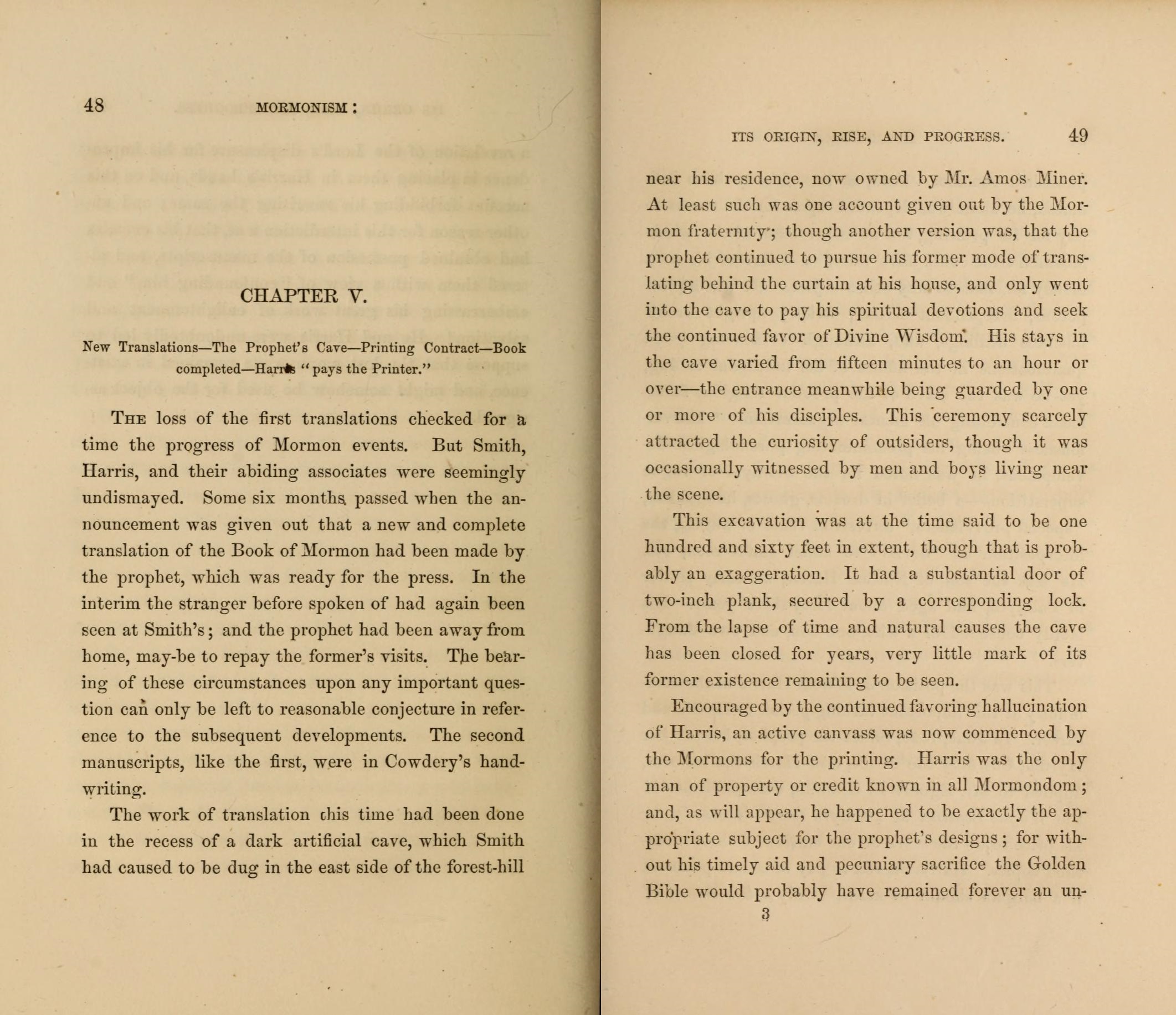
Origin, rise, and progress of Mormonism, 1867, pgs 48-49
|
|
|
|
|
Pomeroy Tucker Account
|
|
Pomeroy Tucker
|
|
1867
|
|
|
The word of translation this time had been done in the recess of a dark artificial cave, which Smith had caused to be dug in the east side of the forest-hill near his residence, now owned by Mr. Amos Miner. At least such was one account given out by the Mormon fraternity; though another version was, that the prophet continued to pursue his former mode of translating behind the curtain at his house, and only went into the cave to pay his spiritual devotions and seek the continued favor of Divine Wisdom. His stays in the cave varied from fifteen minutes to an hour or over--the entrance meanwhile being guarded by one or more of his disciples. This ceremony scarcely attracted the curiosity of outsiders, though it was occasionally witnessed by men and boys living near the scene.
This excavation was at the time said to be one hundred and sixty feet in extent, though that is probably an exaggeration. It had a substantial door of two-inch plank, secured by a corresponding lock. From the lapse of time and natural causes the cave has been closed for years, very little mark of its former existence remaining to be seen. |
|
|
|
|
|
External Link
|
|
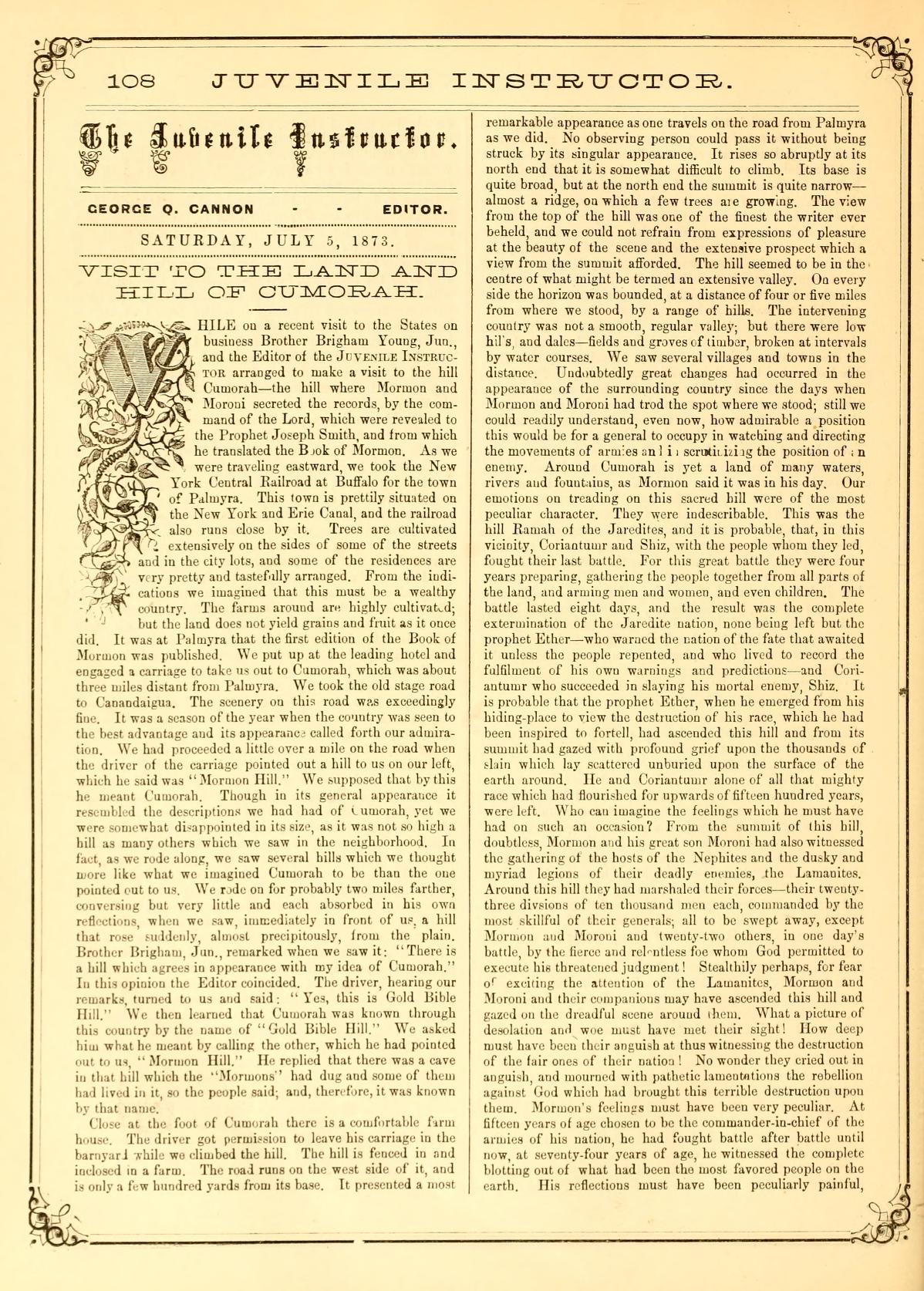
Juvenile Instructor, July 5, 1873, Vol 8, No 14, pg 108
|
|
|
|
|
George Q. Cannon Visit
|
|
George Q. Cannon
|
|
Jul 5, 1873
|
|
|
|
We put up at the leading hotel and engaged a carriage to take us out to Cumorah, which was about three miles distant from Palmyra. We took the old stage road to Canandaigua. The scenery on this road was exceedingly fine. It was a season of the year when the country was seen to the best advantage and its appearance called forth our admiration. We had proceeded a little over a mile on the road when the driver of the carriage pointed out a hill to us on our left, which he said was ‘Mormon Hill.' We supposed that by this he meant Cumorah. Though in its general appearance it resembled the descriptions we had had of Cumorah, yet we were somewhat disappointed in its size, as it was not so high a hill as many others which we saw in the neighborhood. In fact, as we rode along, we saw several hills which we thought more like what we imagined Cumorah to be than the one pointed out to us. We road on for probably two miles farther, conversing but very little and each absorbed in his own reflections, when we saw, immediately in front of us, a hill that rose suddenly, almost precipitously, from the plain. Brother Brigham, Jun., remarked when we saw it: ‘There is a hill which agrees in appearance with my idea of Cumorah.' In this opinion the Editor coincided. The driver, hearing our remarks, turned to us and said: ‘Yes, this is Gold Bible Hill.' We asked him what he meant by calling the other, which he had pointed out to us, ‘Mormon Hill.' He replied that there was a cave in that hill which the ‘Mormons' had dug and some of them had lived in it, so the people said, and, therefore, it was known by that name. |
|
|
|
|
No Preview Available
|
|
External Link
|
|
Manchester in the Early Days, The Ontario County Times, June 23, 1875, Vol 25, No 25
|
|
|
|
|
1875 Newspaper Account
|
|
Charles W. Brown
|
|
Jun 23, 1875
|
|
|
|
While these mysterious hints were being circulated thro the community, the conspirators had excavated for their own use a hole in the ground. This was nothing more nor less than an artificial cave which they had dug in a side hill now owned by the Chauncey Miner heirs. This hill may be found at any time on lot 77 of the original survey, to the south of the highway running from the Palmyra Plank road to the residence of Mark Johnson. It is situated about equi-distance between the terminii of the road and faces to the north. The entrance to this cave was guarded by an iron-plated door. The cave itself was about sixty feet in length and ten feet high. From the door for a distance of forty feet, there was a hall fifteen feet wide which led to the chamber beyond. This chamber or audience room was twenty feet square, and was furnished with one rude table and half a dozen uncouth stools. It was here that the secret meetings of the plotters were held up to the time they commenced holding public meetings for the purpose of making converts. In this small recess, secure from any interference by skeptical persons, by the flaring light of a tallow candle, was the plan of operations fully discussed and decided upon. It is stated that Darius Pierce, one of the sons of Nathan, at the head of a party of his associates surprised the parties when they were assembled together in one of their nocturnal consultations and that a lively time ensued. |
|
|
|
|
No Preview Available
|
|
External Link
|
|
Joe Smith, Broome Republican, February 2, 1876, Vol 54
|
|
|
|
|
Letter from Gilgal
|
|
Broome Republican
|
|
Feb 2, 1876
|
|
|
|
The western portion of this wood reaches over a high hill or ridge running north and south, and the little voices are often heard calling attention to a mound of earth, overgrown with young trees, as the location of "The Prophet's Cave." I was present on one of these occasions, a few years ago, and visited the place to find only such remams as forty years of time could not obliterate. The entrance was wholly closed by the yielding earth, which year after year has been dropping into it and hiding its inner walls from the prying eye of the hunter of curious relics of the past. It was here that Joe Smith pretended to interpret the golden plates of Camorah. Here he sat behind the screen and announced to Oliver Cowdrey, the village schoolmaster and scribe of the prophet, the translated word which was to be the scriptural guide of the church of Latter Day Saints, This cave was said to have been large enough to contain thirty persons, that it was strongly guarded by a plank door, three inches thick and provided with [locks]and bars within. However, the story can hardly be true judging from the outward appearances as now seen. It was here that Joe used to slay the fat lambs of Calvin Stoddard's flock of sheep, and offer them to the Lord, as Calvin supposed, for he was one of the early converts to Joe's church and believed in the prophet to the letter, but somehow it always happened that Joe failed to get a communication with the Lord if any body was present, and when they were all gone, the father of the prophet would come down over the hill, shoulder be sheep, calf or pig -- It made but little difference which -- and carry it home, where it was offered up to the hungry mouths of the Smith family each day, as long as it lasted. |
|
|
|
|
|
|
Saints Herald 1881 Account
|
|
|
Tell us about the cave you spoke of.
"The cave is over there in the hill now--a large cave."
In what hill? The hill they call "Mormon" Hill?
"No; it is about a mile from that; but what are you so particular about it for?"
We want to go and see it--we want to see the thing itself. Now you have been there; give us the description, while we write it down, so that we can find it.
"No; I never saw it; besides it is all caved in now, so you could not see anything. There is no cave there now, it is all fallen in."
|
|
|
|
|
No Preview Available
|
|
External Link
|
|
Lorenzo Saunders, Interviewed by William H. Kelley, 17 September 1884, 1-18, E. L. Kelley Papers, RLDS Church Library-Archives, Independence, Missouri.
|
|
|
|
|
Lorenzo Saunders Interview with William Kelley
|
|
William H. Kelley
|
|
Sep 17, 1884
|
|
|
Q. Did you ever see the Smiths dig yourself or [others?] for money?
A. I never saw them digging for money. I saw them dig in a hill, said to be for that purpose; that young Joe could look in his peep stone and see a man sitting in a gold chair. Old Joe said he was king i.e. the man in the chair; a king of one of the Nephites or Lamanites who was shut in there in the time of one of their big battles. This digging was a mile from Smiths. Don't know as there was ever anything in the cave. The cave was on our place. This was in 1826. The cave had a door to it. We tore it off and sunk it in a pit of water where they got dirt to cover a cole pit. |
|
|
|
|
No Preview Available
|
|
External Link
|
|
Lorenzo Saunders, Interviewed by E. L. Kelley, 12 November 1884, 1-22, E. L. Kelley Papers, Miscellany, RLDS Church Library-Archives, Independence, Missouri.
|
|
|
|
|
Lorenzo Saunders Interview with Edmund Kelley
|
|
Edmund L. Kelley
|
|
Nov 12, 1884
|
|
|
E.L.K. You see I have been up there and look after these Chases. His brother Able Chase says he never saw any digging there.
Mr. S. (Excited) I tell you, sir, I am one of them that saw digging there & I will Swear to it. I am one of them that went & tore the door down to the cave. My Father was in possession & he ordered us to break that door down & put the hole up.-
Benjamin Tabor owned the land at that time. The cave was situated on the East side of the hill. It was a farm of a hundred acres; He had it on an article & his article run out & he was likely to lose it. I went to Albany & I sold it to Amos Macy. I never Saw young Jo. Smith there by the cave. I will tell you I take the evidence from what the old man said respecting that; The old man said that Jo. could see in his peep stone what there was in that cave. & the old man said that Joseph could see. |
|
|
|
(Note:
Saunders' father died on October 10, 1825)
|
|
|
|
|
No Preview Available
|
|
External Link
|
|
The New York Herald, 25 Jun, 1893
|
|
|
|
|
The New York Herald Account
|
|
The New York Herald
|
|
Jun 25, 1893
|
|
|
AT THE PROPHET'S CAVE.
Next we visited the cave where the Mormon plates were translated. It is situated on the eastern brow of Cave Hill, a prominence about two-thirds as large as Mormon Hill and exactly half way between Mormon Hill and Palmyra. It is four miles from Palmyra to Mormon Hill. The door jambs leading into the cave are still sound and partly visible, but the earth has been washed down by storms and the opening to the cave nearly filled, so that it cannot be entered at present. A few years ago it was dug out, the earth removed from the door and Orson Saunders, who went in, said that he found quite a large chamber many feet in extent, with the marks of the pick plainly visible in the light of his candles. The passageway within the chamber was eight feet wide and seven feet high. The Miner boys intended to keep the cave open for public inspection, but the mouth was choked by a small land slide during a heavy rain and since then Nature has been allowed its way. The door jamb is heavy plank of beech or maple, and the inscriptions, which had evidently been cut deeply by a sharp knife, were partially worn away.
This hill was one of the favorite places which Smith selected for his money digging exploits. In the old days half a dozen of these holes could be found on any of the hills of the neighborhood. It is quite a severe climb to reach the mouth of the cave, but Major Gilbert made the ascent without difficulty and rather gloried in the vigor of his ninety-one years. |
|
|
|
|
No Preview Available
|
|
External Link
|
|
Palmyra and Vicinity, 1930, pg 238
|
|
|
|
|
Thomas Cook Account
|
|
Thomas L. Cook
|
|
1930
|
|
|
Looking to the southwest we can plainly see "Old Sharp," the hill on which Joseph Smith sacrificed the sheep, as before mentioned. After Joseph had found the golden plates on Mormon Hill, Thum Moroni, his guardian angel, told him to go east of the house and dig a cave. There he would nleet him and reveal to him the hieroglyphics on the golden plates, and following the command he commenced digging on the east side of "Old Sharp." After digging about twenty feet Thum Moroni informed him it was not holy ground. From here he went to the next hill east, on the west side of Canandaigua Road, where he again commenced digging. After he had dug about twenty feet he was again told he was not yet on holy ground.
He then repaired to the east side of Miner's Hill, which was at that time covered with forest, and after digging twenty feet it was made known to him that this was the accepted spot and to dig twenty feet more, making nearly forty feet.
After the cave had been dug a door was put up at the opening and fastened, and every evening, just at twilight, for the next three months he visited the cave, always accompanied by two or more, but always entering the cave alone.
For several years this cave remained practically intact. After it had commenced to fall in, Wallace W. Miner, a grandson of Amos Miner, the owner of the hill at that time, partly restored the old cave. The grandson, who is now over eighty six years of age, owns and occupies the farm, but no trace of the old Joe Smith cave can be found.
"Old Sharp" was just across the town line going south, located on the Chase farm. Mr. Chase was one of the early settlers. As mentioned before, his log house was about thirty rods south of the town and county line and on the east side of the road or new highway. |
|
|
|
|
|
External Link
|
|
The Courier-Journal, Southwestern Wayne County, May 1, 1974, Vol 46, No 18
|
|
|
|
|
Rediscovery in 1974
|
|
Andrew H. Kommer
|
|
May 1, 1974
|
|
|
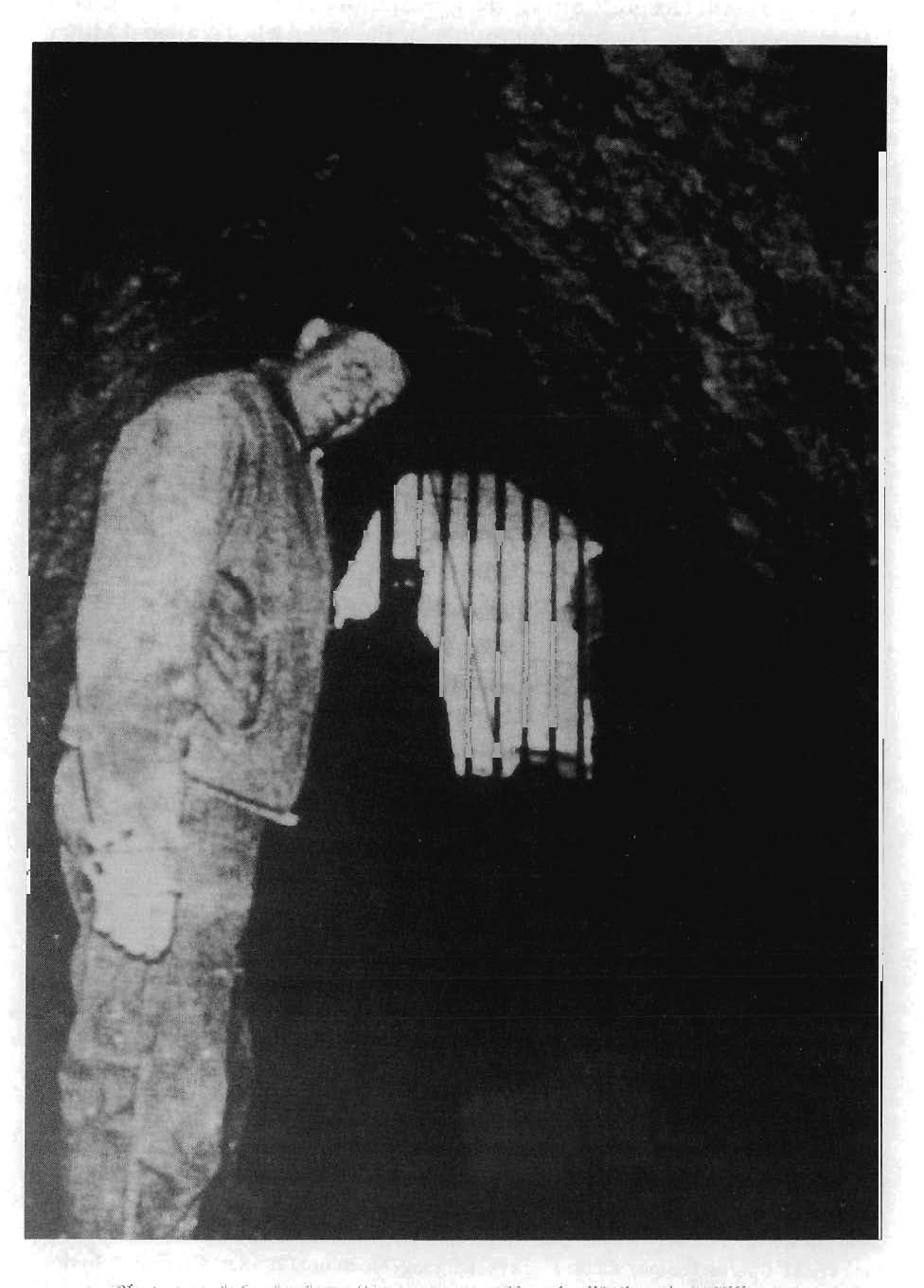
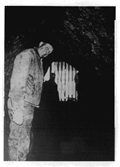
PALMYRA -- Mormon leaders in Salt Lake City, Utah, are playing it down, but Palmyra dairy farmer Andrew Kommer says he thinks he's "got something" and has already begun taking measures to protect it. Last week Kommer brought bulldozers to a site on Miner's Hill, on Miner Road, to uncover a cave that he says was dug by prophet and founder of the Mormon Church, Joseph Smith, 150 years ago.
A bulldozed path leads the way to the side of the hill where Kommer and two workers spent most of last week clearing the cave and erecting iron bars to "keep the sightseers from hurting themselves."
An official in the Mormon historian's office in Utah said no records could be found to indicate that Joseph Smith dug the caves in Question...
...Jim Young, 26; 171 Canandaigua Road, Palmyra said when he was "12 or 13" he and another boy, Dick Van Haneghan, discovered the cave on Miner's Hill while exploring. He said they could crawl a "few feet" into the cave on their hands and knees, but could not stand up or penetrate further than that.
Kommer said he had known about the cave "all along" and had wanted to uncover it, but had not had the chance until now. "The dairy business is a little slow, and I'm partially retired, so I thought I'd take a look under," he said.
Reporters inspected the cave shortly after supports had been added and bars erected at the mouth of the cave which is about six feet high at the largest point in the middle and 10-12 feet long.
Kommer said he may sell the land to the Mormons if they are interested or may allow tourists, who flock 200,000 strong along nearby Canandaigua Road to Hill Cumorah to see the annual "America's Witness For Christ" (Mormon Pageant), to view the site. Tourists will not be allowed into the cave. |
|
|
|
(Note:
No images of the original article are available online. This photo was published in an article written for Dialogue by Dan Vogel, which can be found here.)
|
|
|
|
|
|
External Link
|
|
The Location of Joseph Smith's Early Treasure Quests, Dialogue, a Journal of Mormon Thought, Vol 27, No 3, Pg 209
|
|
|
|
|
1992 Revisit
|
|
Dan Vogel
|
|
Oct 7, 1992
|
|
|
|
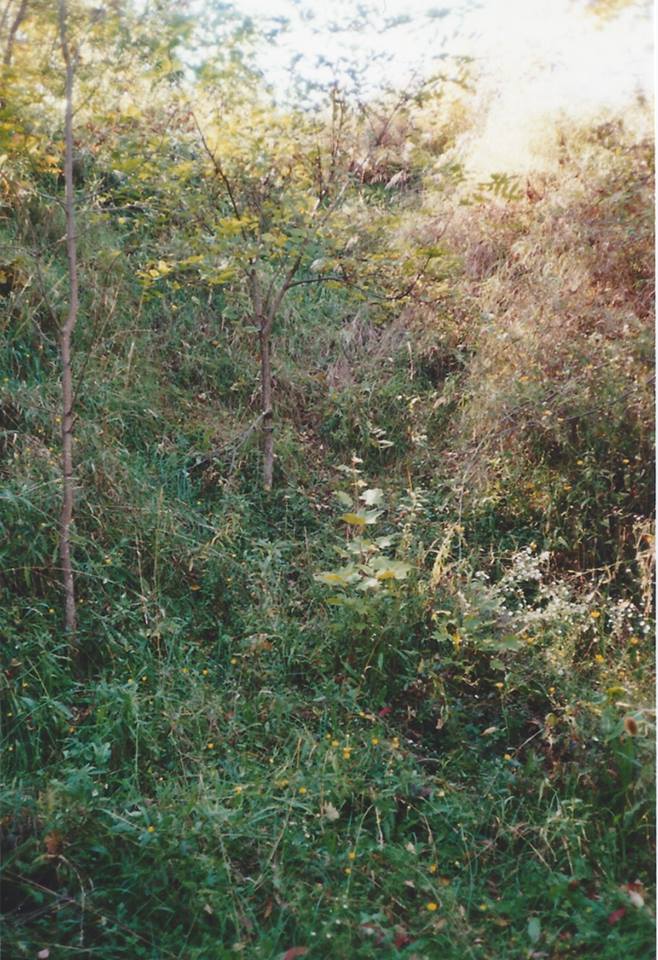
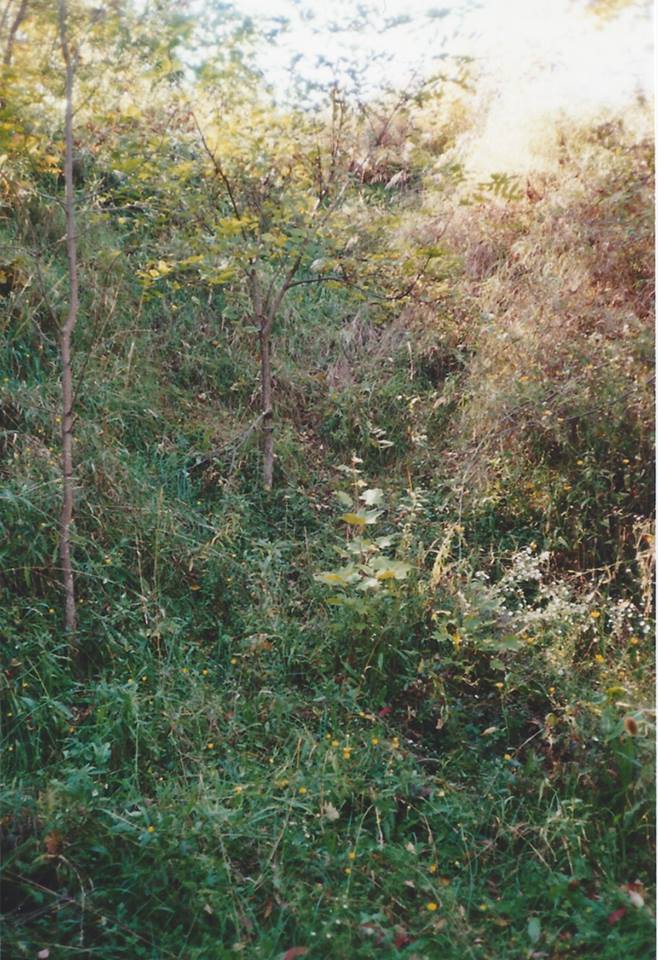
Today the entrance of the cave is closed and overgrown with foliage. |
|
|
|
(Note:
This photograph taken during the visit was provided by Dan Vogel, and is not part of the publication in Dialogue, a Journal of Mormon Thought.)
|
|
|
|
|
|
External Link
|
|
Discovering Joseph Smith's Cave in Miner's Hill, Manchester, New York, By: KC Kern
|
|
|
|
|
Rediscovery in 2015
|
|
KC Kern and Greg Pavone
|
|
Sep, 2015
|
|
|
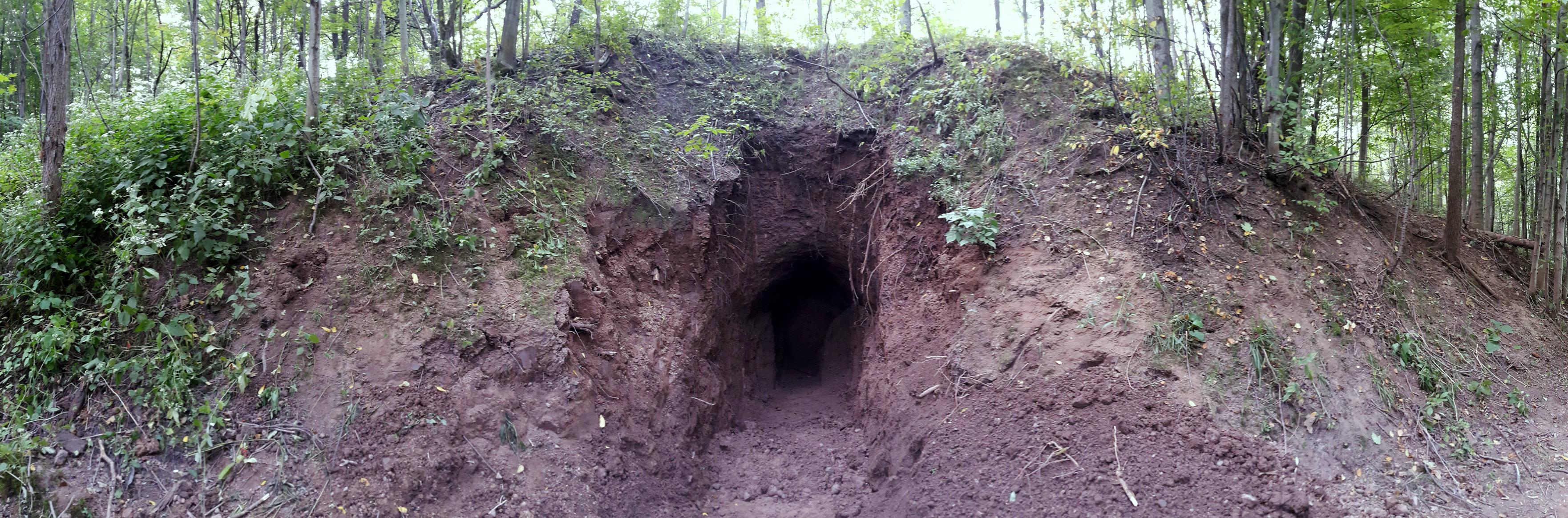
While in Palmyra, NY, we stumbled into an older local non-Mormon man who asked us if we had ever heard of the "lost Mormon cave." It was news to us. He went on to explain that as a younger man sometime in the early 1960s, he visited and entered a nearby cave that was discovered by some local kids. Word had it that Joseph Smith himself had dug the cave. He told of how the past property owner had cleared the cave and tried to turn it into a commercial attraction, but now the cave had all but disappeared into the brush of the hill. We felt impelled to follow up on this story. Over the next year, we looked up every historical source to ever mention the cave and determined the cave's likely geographic location. We contacted the current property owners and secured permission to engage in excavation activities. We rented a Kubota KX191 Mini-Excavator, and in the first week of September, 2015, after months of planning, we had boots on the ground and began the field work...
On the east side of Miner's Hill, near the top, we found a large depression in the slope in front of a landing located at the top of a small access trail. A walnut tree of considerable size was growing out of the dirt in the depression. The first item of business was cutting down the tree and removing the stump with our rented excavator. With the stump gone, we continued digging into the hill. With the help of a neighbor's metal detector, we recovered door hinges, a chain, and a padlock early in the digging. Plastic lining started to turn up in the earth as well. All these artifacts would have been part of the external structure that Andrew Kommer would have built around the cave in the 1970s.
The digging continued, now moving higher up the slope. Soon the excavator shovel reached a consistency of dirt that was markedly different. We had cut through topsoil and had hit packed clay. In a moment of rest, a large chunk of dirt near the top of the dig site collapsed inward, leaving a hole. The neighbor who had brought the metal detector climbed up, put his arm in the hole, and noted a void in the earth. After a little manual clearing he looked in and saw the main arch of the cave, its ceiling, and walls. Most of the cave was filled with dirt that had collapsed in from the front. The cave interior was like half an igloo. The back wall was curved like the side walls and ceiling arch.
After some enthusiastic celebration at having made this breakthrough, the remaining task was to dig the fallen earth out in order to restore the cave floor to its original level. This proved to be particularly challenging because we did not want to risk destroying the cave ceiling by bringing the excavator arm and bucket into the cave interior. We continued to use the excavator to clear the earth leading up to the covered area, but all of the dirt inside the cave itself had to be cleared out by hand.
We spent many hours with a pickaxe, a shovel, and a wheelbarrow incrementally shaving down the ground level of the cave, leaving a cross section of the fallen earth on the sides for reference. After several days of digging, we finally reached some wood planks directly under the cave ceiling. The planks contained round nails and appeared to be milled lumber, indicating that they probably dated to the 1970s as well. At this point, we could stand up in and even walk around inside the cave.
We photographed and measured the cave as we had thus far dug it out. There may be other secrets waiting to be discovered under the cave floor or in the surrounding earth. |
|
|
|
| |